Showing posts with label Ship Construction. Show all posts

Friday, February 13, 2026

Constellation Lessons

Christopher Cavas has a maritime podcast and recently offered a ‘lessons learned’ episode about the Constellation.[1]  In it, he speaks with former Under and Acting Secretary of the Navy Thomas Modly and retired Rear Admiral and former Fincantieri executive Chuck Goddard about lessons from the Constellation disaster.  Both Modly and Goddard were intimately involved with the Constellation.  Modly’s contribution was the usual worthless civilian nonsense.  Goddard’s thoughts are what we’ll focus on.  The podcast is interesting and worth listening to but not for the right reasons.
 
As you listen to the podcast, understand that both men were involved with the Constellation and, given the magnitude of the program failure, clearly neither man was part of the solution which means they were part – a very large part! - of the problem.  The entire interview, then, is the problem explaining what went wrong without being aware enough to even recognize that they were what went wrong!  The problem was trying to explain what the problem was!  The resulting discussion was exactly what you’d expect:  a mishmash of delusion and obvliviousness.
 
Before we go any further, it is important to understand Goddard’s background.
 
  • Senior Vice President responsible for the FFG 62 Program for Fincantieri Marinette Marine (FMM)
  • Capture Executive for the $5.5 billion FFG(X) program at Fincantieri Marine Group
  • CEO, President and GM of FMM from Jun 2011 – Jul 2014
  • Lockheed Martin director of Aegis Program Integration and Capture Manager for the Aegis Combat Systems Engineering Agent (CSEA) competition
  • During his thirty-year career with the Navy, he led a variety of complex ship programs from destroyers to sealift ships, culminating in his role as the Navy Program Executive Officer, Ships
  • Vice Commander Naval Sea Systems Command
  • Chairman SUBSAFE Program review
  • DDG 1000 Major Program Manager during design and development
  • New Construction Officer at Supervisor of Shipbuilding, San Diego, CA overseeing AOE-10, Sealift Conversion and Sealift New Construction programs
 
He has been involved in a lot of failures and had an entire career to effect positive changes and completely failed to do so.  Almost every group he was with has been heavily criticized on this blog.  He has been part of, and known nothing but, failure his entire career.
 
As a general observation, Goddard utterly fails to grasp any actual lessons learned beyond the superficial and nearly irrelevant level which is typical of managerial incompetence.  Such managers simply can’t see or grasp the real lessons.  If they could, they would have changed things while they were in a position to do so.
 
For example, one of the major (perhaps the main) lessons from the Constellation was something we’ve harped on relentlessly:  the failure to generate a comprehensive Concept of Operations (CONOPS).  The Constellation never had a sharply defined mission/function.  It was a mini-Burke which is to say that it was all things to all people.  Goddard himself offers an observation that simultaneously demonstrates this and illustrates his complete failure to grasp what it means.  He noted that the Constellation eventually sank under the weight of the never-ending flood of change orders emanating from NAVSEA’s attempt to spec and build the frigate as a destroyer because they had no experience designing and building a frigate so they fell back on what they knew:  the Burke!  They designed and spec’ed the Constellation as if it were a Burke.  This demonstrates the lack of a CONOPS that would have filtered out any destroyer-like, non-frigate changes.  Absent a sharply defined CONOPS, there was no basis to reject any change order since each change, in isolation, seemed justifiable.  
 
While he fails to understand the true relevance of his observation, Goddard nevertheless identifies a key failing of the Navy:  they only know how to make one type of surface combatant, the Burke.  All their expectations, requirements, specifications, etc. are from the Burke.  I’ve repeatedly talked about the folly of continuing to build the Burke class (see, “Burkes – TheAnchor Around the Navy’s Neck”) and the folly of building large, multi-function ships, in general.  We should be building many types of single function ships and this is yet another reason why.  We need a Navy/NAVSEA that is comfortable with multiple ship types and understands why they exist, what their roles are, how they differ, and how to spec and build them.  The Chinese have extensive classes of missile boats, corvettes, frigates, destroyers, and destroyer/cruisers.  We have Burkes and that’s it.  We are a one-trick pony surface fleet and one-trick NAVSEA.  We know nothing else but Burkes.
 
Goddard’s comment about NAVSEA attempting to spec the Constellation as a Burke finalizes and confirms the observation that the Constellation was a mini-Burke rather than an ASW frigate or convoy escort or whatever else some observers wished it was.  Again, Goddard recognizes the change orders as a problem but fails to see that the mini-Burke mindset was a problem stemming from the lack of a CONOPS and that NAVSEA should have been “educated” and squashed from day one.
 
The entire NAVSEA attempt to spec the Constellation as a Burke also offers the larger issue of how to appropriately “downgrade” a ship from a high end destroyer to a low level frigate.  What degree of reduced structural strength is appropriate?  What level of reduced survivability?  How much redundancy?  What degree of separation of key components? And so on.  A frigate must be “less” than a destroyer or else it is a destroyer.  Navy/NAVSEA have clearly not come to terms with the appropriate level of downgrading for a frigate.
 
Goddard and Modly go on to offer other, multiple, supposed lessons learned but fail to accept even the slightest blame for their own involvement and failings.  For example, Goddard notes that the Constellation, still only partially complete, had already gained 1000 ton on what was intended to be a 7000 ton ship.  That’s more than a 14% growth even before the ship was half complete!  Despite that stunning failure, no one made any attempt to figure out why the weight gain was occurring and what to do about it.
 
The podcast is interesting but ultimately worthless in terms of any actual lessons learned and illustrates that the people running the Navy are so completely incompetent that they are inherently incapable of recognizing and learning any actual lessons.


__________________________________
 
[1] Defense & Aerospace Report CAVASSHIPS Podcast [Dec 04, ’25] Ep: 220 Tom Modly & Chuck Goddard on Constellation Lessons Learned, 4-Dec-2025,
https://podcasts.apple.com/us/podcast/defense-aerospace-report-cavasships-podcast-dec-04/id1573063059?i=1000739767674

Saturday, November 29, 2025

Constellation Construction Progress

We’ll probably never know the real reason why the Navy decided to terminate the Constellation program but one of the factors certainly had to be the glacially slow pace of construction progress.
 
Constellation was laid down 12-Apr-2024 although, as with most modern ships, construction of subassemblies had already begun.  Now, Nov-2025, 19+ months later, the ship is reportedly 12% complete.[1]  That’s 12% in 19+ months.  That’s an average of 0.6% construction progress per month.  At that rate, it would require 167 months (13.9 years!) to complete the construction and even then, that would only be the basic hull.  Fitting out would require many more months.
 
Fourteen years to partially build a frigate?
 
If you were SecNav, would you have continued this program?

 
Constellation Under Construction?


________________________________
 
[1]USNI News website, “Navy Cancels Constellation-class Frigate Program, Considering New Small Surface Combatants”, Sam LaGrone, 25-Nov-2025,
https://news.usni.org/2025/11/25/navy-cancels-constellation-class-frigate-program-considering-new-small-surface-combatants

Wednesday, March 19, 2025

USS Constellation Update

The Navy’s new frigate, the USS Constellation, is now expected to deliver 3 years late, or more (spoiler alert!  It will be more!).  What’s going wrong?  Let’s get an update.
 
 
Design
 
The Constellation contract was awarded in April 2020 which means the design work began more than 5 years ago and is still nowhere near complete.  That’s astounding.  Over 5 years to generate a design and it still isn’t complete.
 
… the U.S. Navy had to significantly modify the design to meet U.S. survivability and growth margin standards.
 
Speaking at the Naval Institute’s Defense Forum Washington event, Fincantieri Marinette Marine CEO Mark Vandroff said the Navy and the shipyard underestimated the complexity of altering the design.[2]

The entire point of the so-called parent design approach was exactly to avoid significant design changes and yet the Navy ignored that philosophy and instituted extensive changes.
 
Concurrency and Schedule
 
As we’ve seen with every acquisition program in recent years, concurrency (simultaneous design and construction) always causes cost and schedule havoc.  Despite this repeated, soul-deep lesson, the Navy opted for concurrency, yet again, beginning construction with only partial design plans.  Predictably (well … predictable by everyone except the Navy), this has caused schedule problems among other issues, with the ship now scheduled to deliver more than three years late.
 
The Navy’s decision to commence construction before completing the design has led to significant schedule slippages.[1]

Cost
 
As always, the Navy’s cost estimates have proven fraudulently underestimated.
 
Initially, the estimated cost for the first ship was around $1.28 billion, with subsequent ships expected to cost approximately $1.05 billion each. However, these estimates have proven to be overly optimistic. The actual costs have increased significantly, with some estimates suggesting that the final cost per ship could be as high as $1.6 billion. This 40% increase in costs has raised concerns about the program’s affordability and sustainability.[1]

Actually, those costs aren’t even true.  The Congressional Research Service Feb 2021 report notes,
 
The Navy’s FY2021 budget submission estimated that subsequent ships in the class will cost roughly $940 million each in then-year dollars.[emphasis added][2]

Weight
 
The weight of the ships has increased by over 10% from the initial estimates. This weight growth is attributed to design decisions and the challenges of adapting a foreign design to meet U.S. Navy requirements.[1]

Unfortunately, the Navy is now looking at reducing or eliminating other capabilities in order to compensate for the weight increase.  It is almost certain that the range and speed requirements will be downgraded among other detrimental changes.
 
Workforce
 
The shipyard is reportedly a “few hundred” workers short, which has contributed to delays in the construction schedule.[1]

Come on, now.  It’s not as if the builder didn’t know how many workers they had when the bid the project.  If they’re short of workers now, they certainly knew they were short of workers when they bid.  This is, again, fraud on the part of the builder and willful complicity on the part of the Navy who also knew the builder’s workforce compared to the project requirements.
 
Risks
 
The Navy has yet to demonstrate the full capabilities of the propulsion and machinery control systems … [1]
 
The Navy is considering additional land-based testing to mitigate these risks and ensure the reliability of the systems before the ships are deployed.[1]

When have we ever seen ‘risks’ not become problems?  The point of land based testing is to find problems and solutions before beginning construction.
 
Second Yard
 
Given the inability of Fincantieri to meet the contracted schedule, the Navy has begun looking at a second source shipyard.  Possibilities include:
 
… specifically mentioned Austal USA, Bollinger, HII’s Ingalls Shipbuilding and General Dynamics Bath Iron Works as potential second yards.[2]

 
Conclusion
 
The Navy’s absolute refusal to design and build a ship the proper way (complete the design and then begin construction) is, after so many demonstrated failures using this approach, a near criminal act of fraud and negligence perpetrated against the American taxpayer.
 
As we all knew, with 100% certainty, concurrency has, once again, caused schedule slippage and cost overruns.
 
The Constellation class is now in the process of having its requirements downgraded to compensate for weight increases.  So much for the supposed benefits of a parent design.  The Navy never had any intention of building the parent design.  That was just a ploy to evade additional Congressional oversight.
 
It bears noting that the yard’s manpower shortages are not exactly a new problem that suddenly reared its head.  Both the yard and the Navy knew they couldn’t build the ship in the required time frame with the workforce they had.  Essentially, the yard and the Navy conspired to hide the inability to meet the contract.
 
Worse than all the listed problems is the fact that even if there were no problems, it would only produce an obsolete design unsuited for modern combat.
 
There is no other way to describe this program than as a massive fraud and failure. 


____________________________

[1]1945 website, “The U.S. Navy’s New Constellation-Class Frigate Is In Big Trouble”, Isaac Seitz, 25-Feb-2025,
https://www.19fortyfive.com/2025/02/the-u-s-navys-new-constellation-class-frigate-is-in-big-trouble/
 
[2]USNI News website, “Navy: Constellation Frigate Design Will be Ready in May, Second Yard Could Come in FY 2027”, Mallory Shelbourne & Sam LaGrone, 13-Dec-2024,
https://news.usni.org/2024/12/13/navy-constellation-frigate-design-will-be-ready-in-may-second-yard-could-come-in-fy-2027

Thursday, July 11, 2024

Efficiency and Competition

In WWII, a dozen or more shipyards built Fletcher class destroyers.  The yards were given a set of blueprints and contracted to build the ships according to the plans.  It didn’t matter which yard built any given destroyer, they were all the same.  This worked because the Navy designed the ship and generated the blueprints.  Once that was accomplished, any yard could build the ship.  It was just a matter of following the plans.
 
In contrast, because the Navy no longer designs ships, generates blueprints, or even requires complete designs and blueprints prior to the start of construction, only the contracted yard can build a given ship.  The LCS is the standout example of this badly flawed approach.  Lacking any guidance or blueprints, both Lockheed and Austal generated their own LCS designs, spec’ed their own equipment and combat systems, and no one else could build them.  Thus, we wound up with two LCS classes that had almost nothing in common;  the epitome of inefficiency.
 
What should have happened is that the Navy should have generated a complete design concept – and locked it down instead of continuously changing it! – followed by a complete set of construction blueprints.  They could have then shopped around for the best manufacturing deal and, if necessary, utilized multiple shipyards to in competition to ensure that costs and quality were well controlled.
 
 Our ship design and contracting approach is badly broken and yet the Navy is not only embracing it but doubling down on it.  Ignoring common sense, best practices, and all previous experience, the Navy began the Constellation class frigate construction without a complete design or complete set of construction blueprints (see, “Lesson Learned?”).
 
How do we expect the shipbuilder to accurately bid on the construction without a locked in design and a complete set of blueprints?  They can’t!  And yet we turn around and try to blame the manufacturer when costs inevitably balloon out of control.
 
The Navy absolutely must regain control over the ship design and construction process.  We must reinstitute the General Board (design) and BuShips (blueprints).  Without those capabilities, the Navy is just going to continue producing failure after failure.

Saturday, June 1, 2024

Constellation Train Wreck Gathers Steam

The Government Accountability Office (GAO) has released a report on the Constellation class frigate construction program delays and it’s an eye opener even for ComNavOps who predicted exactly these kinds of problems long ago.
 
To review, the contract delivery date is April 2026.  Current estimates by the Navy put delivery sometime in 2029, three years late and seven years after the Aug 2022 start of construction (seven years to build a frigate?!), and you know that date is going to continue to be pushed further out with more delays.
 
As with all sizable ships, the Constellation is being built in sections, called blocks (although the Navy now calls them ‘Grand Modules’ in their typically PowerPoint-ish, pointless churn style;  someone undoubtedly got a promotion for coming up with the phrase, ‘Grand Module’) and, according to a diagram in the report, the Constellation has 31 blocks.  Of the 31 blocks, 11 are currently being manufactured despite not having completed design documents.  GAO lists the percentage design completion of the blocks under construction: 
 
3x   56-75% complete
2x   76-90% complete
6x   >91% complete
 
None of the block designs are complete despite being under construction.  How you build blocks (or anything!) with incomplete designs is a complete mystery and, as the report details, is a major reason why the Constellation is running around three years late already.
 
Worse, GAO cautions that the Navy’s method for estimating the degree of design completion guarantees that even these woeful achievements are overestimated and the designs are not really to the stated level of completeness.[1]  The designs have been ‘pencil whipped’ for reporting purposes.  GAO notes,
 
Now, over 18 months after lead ship construction start, the functional design remains unstable, which has undermined confidence in the accuracy and maturity of detail design products needed to construct grand modules—and construction progress has effectively stalled. The Navy and shipbuilder have resorted to correcting deficient drawings previously credited toward design progress, but the program continues to credit design progress based largely on quantity of deliverables rather than on the underlying quality of the document itself.[1][emphasis added]

The Navy has committed to fraudulent reporting to cover their failure to use best shipbuilding practices that are standard throughout the commercial shipbuilding industry.
 
In addition to design deficiencies, other problems are beginning to emerge. 
 
As of Oct 2023, the builder was reporting a 10% increase in weight growth over the June 2020 calculated weight.  Weight growth has both short and long term negative impacts, as GAO notes, 
Further, as we previously found in a July 2014 report evaluating the LCS program, unplanned weight growth during ship construction can compromise ship capabilities in the short term (i.e., upon delivery of the ship to the fleet) and in the long term, as the fleet seeks to alter and improve initial capabilities over the planned decades-long service life of the ship.[1]
And, 
The Navy disclosed to us in April 2024 that it is considering a reduction in the frigate’s speed requirement as one potential way, among others, to resolve the weight growth affecting the ship’s design.[1]

So, we can expect reductions in the ship’s specifications and performance requirements.  This is exactly what happened with the LCS.  Its specifications and requirements were continually reduced in response to weight increases and other problems that cropped up during construction. 
 
I thought the parent design concept was supposed to eliminate these kinds of problems?  Well, it might have if the Navy had actually used the parent design instead of hoodwinking Congress and designing, essentially, a brand new ship under the guise of a ‘parent’ vessel.
 
The Navy has learned absolutely nothing about ship design, acquisition, and program management from the lessos of the LCS, Zumwalt, and Ford fiascos. 
 
Well done, Navy.  Make us proud.


________________________
 
[1]Government Accountability Office, “Navy Frigate - Unstable Design Has Stalled Construction and Compromised Delivery Schedules”, May 2024, GAO-24-106546

Monday, January 15, 2024

Constellation Fraud

The Navy assured us that the Constellation class frigate would be a zero risk, on-time, on-cost, romp through the park to build since it was, essentially, a copy of an existing Fincantieri FREMM design.  There would be only minor, inconsequential changes – the color of the paint, perhaps, or an extra bulkhead or two for greater compartmentalization – that would have no impact on the design or production of the ship.
 
Of course, when the concept drawings were released, it turned out that the ship had been heavily modified and actually bore little resemblance to the parent FREMM design.  The Navy had lied to Congress and the public by presenting the frigate as a minor variation of an existing design when, in reality, it was a nearly brand new design with little in common with the so-called parent.  I won’t bother reciting the litany of changes from the parent design as those are readily available on line.
 
So, how’s all that working out?
 
USNI News website reports that the ship construction and delivery is going to be delayed at least a year.[1]  Construction began in Aug 2022 and the Navy is now hoping for delivery in 2027.  Far more likely is a 2028-9 delivery.  That’s a five to seven year delivery for what the Navy claims is a minor tweak of an existing design!
 
This babbling, incoherent, pointless statement from Andy Bosak (deputy manager for the frigate program) tells you everything you need to know about the state of the program.  The Navy has no idea what’s happening, no idea how to fix it, and no idea when the ship will be delivered. 
We are doing our analysis, as the Navy does, of doing deep dives of causes and effects and various different levers of which we can pull within that shipyard,” he added. “And we need to, as a program, work with our leadership, kind of figure out what we want to do. And from that, we will make that assessment as to what the actual schedule impact is of where we are. And that effort is ongoing.[1]
The builder, Fincantieri, blames much of the delay on labor shortages, welders, in particular.  No doubt this is a factor but I suspect there are other, far more impactful problems.  For example, 
… Fincantieri … wrestled with Americanizing the FREMM design for two and half years before it hit the 80 percent design completion and could begin fabrication on Constellation in 2022.  The modification of the design altered almost every drawing of the FREMM and required review from NAVSEA … [1]
The labor situation was well known before Fincantieri submitted a bid and the before the Navy awarded them a contract so that should have already been factored into the schedule.  What wasn’t factored in was the extent to which the Navy would modify the design.  The modifications sent ripple waves of disruption spreading throughout the program, culminating in the major schedule slippage we learn about now.  Undoubtedly, the schedule will slip even further.  We’re likely looking at closer to a two year schedule delay for a ship that was supposedly a knock off of an existing design.
 
The Navy knew all this and understood what deviating from the parent design would mean. 
"[The Navy] and the shipbuilder agreed that design maturity was probably the single biggest factor we could do to reduce the risk of production,” former program executive officer for unmanned and small combatants Rear Adm. Casey Moton said in August of 2022.[1]
So, knowing full well what a modified (immature) design would do to the production schedule, the Navy went ahead and completely redesigned the ship anyway.  Not only is the Navy complicit in the current problems, they are the proximate cause of the problems!
 
Here’s yet another example of the ‘minor, insignificant’ changes the Navy made: 
… testing at Naval Surface Warfare Center, Carderock found that the modified design did not meet service standards for operating in heavy seas, necessitating design changes that ate into the schedule margin … [1]
 
“We were already into the functional and detail design when that report came from Carderock – something of a surprise because the parent design didn’t really have that,” Vandroff (Mark Vandroff, Fincantieri Marinette Marine’s chief executive officer) said.[1]
That was a surprise to you, Mr. Vandroff?  Seriously?  You completely changed the design to the point that it is a brand new, never before produced design and were surprised to find that created new problems?  You’re not an engineer, I’m assuming?


Conclusion
 
This program has been nothing but fraud and deception piled on fraud and deception from the very beginning and now it’s coming home to roost.  The Navy tried to hide a completely new ship inside the shadow – and lies – of an existing ship and now they’re acting surprised that the fraud is impacting the production schedule.
 
We need to also keep cost in mind.  Schedule slippages of this magnitude don’t come free.  The cost is going to skyrocket and the Navy will, again, act surprised and attempt to blame the builder.
 
By the way, do you recall that the Navy claimed that the follow on ships (2-20) would cost less than $800M?  Yeah, they said that.  Here’s the quote from RAdm. John Neagley:
 
“The follow-on objective cost for FFG(X) is $800 million. We think we can get below that.”[2]
 
The Congressional Budget Office (CBO), on the other hand, estimated an average cost of $1.2B per ship.[3]
 
As it turns out, the actual budgeted costs are around $1.1B-$1.2B, and that’s before the inevitable cost overruns, costs associated with schedule slippages, deferred completion costs for incomplete delivery, etc.  The true cost will be somewhere in the $1.5B+ range.


______________________________
 
[1]USNI News website, “First Constellation Frigate Delayed At Least a Year, Schedule Assessment ‘Ongoing’”, Mallory Shelbourne and Sam LaGrone, 11-Jan-2024,
https://news.usni.org/2024/01/11/first-constellation-frigate-delayed-at-least-a-year-schedule-assessment-ongoing#:~:text=The%20service%20has%20briefed%20Congress%20that%20the%20future,legislative%20source%20confirmed%20to%20USNI%20News%20this%20week.
 
[2]Breaking Defense website, “Navy Says It Can Buy Frigate For Under $800M: Acquisition Reform Testbed”, Sydney J. Freedberg Jr., 12-Jan-2018,
https://breakingdefense.com/2018/01/navy-says-it-can-buy-frigate-for-under-800m-acquisition-reform-testbed/
 
[3]CBO website, “The Cost of the Navy’s New Frigate”, Oct-2020,
https://www.cbo.gov/publication/56675

Monday, September 25, 2023

Lesson Learned?

A cursory recall of the Navy’s recent failed surface ship programs includes the LCS, Zumwalt, Ford, MLP, etc.  That’s a lot of data and opportunities for lessons learned, right?  The Navy, through trial and [mostly] error should be getting pretty good at managing ship acquisition programs by now, right?
 
One of the major lessons learned has to have been that concurrency (simultaneous design and construction) never works.
 
I wonder how the new Constellation class frigate program is doing?
 
The GAO annual report has this to say, 
Program officials stated that over 90 percent of the FFG 62 functional design and 80 percent of the detail design—which adds 3D modeling to show the configuration of equipment on the ship—were completed when construction began on the lead ship in August 2022. They noted that these results align with the Navy’s general expectations for design maturity needed before construction begins. However, beginning construction with an incomplete functional design is inconsistent with leading practices and increases the risk of costly design changes and rework.[1][emphasis added]

So, defying all logic, common sense, and bitter, costly experience, the Navy began construction of the Constellation before the design was complete.  Way to learn a lesson, Navy.
 
Constellation - Which will be finished first, the ship or the design?


___________________________________
 
[1]U.S. Government Accountability Office, “Weapon Systems Annual Assessment”, Jun 2023, GAO-23-106059, p.148

Thursday, September 14, 2023

Single Hits

During WWII, Guadalcanal witnessed some of the most brutal and devastating naval battles in history.  Ironbottom Sound acquired its nickname for good reason.  Allied battleships, cruisers, and destroyers absorbed many dozens of torpedo and shell hits.  Despite this onslaught, all the ships remained combat effective right until they either sank or the battle ended.  These were unbelievably tough ships.
 
In contrast, we’ve long noted that modern naval vessels are no longer WARships but glorified cruise ships.  They’re thinly and weakly built with no significant armor and small crews for damage control.  They lack separation and redundancy among other survivability flaws. 
 
Let’s just verify that our belief is correct (or not?) by examining the modern record of naval ships that have taken hits of various types.  The table below lists the ship, the number of hits, and the result.


The obvious observation that jumps out is that only one ship was able to continue its mission and the bomb that hit that ship failed to explode.  Note, also, the very small number of hits that were required to achieve a sinking or mission kill.  Contrast this with the WWII examples where the ships around Guadalcanal sustained many dozens of torpedo and shell hits and continued fighting.
 
For example, at Savo Island the USS Astoria received 65 shell hits, the majority being 8”, and continued to fight though the end of the battle (no mission kill !) before, eventually sinking the following day (see, “Battle Damage – Savo Island”).
 
Another interesting observation is that ship size (displacement) seems to offer no enhanced survivability or resilience, contrary to what one might expect.  This is likely a massive condemnation of the thinness and weakness of modern ship construction materials and design.
 
Also note the large number of bombs and missiles that failed to explode.  This should serve as an eye opener for those who believe, against all of history, that modern weapons are unerring, infallible, certain-kill, wonder weapons.  The reality is that most modern weapons will perform surprisingly (surprising only to those who do not follow this blog) poorly.
 
I had intended to include some examples of ships that took a hit and continued to function but I was unable to come up with any.
 
 
Conclusion
 
It seems obvious that, just as we believed, modern ships are weak and unable to sustain even the slightest degree of damage without being sunk or immediately rendered a mission kill.  Modern navies have completely forgotten how to design WARships.  The US is not alone in this ill-considered trend.  This is a perfect example of the entire world agreeing about how to build a modern navy ship and the entire world being wrong (similar to the pre-WWII battleship debate – everyone agreed and everyone was wrong).
 
 
Note:  It is likely that I’ve inadvertently omitted some examples.  Feel free to offer them in the comments.

Wednesday, May 24, 2023

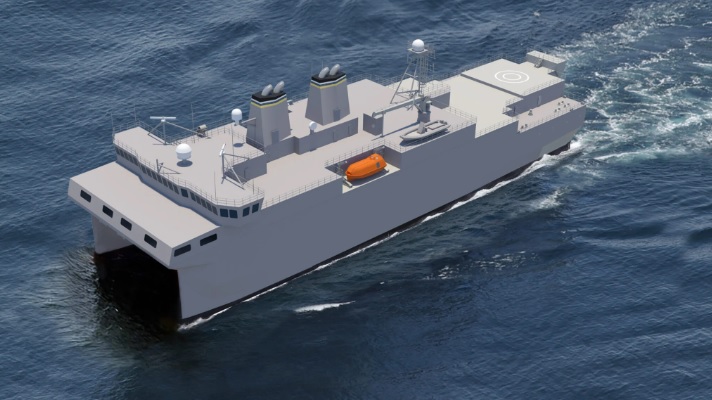
Austal and T-AGOS

One definition of insanity is to repeat a set of actions and expect a different result.
 
The Navy is procuring a new class of ocean surveillance ships (T-AGOS).  That’s fine.  However, they’re contracting with Austal to design them.  Austal, you’ll recall, designed the Independence variant LCS.  I won’t bore you with a litany of the shortcomings and design flaws of that ship.  I would simply ask, after the massive failure of the LCS, why would we immediately turn around and contract with Austal again?  We contracted with them before and they failed miserably so we think that if we contract with them again the result will be success?  I refer you to the definition of insanity at the start of the post.
 
On a related note, the T-AGOS mission is to tow sonar arrays around and collect acoustic data.  The Navy’s cost estimate is around $430M per ship.  What is the one thing we know, with 100% certainty, about Navy cost estimates?  That’s right … they’re always ridiculously low.  So, we’re looking at a $500M-$600M ship, minimum.
 
This ship just tows a sonar array.  It has no radars, no weapons, no fire control, no electronic countermeasures, no high speed, no stealth, no survivability enhancements, no complicated propulsion system, a crew of around 40, and is likely built to commercial standards (unverified, as yet).  It’s an upsized, ocean going tugboat!  Can it really cost over half a billion dollars?  Can’t some commercial cargo ship do the job for a tiny fraction of the price?  Couldn’t we buy a used commercial vessel for pennies on the dollar, mount some sonar array mechanisms and computers and call it a day?
 
Insanity.


T-AGOS-25 Concept Image


__________________________
 
[1]Breaking Defense, “Austal wins contract for first vessel in ocean surveillance ship program valued up to $3B”, Justin Katz, 19-May-2023,
https://breakingdefense.com/2023/05/austal-wins-contract-for-first-vessel-in-ocean-surveillance-ship-program-valued-up-to-3b/
 

Monday, December 19, 2022

Impact of Overhead on Shipbuilding Cost

Shipbuilding costs have skyrocketed, generally exceeding the rate of inflation, exceeding all reasonable expectations, and blowing away all historical precedents.  The reasons for this cost explosion are many and not always obvious.  Unfortunately, the lack of obvious reasons leads to simplistic, sensationalistic explanations among naval observers and, disappointingly, they are largely wrong. 


One of the most common complaints/explanations is that the shipbuilding industry, in cahoots with government and corrupt admirals, is rife with fraud and if we could just eliminate the fraud, shipbuilding costs would drop precipitously.  While this explanation makes for a compelling and, in a sense, satisfying (because we have an identifiable ‘villain’) story, it is unsupported by any significant body of evidence and fails to stand up to analysis.  This is not to say that a degree of corruption and fraud does not exist but it is not responsible for the magnitude of the cost increases we see on every new shipbuilding project.


A far more significant explanation for runaway costs is simple overhead.  We’ve previously covered this in depth (see, “Shipbuilding Costs – Impact of Low Volume”) but it warrants some follow up.  For those who may not be familiar with the basics of accounting and cost allocation, the following is a brief and grossly simplified explanation of overhead.


A product’s cost is the sum of two components:  direct costs and overhead costs.


cost = direct + overhead


Overhead is the cost of business not specifically and directly related to producing a product. 


For example, regulatory compliance costs (diversity, gender, environmental, maternity leave, etc.) are necessary costs (are they really?) but they are not directly related to the cost of production.  A department of lawyers or accountants provide no direct contribution to production but their cost is indirectly included.  Taxes must be paid on land and facilities but they have no direct relation to production.  And so on.


Direct costs, on the other hand, include raw materials, cranes, assembly facilities, and labor.


So, again, a product’s cost is the sum of direct costs plus overhead. 


cost = direct + overhead


Seems simple enough, right?


The thing is, direct costs are fixed whereas overhead is variable.  I know, you think overhead is also fixed but we’re going to demonstrate that it’s not and we’re going to demonstrate how/why that variation impacts shipbuilding cost.


As an illustrative example, let’s pretend there’s an item that has $100 of direct costs to produce, regardless of the time required.  Let’s further assume that the overhead costs are $100/yr.


If that item takes us one year to produce then the total cost is


cost = direct + overhead

cost = $100 + ($100 * 1 yr)

cost = $100 + $100

cost = $200


Now, let’s suppose that item takes us two years to produce.  The total cost becomes


Cost = direct + overhead

Cost = $100 + ($100 * 2 yr)

Cost = $100 + $200

Cost = $300


Now, let’s suppose that item takes us five years to produce.  The total cost becomes


Cost = direct + overhead

Cost = $100 + ($100 * 5 yr)

Cost = $100 + $500

Cost = $600


Wait a minute, how can the costs vary widely if it’s the exact same item with the exact same direct cost?  It’s the overhead, of course.  More specifically, it’s the time required to complete the item;  the longer the time, the more overhead that has to be applied to the item’s final cost.


Now, suppose that the item is a US Navy aircraft carrier that has $10B of direct cost to produce and the shipyard has an additional $1B of overhead per year.


If the yard could build the carrier in one year, the total cost would be


Cost = direct + overhead

Cost = $10B + ($1B * 1 yr)

Cost = $10B + $1B

Cost = $11B


In reality, we have historically produced a carrier in four to five years (we’ll call it five) which makes the total cost


Cost = direct + overhead

Cost = $10B + ($1B * 5 yr)

Cost = $10B + $5B

Cost = $15B


However, the Navy sometimes stretches out the build times to around seven years which makes the total cost


Cost = direct + overhead

Cost = $10B + ($1B * 7 yr)

Cost = $10B + $7B

Cost = $17B


We see, then, that the carrier could cost anywhere from $13B (3 yr build time) to $17B (7 yr build time), depending on the build time and the number of years of overhead that have to be applied.


Why does overhead have to be applied?  A company does not produce products for free.  It has to pass on all its costs to the buyer.  Therefore, the overhead accumulates, year after year, for every year that it takes to build the carrier and, at the end, the total accumulated overhead gets dumped on the carrier and the Navy/taxpayer pays the cost.


Now, let’s take a look at the actual build times for Navy aircraft carriers, as shown in the table below. 


Carrier Build Time, yrs

Laid to Commissioning

CV-63 Kitty Hawk

5

CV-64 Constellation

4

CVN-65 Enterprise

3

CV-66 America

4

CV-67 Kennedy

4

CVN-68 Nimitz

7

CVN-69 Eisenhower

7

CVN-70 Vinson

7

CVN-71 Roosevelt

5

CVN-72 Lincoln

5

CVN-73 Washington

6

CVN-74 Stennis

4

CVN-75 Truman

5

CVN-76 Reagan

5

CVN-77 Bush

6

CVN-78 Ford

8


We see that build times went from 3-5 years, pre-Nimitz, to 5-8 years.  That means that recent carriers are being hit with 2-5 years of added shipyard overhead.  Of course the total cost is going to increase and increase substantially! 


Someone with too much time on their hands is going to point out that the shipyard likely has other work and 100% of the yard’s overhead isn’t dumped on a single carrier.  That is true, of course, however, for our simplified discussion, the concept is valid and substantially correct.


While it may be satisfying and cathartic to blame all our shipbuilding cost problems on fraud and corruption, the reality is that those are minor factors.  Overhead is a much larger factor and may well be the main culprit.  Of course, without an itemized breakdown of the production costs, I can’t say for sure.


Wednesday, May 4, 2022

Battleship Delivery

Here’s a quick, fun item …


How many battleships did the US build during WWII?  Several, maybe a dozen?  This may shock you but the answer is zero.  We didn’t produce a single battleship during WWII.


What???  That can’t be true!  We built the North Carolina, South Dakota, and Iowa classes, right?  Wrong!  Only 8 battleships were commissioned during WWII and all of them began building (laid down) before the war started.  In other words, we were unable to start and finish a single battleship during the war.


Following is a list of the BBs commissioned during the war.  Note that they were all laid down pre-war.


Laid Down

Commissioned

South Dakota

5-Jul-1939

20-Mar-1942

Indiana

20-Sep-1939

30-Apr-1942

Massachusetts

20-Jul-1939

12-May-1942

Alabama

1-Feb-1940

16-Aug-1942

Iowa

27-Jun-1940

22-Feb-1943

New Jersey

16-Sep-1940

23-May-1943

Missouri

6-Jan-1941

11-Jun-1944

Wisconsin

25-Jan-1941

16-Apr-1944


We only started (laid down) 2 battleships (Illinois and Kentucky) during the war.  Neither was finished and both wound up being scrapped prior to completion when the war ended.


In contrast, 19 fleet carriers commissioned during WWII and 16 of those were laid down during the war.


No particular point to this post, just a fun fact!