One of the challenges of ship design is the propulsion
system. The traditional propeller and
drive shaft present problems such as:
Complicated gearing systems which are an operating and maintenance challenge
Long drive shafts which take up precious space in the ship
Multiple points of watertight seals that have proven to be less than watertight in damage situations
Shaft bearings that are prone to overheating and require lubrication and cooling
Complex lubrication systems for shafts and gears with sea water influx being a common problem
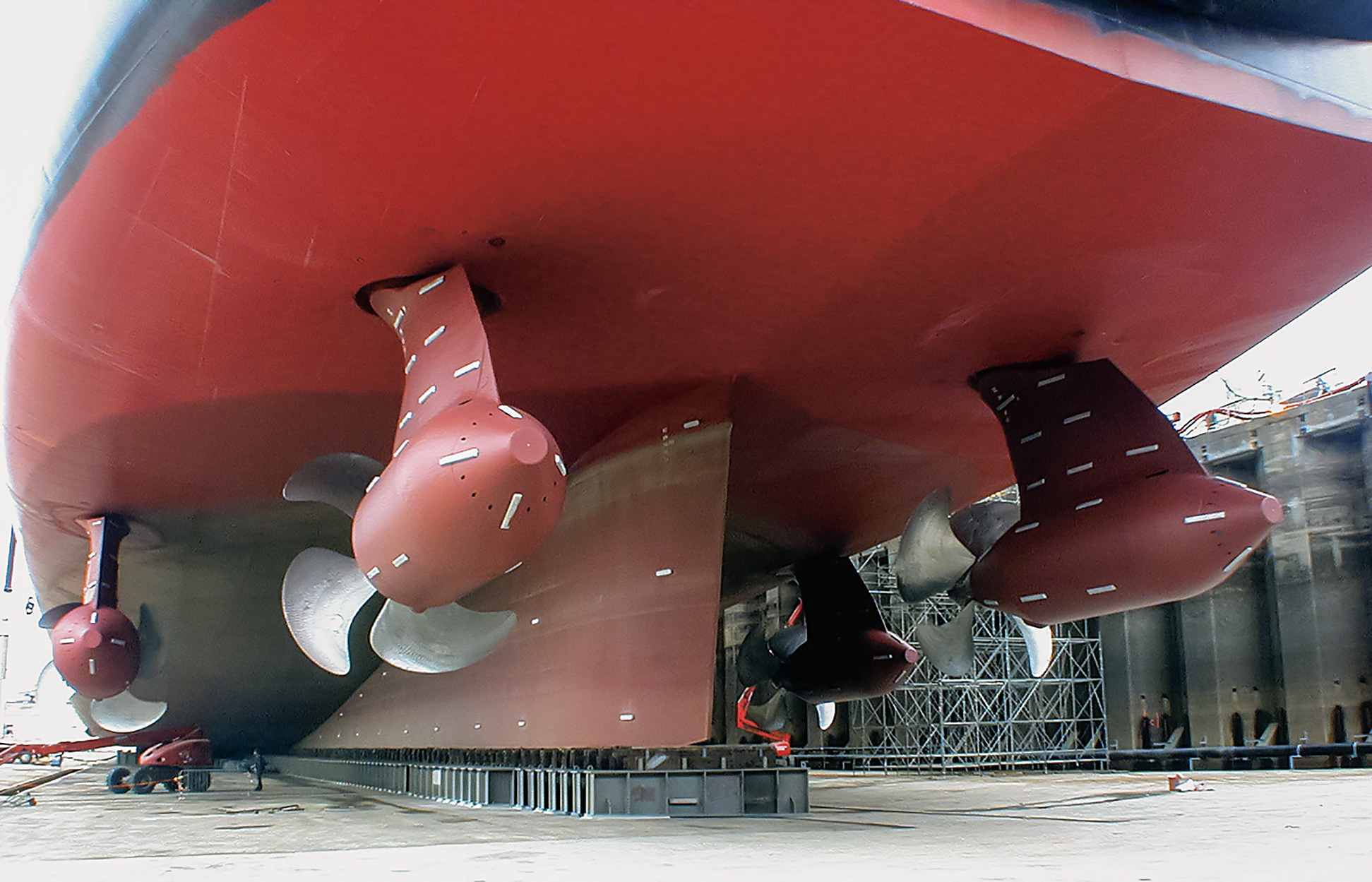
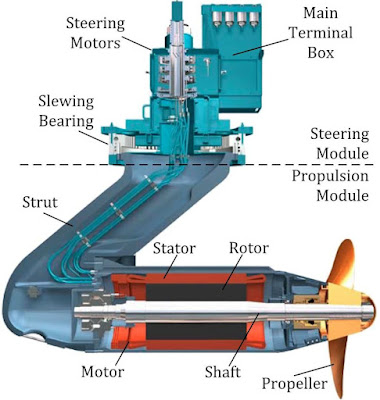
One potential solution is the pod system in which an
electric drive motor and propeller are mounted in a pod external to the ship’s
hull. This eliminates the shaft, many
bulkhead penetrations and seal points, complicated gearing, etc. The pod rotates via a small steering motor
mounted in the ship’s hull directly above the pod’s mounting flange. The only penetration of the hull is the
electric cables from the power generating unit to the electric motor in the
pod. Large commercial pods may have
maintenance access hatches built into the pod mount.
 |
| Typical Propulsion Pod Concept |
Pods can be either push (traditional rear mounted propeller)
or pull (front mounted, like an airplane) and can be either fixed or rotating
(azimuthing). Some ships have used a
combination of fixed and rotating pods.
Front mounted (pull) pod props have been claimed to reduce cavitation
compared to conventional push propulsion systems due to operating in less
disturbed water flow.[2]
The features of pod systems include:
Pods have a range of power outputs from 2-25 MW per
pod. As a point of comparison, the
Burke’s propulsion system consists of 4x LM2500 turbines connected via gearing
to two propeller shafts producing a total of 78 MW of power. Two large pods would produce 25 MW and three
would produce 75 MW which equals the conventional Burke output.
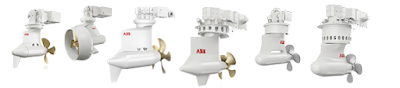
 |
| Various Types of Pods |
Pods have been extensively fitted to icebreaking vessels and
cruise ships, among others. Some examples
include:
Rolls Royce Mermaid Pod
The
QUEEN MARY 2 has four Rolls Royce Mermaid podded propulsion systems, the first
four-podded installation to date and the largest output for any podded-driven
vessel. The system comprises two fixed and two azimuthing pod units delivering
a combined output of more than 85 MW, which gives the ship a service speed of
30 kts. [1]
ABB azipods are produced in a range of sizes and power
outputs. For example,
The
luxury polar expedition cruise ship, due delivery for the French cruise company
Ponant in 2021, will feature two Azipod VI propulsion units, designed for the
most challenging ice conditions.
Upon
delivery from Norway’s Vard Søviknes, a Fincantieri Company, the cruise ship
will take passengers to unexplored destinations in Arctic and Antarctic waters.
In the harsh conditions of ice-covered seas, Azipod units with six-meter
propellers and combined power of 34 MW will help the vessel achieve greater
maneuverability and efficiency, as well as lower the environmental impact. Due
to minimal noise and vibration, Azipod propulsion will also improve passenger
and crew comfort. [3]
On a larger scale, the Royal Caribbean cruise ship, Oasis of
the Seas, uses 3x ABB 20 MW (60 MW total) rotating azipods.
Some naval examples of pod propulsion include:
French Mistral LHD class uses 2x 7 MW pods. The ship is 650 ft long, 20,000 tons displacement, and can achieve 18 kts.
Australian Canberra LHD class uses 2x Siemens Navantia 11 MW pods. The ship is 757 ft long, 27,500 tons displacement, and is rated at 20+ kts.
Summary
Pods seem like a worthwhile possibility for naval
vessels. The reduction in complexity, equipment,
and bulkhead/hull penetrations make pods an attractive alternative to
convention systems. In particular,
eliminating the complex combination gearing systems that the Navy seems
completely unable to operate and maintain would significantly reduce the number
of ship breakdowns the Navy has encountered of late. How pod systems would fare in combat and
damage control situations is, of course, unknown and would have to be tested.
At the moment, I see a lot of upsides and no real downsides
to this technology.
________________________________
[1]https://www.wartsila.com/encyclopedia/term/mermaid-propulsion-unit
[2]https://www.beyondships2.com/faq-pods-and-azipods.html#:~:text=Most%20cruise%20ships%20have%20two%20pods.%20However%2C%20Oasis,backwards%20propulsion.%20Not%20all%20cruise%20ships%20use%20pods.
[3]https://www.maritime-executive.com/article/one-hundred-cruise-ships-feature-abb-azipod