Showing posts with label Procurement. Show all posts

Monday, July 6, 2026

Constellation Frigate Update

As you know, the Navy has terminated the Constellation frigate program with only the first two ships possibly being completed and even that now appears to be unlikely, according to the most recent GAO annual weapons assessment report.[1]
 
According to senior Navy officials, these two ships are under review for potential termination.  ... These officials further stated that in March 2026, the Navy directed its shipbuilder to pause ordering material for FFG 62 and FFG 63 to evaluate its necessity as those ships remain under review.[1]

With the continuation of the two remaining ships under review and the shipbuilder having been directed to stop ordering materials, the conclusion seems inescapable:  the two ships will be terminated.
 
Why does this kind of debacle continue to happen to the Navy?  The Navy knowingly continues to commit programmatic suicide by failing to follow best practices.
 
As we previously reported, the Navy had obligated over $3.4 billion to construct six ships before completing the frigate’s basic and functional design—an approach counter to shipbuilding leading practices.[1]

The Navy paid for a ship that didn’t even have a design.  Who could have anticipated anything would go wrong with that?
 
What went wrong?
 
The extent of design changes exceeded the original expectation of conducting limited design changes on the parent design.[1]

This tells me the Navy is incompetent on an almost unimaginable scale and failed to do their homework before committing.  How has no one been fired over this?
 
As weight growth became an issue, the Navy’s response was hilariously stupid.
 
Concurrently, the Navy and shipbuilder have evaluated weight savings opportunities, including removing redundant systems, removing primer from steel plating, and reducing firefighting system capacity, among other things.[1]

What could possibly go wrong by removing redundant systems (a vital element of combat survivability), removing primer from steel (of course the paint will stick without primer … won’t it??), and reducing firefighting capacity (every damage control effort in history has depended on firefighting – did the Navy learn nothing from the 202 fire aboard USS Bonhomme Richard?)? 
 
Eliminate primer and reduce firefighting?  Come on.  I couldn’t even sell that as an April Fools joke.
 
There’s stupid and then there’s Navy stupid which is just a whole ‘nother level of stupid.  How has no one been fired for even considering these changes?
 
I can only conclude that one of the requirements of for attaining flag rank is to undergo a lobotomy and a pretty extensive one, at that.  Either that or they’re all Chinese agents.  Nothing else can explain the non-stop parade of stupid ideas and decisions spewing forth from Navy leadership.


__________________________________

[1]Government Accountability Office, "Weapon Systems Annual Assessment", Jul 2026, p.144

Tuesday, October 14, 2025

ESSM Blk 2 Delivery

In case you missed it, here’s a brief update on ESSM Blk 2 missile deliveries.  According to DOT&E[1], ESSM production missiles began delivery to the Navy in July 2022.  Raytheon has just delivered the 500th missile to the Navy.[2]  That’s 500 missiles in a bit over three years.  That also tells us what the entire current, maximum Blk 2 inventory for the Navy is.  Those who envision ships teeming with quad-packed ESSM missiles should note that a single Burke, with 96 VLS cells, would consume almost the entire inventory of ESSM Blk 2 missiles!
 
ESSM Blk 2


_____________________________

Wednesday, May 21, 2025

Ship Order Quantities

Continuing on a little bit of an acquisition theme, we have become conditioned to think of military acquisition ordering, specifically ship ordering, as occurring in large quantities.  For example, here’s some planned or built orders for some classes:


But, this was not always the case.  In fact, this is an anomaly in the history of the Navy.  Historically, most shipbuilding programs resulted in small orders.  Consider the following sequential list of combat ship types in the WWII era and note the size of each class, as shown in the table below.


We see that even in the midst of an emergency wartime crash construction program that would see the Navy ultimately build a fleet of 6000 ships, the individual class sizes were still very small … stunningly small by today’s norm.
 
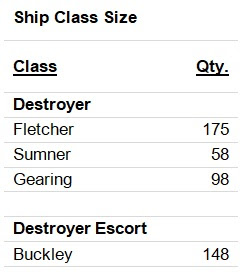
Even the smaller ships, of which the Navy needed many hundreds, were built in fairly small quantities as shown below.


Even these larger destroyer and destroyer escort class numbers are deceptive in that they were all built in the span of a few years.  Thus, although the numbers may have been larger, the construction period for the classes was very short which is almost the same as being a very small class as far as how it impacts ordering, construction, and pricing.  Contrast this with the LCS class, a corvette size ship, which has been under construction for some twenty years or the 3-ship Zumwalt class which began construction in 2009 and is still continuing, sixteen years later!
 
 
Future Proofing
 
One of the major impacts of class size has to do with the misguided notion of future proofing, the concept so beloved by so many naval observers.  The idea of future proofing is that if we build excess capacities (weight margin, electrical power, internal hull volume, hull length, extra cabling and ducting, etc.) into the new ship it will be much cheaper to upgrade it in the future as new technologies emerge.  While superficially appealing, the concept has failed almost completely in practice and has resulted in more expensive ships that never get ‘futured’, meaning, they never receive those nebulous, undefined future upgrades.
 
Future proofing results in compartments that have no function, cables and ducting that are dead ends, and length, width, and volume added to the ship for future needs that, history tells us with near 100% certainty, will never happen.  In short, we increase the cost of ships trying to future proof them despite knowing full well that we’ll never apply the future upgrades.  Instead, when the time comes for adding future upgrades, the Navy will claim, as they always do, the ships are too old and that it is no longer cost effective to upgrade the ship and that the ship is too worn out to be worth upgrading and that we must buy new hulls.  How many times have we seen this happen and yet naval observers keep calling for future proof designs?  Remind me, what’s the definition of insanity?  Oh yeah, that’s right …
 
In WWII, there was zero future proofing built into ships.  Future proofing, meaning the incorporation of new technology, was handled by building small classes so frequently that classes with new technologies (or the lessons of actual combat) were always just around the corner.
 
 
Order Size
 
One might think that industry would love large orders and, in theory, that would be correct if the Navy ever followed through on the large order (see, “Follow Through”).  In theory, large orders would lend stability to shipbuilders since they could plan years ahead for their workloads, better manage workforce levels, and intelligently plan facility improvements.  Of course, this is not what happens in practice.  In practice, shipbuilders are left unsure about future workloads since every program is always on the verge of being cancelled or reduced, orders surge and wane resulting in frantic attempts to hire workers followed shortly by layoffs, and facility improvements and, indeed, basic maintenance, keeps getting pushed into an undefined ‘someday’ that never arrives.  What’s the point of large orders that just get cancelled or reduced?
 
Contrary to what one might think, small orders actually promote stability in the shipbuilding industry because industry has a much higher confidence that the order will be fully carried to completion and that subsequent small orders are coming.
 
Large orders have had the effect of reducing new classes and new projects to near zero.  For example, we’re down to one new combat aircraft order every twenty or thirty years now.  This results in one winner in industry getting all the work for decades (Lockheed Martin and the F-35, for example) and the other manufacturers being forced to consolidate and/or die due to lack of work.
 
It is time to return to the historically more normal practice of building frequent, small classes of ships with short life spans (10-20 years).  We knew this, once upon a time, but stupidly abandoned timeless wisdom.  Let’s study our history, recall the lessons, and return to sanity.

Friday, May 16, 2025

Follow Through

We are constantly amazed – but, by this time, not surprised – by the inevitable increases in prices on military acquisition programs and the 100% guaranteed cost overruns.  We’ve discussed many of the factors that cause this but here’s one that we haven’t emphasized enough:  quantity reductions.
 
The more you build of something, the cheaper it gets due to economy of scale … at least, that’s the theory although it’s almost impossible to find evidence of that in any acquisition program.  But, what happens when the initial quantities get reduced as the program progresses?  Prices skyrocket for the remaining items and subsequent construction bids soar.
 
As a reminder, consider the historical programs listed below and the change from the initial quantities to the final purchased amounts, as shown.  Note that some of the quantities, especially the planned quantities, vary depending on source.  I’ve listed the most commonly cited quantities that I’ve found.  For programs with international sales, the figures shown are for US sales only.
 
 
  • Seawolf-class - planned 29, built 3
  • Zumwalt-class – planned 32, built 3
  • Zumwalt AGS – planned 64, built 6
  • F22 - planned 750, built 195
  • LCS – planned 55, built 35
  • LCS Modules – planned 64, built 35
  • B-2 – planned 132, built 21
  • M10 Booker – planned 504, built 80
  • MQ-8C – planned 177, built 38
  • EFV – planned 1025, built 0
 
 
There are also programs that have not yet concluded but appear to be on their way to reducing the planned quantities.
 
  • LRASM – interest has died and the program is on the verge of termination
  • F-35B – planned 353, now planned 280
  • F-35C – planned 353, now planned 280
  • ACV – planned 1122, now planned 632
  • P-8 – planned 138, now planned 128
  • F-35   planned 2866, now planned 2470
  • MQ-4C Triton – planned 70, now planned 27
 
With this background, does anyone think programs such as the B-21, Columbia-class, and Constellation-class will survive with no quantity reductions?
 
 
Discussion
 
To return to the original premise, how do quantity reductions impact costs and future program bids?  Think about it.  If you’re running a defense industry company and you’re asked to bid on a project, you know, with near 100% certainty, that the quantity you’re bidding on will be reduced at some point.  So, what do you do?  Obviously, you calculate the actual cost to produce the specified number of products and then you add a significant extra amount to your bid to cover the inevitable reduction in quantity.  You have to do this to ensure your profit.  This isn’t price gouging … it’s just basic, common sense business.
 
The military’s instability in program quantities drives up costs as a simple matter of business.  If the military would hold to the planned quantities, the savings would be huge.

Monday, April 28, 2025

Small Potatoes

I’ve previously stated that I am, thus far, disappointed in SecDef Hegseth.  I had hoped he would come in and clean house and, while he has fired a handful of people, the vast majority of incompetent military leaders are still firmly in place.  Similarly, SecNav Phelan has disappointed me.  An example is his latest announcement that he is cancelling some $570M in various DEI, climate, and AI-logistics contracts.  While I applaud these cancellations, they are incredibly small potatoes.  They are the kind of thing that could have been done between bites of his sandwich at lunch on the first day.  How about going after some large, truly catastrophically wasteful programs?  Can’t think of any?  Well, how about cancelling the rest of the Constellation class?  How about terminating the Ford class in place?  How about retiring the entire remaining LCS class and saving billions in operating and maintenance costs?  How about terminating all unmanned contracts until someone comes up with a viable CONOPS that demonstrates that they have any combat value?  How about firing 90% of the flag officers and returning their hundreds of staffers to sea duty?  I could go on all day but you get the idea. 
 
There are unimaginable savings to be had but SecNav Phelan is, so far, focused on the nearly trivial and almost free items (on a relative basis).  Come on, Phelan, do something significant.  It doesn’t require years of study groups.  If you can’t come up with tens and hundreds of billions of dollars of savings off the top of your head, you have no business being Secretary of the Navy.  On the other hand, if you can come up with the list … START CUTTING !!!

Wednesday, March 19, 2025

USS Constellation Update

The Navy’s new frigate, the USS Constellation, is now expected to deliver 3 years late, or more (spoiler alert!  It will be more!).  What’s going wrong?  Let’s get an update.
 
 
Design
 
The Constellation contract was awarded in April 2020 which means the design work began more than 5 years ago and is still nowhere near complete.  That’s astounding.  Over 5 years to generate a design and it still isn’t complete.
 
… the U.S. Navy had to significantly modify the design to meet U.S. survivability and growth margin standards.
 
Speaking at the Naval Institute’s Defense Forum Washington event, Fincantieri Marinette Marine CEO Mark Vandroff said the Navy and the shipyard underestimated the complexity of altering the design.[2]

The entire point of the so-called parent design approach was exactly to avoid significant design changes and yet the Navy ignored that philosophy and instituted extensive changes.
 
Concurrency and Schedule
 
As we’ve seen with every acquisition program in recent years, concurrency (simultaneous design and construction) always causes cost and schedule havoc.  Despite this repeated, soul-deep lesson, the Navy opted for concurrency, yet again, beginning construction with only partial design plans.  Predictably (well … predictable by everyone except the Navy), this has caused schedule problems among other issues, with the ship now scheduled to deliver more than three years late.
 
The Navy’s decision to commence construction before completing the design has led to significant schedule slippages.[1]

Cost
 
As always, the Navy’s cost estimates have proven fraudulently underestimated.
 
Initially, the estimated cost for the first ship was around $1.28 billion, with subsequent ships expected to cost approximately $1.05 billion each. However, these estimates have proven to be overly optimistic. The actual costs have increased significantly, with some estimates suggesting that the final cost per ship could be as high as $1.6 billion. This 40% increase in costs has raised concerns about the program’s affordability and sustainability.[1]

Actually, those costs aren’t even true.  The Congressional Research Service Feb 2021 report notes,
 
The Navy’s FY2021 budget submission estimated that subsequent ships in the class will cost roughly $940 million each in then-year dollars.[emphasis added][2]

Weight
 
The weight of the ships has increased by over 10% from the initial estimates. This weight growth is attributed to design decisions and the challenges of adapting a foreign design to meet U.S. Navy requirements.[1]

Unfortunately, the Navy is now looking at reducing or eliminating other capabilities in order to compensate for the weight increase.  It is almost certain that the range and speed requirements will be downgraded among other detrimental changes.
 
Workforce
 
The shipyard is reportedly a “few hundred” workers short, which has contributed to delays in the construction schedule.[1]

Come on, now.  It’s not as if the builder didn’t know how many workers they had when the bid the project.  If they’re short of workers now, they certainly knew they were short of workers when they bid.  This is, again, fraud on the part of the builder and willful complicity on the part of the Navy who also knew the builder’s workforce compared to the project requirements.
 
Risks
 
The Navy has yet to demonstrate the full capabilities of the propulsion and machinery control systems … [1]
 
The Navy is considering additional land-based testing to mitigate these risks and ensure the reliability of the systems before the ships are deployed.[1]

When have we ever seen ‘risks’ not become problems?  The point of land based testing is to find problems and solutions before beginning construction.
 
Second Yard
 
Given the inability of Fincantieri to meet the contracted schedule, the Navy has begun looking at a second source shipyard.  Possibilities include:
 
… specifically mentioned Austal USA, Bollinger, HII’s Ingalls Shipbuilding and General Dynamics Bath Iron Works as potential second yards.[2]

 
Conclusion
 
The Navy’s absolute refusal to design and build a ship the proper way (complete the design and then begin construction) is, after so many demonstrated failures using this approach, a near criminal act of fraud and negligence perpetrated against the American taxpayer.
 
As we all knew, with 100% certainty, concurrency has, once again, caused schedule slippage and cost overruns.
 
The Constellation class is now in the process of having its requirements downgraded to compensate for weight increases.  So much for the supposed benefits of a parent design.  The Navy never had any intention of building the parent design.  That was just a ploy to evade additional Congressional oversight.
 
It bears noting that the yard’s manpower shortages are not exactly a new problem that suddenly reared its head.  Both the yard and the Navy knew they couldn’t build the ship in the required time frame with the workforce they had.  Essentially, the yard and the Navy conspired to hide the inability to meet the contract.
 
Worse than all the listed problems is the fact that even if there were no problems, it would only produce an obsolete design unsuited for modern combat.
 
There is no other way to describe this program than as a massive fraud and failure. 


____________________________

[1]1945 website, “The U.S. Navy’s New Constellation-Class Frigate Is In Big Trouble”, Isaac Seitz, 25-Feb-2025,
https://www.19fortyfive.com/2025/02/the-u-s-navys-new-constellation-class-frigate-is-in-big-trouble/
 
[2]USNI News website, “Navy: Constellation Frigate Design Will be Ready in May, Second Yard Could Come in FY 2027”, Mallory Shelbourne & Sam LaGrone, 13-Dec-2024,
https://news.usni.org/2024/12/13/navy-constellation-frigate-design-will-be-ready-in-may-second-yard-could-come-in-fy-2027

Monday, September 30, 2024

Multi-Year Amphibious Ship Buy

As reported by Naval News website, the Navy has awarded a multi-year contract for the purchase of three San Antonio LPDs and one America LHA. 
The deal, which will fund three San Antonio-class LPDs and one America-class Flight II LHA, will save taxpayers an estimated $1 billion.[1]
I have a couple of problems with this contract award.
 
Savings – The supposed savings is estimated at $1B.  In the aggregate, that sounds impressive.  A billion dollars!  Wow!  However, across four ships that’s just $250M savings per ship.  That’s not nothing but it’s not a miraculous savings, by any means.  More importantly, you know those savings will never materialize.  With 100% certainty, the ships will come in over budget and behind schedule with a litany of excuses like supply chain disruptions, parts shortages, design modifications, and all the other usual suspects.  There won’t be any savings.  The absolute best case is that the ‘savings’ (let’s be optimistic and assume there will be actual savings) will slightly reduce the magnitude of the inevitable cost overruns.  Again, better than nothing but let’s not kid ourselves into thinking we’re actually going to save money.
 
Make no mistake, the Navy didn’t do this to save the taxpayers any money; they did it to lock down budget commitments.  The Navy doesn’t care what a ship costs.  It’s not their money.  Congress will always give them more money.  They did this to lock down budget share.
 
Doctrine – This is the real puzzler.  Neither the Navy nor the Marines have any intention of ever again doing an amphibious assault.  The Marines have publicly and explicitly stated that they are out of the assault business.  The Navy doesn’t care about amphibious assaults and, indeed, balked at procuring more amphibious ships when they instituted a ‘strategic pause’ in amphibious ship procurement. 
 
Similarly, the Navy’s total indifference to the Marine’s Light Amphibious Warfare ship is yet more evidence of their disdain for amphibious operations.
 
Further evidence is the Navy’s total abandonment of naval gun support for amphibious operations and the doctrinal decision to move amphibious ships 25-50 miles off shore – a distance at which it is impossible to conduct an amphibious assault with current technology. 
 
The Navy is never going to conduct another amphibious assault so why are we continuing to buy more amphibious ships?
 
Legality – By law, multi-year procurements can only be applied to a single design that is mature and stable.  While I’m not a lawyer, the mix of ship types and the inclusion of a single (not multi) LHA would appear to be illegal.  Of course, this would hardly be the first time the Navy has ignored the law.  Here’s the verbiage describing the main requirement for using a multi-year procurement. 
FAR17.105-1(b)(3) There is a stable design for the supplies to be acquired, and the technical risks associated with such supplies are not excessive [2]
This is intended to be applied to a single, stable design.  The Navy is most certainly violating the spirit and intent of the law, if not the actual verbiage.


Discussion
 
So, with no savings and no intention (Marines) or interest (Navy) in ever conducting an amphibious assault, tell me again, why are we continuing to procure any amphibious ships? 
 
It seems clear that the only viable reason for the Navy going down this path is the desire to lock in budget share.
 
Layer the potential illegalities on top of this highly questionable contract and it becomes even more clear that this is a budget machination, not a sincere attempt at saving the taxpayers money.


____________________________
 
[1]Naval News website, “U.S. Navy’s First Ever Multi-Year Amphibious Ship Contract Awarded”, Carter Johnston, 25-Sep-2024,
https://www.navalnews.com/naval-news/2024/09/us-navy-finalizes-first-amphibious-multi-year-buy/
 
[2] https://www.acquisition.gov/far/subpart-17.1

Wednesday, March 15, 2023

2024 Weapons Procurement Increase

As we’re all well aware, the US military has been hemorrhaging weapons in the form of transfers to Ukraine.  Inventories for many weapons are critically low.  It should, therefore, be safe to conclude that next year’s (2024) weapons procurement quantities should be massively increased over 2023, right? 
 
On top of that, the Navy has publicly stated that China will invade Taiwan within the next couple of years so that is, obviously, going to trigger a massive increase in weapons procurement for 2024 as we gear up for a peer war, right.
 
I’m guessing we’re going to be seeing many thousands of additional missiles budgeted for 2024, right?
 
Let’s see just how big the procurement increases are for some common weapons.  The table below shows the 2023 and 2024 procurement quantities.[1]


So, with a peer war looming and depleted inventories due to Ukraine, the Navy is ordering 218 fewer weapons than last year.  Do I really need to add any more commentary to this post?
 
__________________________
 
[1]“Highlights of the Department of the Navy, FY 2024 Budget”, p.2-9

Monday, September 5, 2022

Freedom PSA Contract

The Freedom class USS (PCU) Cooperstown, LCS-23, was laid down in Aug 2018 and launched in Jan 2020.  The ship is not yet commissioned. 


The Navy has awarded a $25M contract to BAE Systems Jacksonville Ship Repair LLC, Jacksonville, Florida to perform a post-shakedown availability (PSA).  PSA’s are performed to fix all the things that should have been working prior to delivery but weren’t or that broke during trials.


… post-shakedown availability will include correction of trial card deficiencies, new work identified between custody transfer and the time of the availability and incorporation incorporation of approved engineering changes not addressed under the building yard's construction contract.[1]


Why is the Navy accepting ships with known deficiencies (trial cards)?  Would you?


Given that an LCS costs around $500M, depending on what you want to include or exclude, the $25M PSA represents an additional 5% of the ship’s total cost, added to the procurement cost for things that should have been corrected before delivery and at the manufacturer’s expense.


Cooperstown’s PSA work is expected to be completed by Mar 2024.  Does it really take two years to do a PSA?  How incomplete and broken was this ship when it was delivered?  And why did the Navy accept it if it requires two years of additional work to finish/repair?


On a related note, despite having been laid down in 2018 and completed acceptance trials (with known deficiencies !) in 2020, there is no commissioning date set, yet.  We’re looking at six-plus years or so to build and commission a corvette size ship.  WWII Flower class corvettes were commissioned around 9 months from being laid down.  Yes, I know COVID issues impacted things but still … six-plus years to commission a modern corvette versus nine months?


I wish I could tell you that this was some kind of one-off fluke but it isn’t.  This is routine.  Would you buy a car with documented deficiencies (trial cards), take delivery, and then give it right back to the garage to finish/fix it for two years … all at your expense?  Of course not!  The Navy really needs to learn how to procure ships because they clearly haven’t got a clue.


______________________________________


[1]https://www.upi.com/Defense-News/2020/02/14/BAE-Systems-awarded-246M-for-post-shakedown-availability-for-Freedom-class-ship/1081581727313/#:~:text=A%20post-shakedown%20availability%20takes%20place%20in%20a%20period,as%20well%20as%20short-range%20missiles%20and%20anti-submarine%20torpedoes.


Wednesday, August 10, 2022

FY22 Weapon System Costs

For informational purposes, following are some Gross Weapon System costs taken from the Navy budget documents[1,2] for FY2022.


Ship Program[1]

Unit Cost

Columbia SSBN

$15.0B

Ford CVN

$12.8B

Virginia SSN

$3.5B

Burke DDG

$2.4B

Constellation FFG

$1.1B

John Lewis T-AO (Oiler)

$0.7B


Of course, the ship costs are only partial costs.  For example, the Ford cost is simply the Congressional cost cap number.  Billions of dollars more have been racked up on the Ford trying to complete elevators, fix EMALS and AAG, making warranty repairs on items that were delivered damaged (main turbine generators, for example), and completion of construction items that were deferred when the Ford hit its cap limit.  Those funds are coming from unknown sources and account lines.  The Ford’s true cost is somewhere in the $15B+ range.


Weapon Program[2]

Unit Cost

Qty

Tomahawk

$2.07M

60

AMRAAM a

$1.7M

122

Standard (type unspecified)

$4.8M

125

JASSM

$1.5M

25

LRASM

$3.4M

48

NSM

$1.7M

34

Mk48 Torpedo

$2.7M

58


Sidewinder

$485,000

178

Small Diameter Bomb II

$227,000

180

RAM

$930,000

100

Joint Air to Ground Missile

$303,000

164

Hellfire

$63,000

120


a from 2021; none procured in 2022


One concerning aspect is the very small procurement quantities of many of the weapon system programs.  For example, when the war with China comes, we’ll need thousands of anti-ship missiles, right?  We’re procuring 34 of the small Naval Strike Missiles per year and 48 of the larger, mainstay LRASM missiles.  Can we increase our procurement from a few dozen per year to the thousands per year that we’ll need?  It seems unlikely.  We could, conceivably, double (triple???) production but that would still leave us thousands short of what we’d need.  If a factory is producing at a rate of dozens per year, they’re not going to have the capacity to suddenly increase production by a factor of 50x or so.  What are we going to do to achieve that kind of instantaneous production capacity increase?  What’s our plan?  We don’t have a plan, as far as I know.  I’ve never heard any discussion of industrial production plans for wartime.


Anyway … this summary is just intended to give us a quick, concise list of some costs to help inform our weapon system discussions.  Hope this helps!


__________________________________


[1]Department of Defense, Fiscal Year (FY) 2022 Budget Estimates, Justification Book Volume 1 of 1, Shipbuilding and Conversion, Navy, May 2021,

https://www.secnav.navy.mil/fmc/fmb/Documents/22pres/SCN_Book.pdf


[2]Department of Defense, Department of Defense, Fiscal Year (FY) 2022 Budget Estimates Volume 1 of 1, Weapons Procurment, Navy, May 2021,

https://www.secnav.navy.mil/fmc/fmb/Documents/22pres/WPN_Book.pdf


Friday, September 11, 2020

Weapon Procurement Status

We often discuss weapons and weapon inventories.  Understandably, the US military’s weapon inventories are not generally public record.  Even so, reasonable estimates can be made from procurement quantities, which are public record, and usage patterns which are somewhat publicized.


Here’s some Navy weapon procurement quantities from the FY20 budget.(1)  The quantities shown are eyeball annual averages of the six year period FY19 – FY24, inclusive.


Weapon

Qty

Comment

Tactical Tomahawk

200

Includes new missiles and modernization upgrades

Standard SM-6

140


RAM

120


ESSM

190

Trending up to 300/yr projected for FY23 and FY24

Mk48 Torpedo

70


LCS Naval Strike Missile

20

Trending up to 26/yr in FY23 and FY24

LCS Hellfire

109


LRASM

48

Constant purchase quantity across the FY19-FY24 period


It is interesting that the LCS Naval Strike Missile (NSM) is programmed for very low purchase quantities through FY24.  At the end of FY24, the fleet inventory will be only 101 (less, actually, depending on the number used for training launches, if any).  This limited procurement may be due to manufacturer shortages or may be recognition by the Navy of the limited usefulness of the LCS in combat and the LCS' impending replacement by the new frigate.


Similarly, the LRASM, which is currently only for aerial launch, is being procured in very small quantities.


Hellfire, which is supposed to be the LCS main weapon against small boat swarms, is also being procured in very small quantities.


It’s fairly obvious that any significant usage – you know … like a war – will require hugely increased annual production rates of weapons.  We’re talking about factors of 10X – 100X.  For example, we’ve seen that a single, partial attack on a small, undefended airbase requires nearly 100 Tomahawks.  A strike against a peer defended base would likely require 300+ missiles.  That’s for one target!  We’ll need 10,000-20,000 Tomahawks per year to wage a peer war.  That’s a hundred-fold increase in production.  Do we have that kind of industrial production capacity?  I seriously doubt it.  We need to be planning for wartime production increases, now.  It does no good to build a fleet with 10,000 VLS cells if we can only produce 200 Tomahawks per year to fill those cells during a war.


_________________________________


(1)”Highlights of the Department of the Navy FY 2020 Budget”, 12-Mar-2019, p.4-8


Wednesday, February 12, 2020

Navy Writing Off The F-35?

In the budget proposals currently being released, the Navy has abruptly changed direction and indicated that 2021 will be the last year that Super Hornets are purchased.(1)  The funding for Super Hornets that would have been purchased between 2022-2024 will be redirected to the nascent Next Generation Air Dominance (NGAD) aircraft, sometimes referred to as F/A-XX.  Interestingly, there has been no concomitant announcement of increased F-35C purchases to compensate for the truncated F-18s.

The Navy has always been lukewarm, at best, about the F-35.  For example, former CNO Greenert often downplayed the importance of stealth and the Navy has delayed and minimized its F-35 purchases as much as possible.

Recognizing that China is the driving threat, the Navy may have realized that the F-35 is not ideally suited for the Pacific theater.  A 2019 Center for Strategic and Budgetary Assessments report points out,

… in order for a future carrier air wing to be effective in a major conflict with China, it would need to develop aircraft that could operate consistently at ranges of up to 1,000 nautical miles from the carrier. That’s double the effective combat range of an F-35C. (1)

That being the case, which ComNavOps happens to agree with, it makes no sense to purchase either Super Hornets or F-35s.

This is one decision by the Navy that I agree with wholeheartedly.  That may surprise some readers but the logic is inescapable.  It is silly and pointless to purchase aircraft that are not suited for the mission.

While the Navy has not announced any increase in F-35 purchases, neither have they announced any decrease.  I’d suggest applying the logic of the F-18 termination to the F-35 and terminating its procurement, right now, in addition to the F-18.  It makes no sense to continue to acquire more aircraft that are not suited to the mission and it’s not as if the lack of new aircraft for a few years will matter.  We have more than enough aircraft to equip the one or two carriers that we’re struggling so mightily to put to sea each year.  If we need more aircraft, we can always focus on repairing some of the 50% of the aviation fleet that is sitting idle, awaiting depot level maintenance.

Of course, the corollary to the decision to terminate F-18 production is that the NGAD has to be suited to the task and be affordable in the requisite numbers.  History suggests that the odds of those two conditions being met in a new acquisition program are quite poor.  The potential saving grace in this situation is that the Navy will not be tied to a monster, joint acquisition program that only partially meets their needs as was the case with the F-35.  If the Navy can keep the NGAD a purely Navy program, they may be able to keep the requirements focused on their needs.

Of course, this also assumes that the Navy even understands what the requirements are.  Given the debacles and poor decisions of the Ford, LCS, CMV-22 COD, MQ-25, and now the unneeded frigate, it is quite likely that the Navy won’t get the requirements right even without interference from other services.  Still, hope springs eternal and we have to hope that they can correctly define the requirements.  If they fail, they will have no one else to blame.

Disturbingly, the latest statements from current CNO Gilday suggest that the Navy doesn’t know what it needs from the NGAD.

Chief of Naval Operations Adm. Mike Gilday said late last year the service was still thinking about how it would move forward with carrier aviation.

“I do think we need an aviation combatant, but what the aviation combatant of the future looks like? I don’t know yet. (1)

Seriously?  You’re the top guy in the Navy and you don’t yet know what you need from the next aircraft?  That’s pathetically inept.  Do you really not know or are you just scared to put yourself on record and are waiting for myriad studies to give you the cover you need for deniability if it fails?  Why don’t you take a lesson from the Marine Commandant?  Although I have misgivings about his vision, he has a very precise vision and it didn’t take him more than about an hour in office to flatly, fearlessly, and emphatically lay out that vision.  So, come on CNO Gilday, either demonstrate some leadership or step aside and let someone with more vision and courage lead the Navy.

Moving on … Cost is other aspect that has to be addressed.  A $100M NGAD is simply not going to be affordable in sufficient numbers.  Again, the Navy’s history of cost control in acquisition is stunningly poor and does not give rise to confidence that the Navy can control costs and produce an affordable aircraft.

Even so, this is a golden opportunity for the Navy to terminate the F-18 and get out from under the crushing F-35 budget weight before too many are purchased.  It’s a chance to reset the entire naval aviation component.  The F-18 can serve as a gap filler while the NGAD comes on line, assuming it happens quickly (and it can – see, “How To Build A BetterAircraft”), and the F-35 can serve as the stealthy sensor platform that the Navy has talked about while allowing the [hopefully] better suited NGAD to assume the workhorse combat role.

No matter how you look at this, one thing seems clear: the Navy seems to be abandoning the F-35 already although, to be fair, they never really embraced it.  It appears they’ll make the minimum number of purchases required by the program directors and move on to the NGAD.

Honestly, the possibility that the Navy could dodge the bulk of the F-35 debacle has me positively giddy.  Of course, leave it to the Navy to quash that feeling with yet another poorly executed acquisition program.  Still, as I said, hope springs eternal!


__________________________________

(1)USNI News website, “Navy Cuts Super Hornet Production to Develop Next-Generation Fighter”, Sam LaGrone, 10-Feb-2020,
https://news.usni.org/2020/02/10/navy-cuts-super-hornet-production-to-develop-next-generation-fighter