Showing posts with label LCS Design. Show all posts

Monday, January 2, 2023

What Happened To Streetfighter?

Let’s start the new year with a post that may ruffle a few feathers and contradict some dearly held beliefs..


The LCS is an abject failure.  Even its staunchest supporters have been reduced to talking not about what LCS is but what it might have been.  Yes, the LCS failed but, oh, Streetfighter!  The Mighty Streetfighter!  If only the LCS had remained true to the Streetfighter concept, what a magnificent combat vessel we would have had!


Streetfighter … it has assumed the status of myth and legend;  capable of total domination of the seas and able to defeat vast fleets of the most powerful ships.  It would have ensured world peace, solved global hunger, and established democracy throughout the known universe!     And now we have the LCS.  What happened?  Where did Streetfighter go?  Why was its self-evident superiority not developed? 


Streetfighter?

Let’s take a look and see if we can figure out what happened.


Here’s a timeline to help keep track and make sense of the various events that led from the origin of Streetfighter to the LCS we have today … or was it the reverse?


Streetfighter / LCS Development Timeline


1987

SC-21 (Surface Combatant for the 21st Century) predecessor studies begin

Jan

1991

End of the Cold War


1992

DD-21 / SC-21 officially begins


1993

Navy begins to focus on small combatant ships (approx. time period)


1995

LCS foundational design wargames (Joint Multi-Warfare Analytical Game) take place in mid-1990’s

Nov

1999

Cebrowski and Hughes publish “Rebalancing the Fleet” which is the first mention of Streetfighter

Jul

2001

Cebrowski unveils Streetfighter ship in Wall Street Journal article by Greg Jaffe

Oct

2001

Cebrowski appointed to head Office of Force Transformation by SedDef Donald Rumsfeld

Late

2001

DD-21 terminated

Apr

2003

Lockheed Martin shows initial LCS concept offering


2003

Adm. Clark declares LCS his number one budget priority

May

2004

Initial LCS construction contracts awarded

Jun

2005

LCS Freedom laid

Nov

2005

Cebrowski died


As we see from the timeline, the end of the Cold War, in 1991, left the Navy with a fleet of large combatants and no peer enemy.  Faced with potentially declining budgets, the Navy opted to create a new enemy which it dubbed ‘littoral’.  Despite having absolutely no evidence that ‘littoral’ required anything new or unique, the Navy latched onto it as a rationale for continued funding (see, “Littoral Warfare – Is There Such A Thing?”).  The solution to defeating the littoral bogeyman was the LCS, according to the Navy.  Well, wait ... what about Streetfighter?  Wasn’t it the answer to the littoral challenge?


Here’s where we start to see the myths surrounding Streetfighter.


One of the [many] misconceptions surrounding Streetfighter was that it preceded the LCS.  In fact, as we see in the timeline, the LCS originated with a series of wargames in the mid-1990’s (see, “LCS Conceptual Origin”).  The first mention of Streetfighter does not occur until 1999, some four or five years later.


Whether Cebrowski/Hughes got their inspiration for Streetfighter from the LCS origin games or whether they developed their concept independently is unknown.  I can find no reference to Cebrowski having participated in or referencing the LCS origins.


In fact, I can find no actual link between Streetfighter and LCS.  There is no document stating that one flowed from, or morphed into, the other.  As best I can tell, the two concepts never overlapped.  Possibly there was informal, undocumented cross pollination but, if so, there’s no evidence of it. 


Again, the timeline demonstrates that the LCS concept arose prior to Streetfighter as evidenced by the mid-1990’s design wargames.  Streetfighter first appeared several years after the original LCS design beginnings.  Thus, all the questions and moanings about the LCS failing to ‘stick’ to the original Streetfighter concept appear to be after-the-fact fantasies and reversed fantasies, at that! 


To sum up, the Navy’s official response to the end of the Cold War was, initially, the DD-21/SC-21 program which began in 1992.  However, within a few years, small combatant studies and wargames had begun and the SC-21 program was on the road to termination.  The LCS concept took hold and quickly began to metamorphose into the directionless, do-everything-but-do-it-poorly fantasy ship that we have today.  Streetfighter appears to have been a very brief, parallel but not overlapping, side road on the LCS development path.


Now, let’s take a closer look at Cebrowski and Hughes article, “Rebalancing the Fleet”, that first mentions the word ‘Streetfighter’.


“Rebalancing the Fleet”


Cebrowski and Hughes published their landmark piece describing a future fleet structure that incorporated small combatants dubbed Streetfighters, in Nov-1999.


While the piece discussed several important, noteworthy issues such as the cost-risk relationship, it failed to offer any details and relied heavily on non-existent technologies and unproven concepts for its envisioned success.  The article was more of a marketing brochure than a substantive technical analysis.  For example,


Foremost, Streetfighter will be able to clear out the clutter and sort friend from foe.[1]


That’s a great marketing campaign slogan but offers no actual, technical insight or methodologies for its claimed ability to “clear out the clutter and sort friend from foe”.


Another myth about Streetfighter is that it was a single, specific ship.  However, in the ‘Rebalancing the Fleet’ article, Streetfighter is described as a family of ‘capabilities’, not a ship.


The Economy B force is a family of capabilities—often referred to as the "Streetfighter Concept"—that, in conjunction with power-projection forces, will enable the U.S. Navy to operate anytime, anywhere … [1]


Indeed, Cebrowski/Hughes never actually described what Streetfighter was beyond generalities.  There are suggestions of vessels in the 300-1200 ton range with no specifics.  There was no description of size, speed, weapons fit, sensors, etc.  This has led every subsequent naval analyst to assign their own vision to Streetfighter, just as happened to the LCS.


The reality is that ‘Streetfighter’ seems to have originally been a reference to a concept of a family of smaller vessels acting as a group.  It was described as a ‘family of capabilities’, not as a type of ship.


A noteworthy follow up piece by Hughes addresses Streetfighter concerns that were raised at the time.


“22 Questions for Streetfighter”


Hughes, himself, offers criticisms of the Streetfighter concept although he does so in what he believes are positive statements.  For example,


One of the first things learned by a task analysis of coastal operations is that low-flying aircraft, not big ships or submarines, are the alternative to streetfighters.[2]


Thus, Hughes, himself, offers a far more cost effective and combat effective alternative to Streetfighter in the form of aircraft!


In attempting to extol the virtues of Streetfighter, Hughes falls back on the common claim that the enemy will be paralyzed with fear at the thought of a single vessel roaming undetected no matter how individually incapable that vessel might be.


… if there is a flock of small ships, each powerfully armed yet hard to detect, then the enemy will live in continuing fear over whether he has found them all.


An enemy probably also will see deviltry and cunning in a squadron of streetfighters.[2]


This is, again, great as a marketing slogan but woefully short on combat reality.


Regarding Streetfighter’s self-defense,


A 300-ton streetfighter would depend on stealth characteristics, soft kill, numbers, and the ability to lose itself "in the clutter." It could carry light antiair weapons such as Stingers. The design philosophy should be that visual detection of it will predominate, no present missile guidance system will detect and home on it, and added safely comes from confronting an enemy with a swarm of targets.[2]


Even a larger 1200 ton Streetfighter was recognized as having inherent defensive problems,


A larger version of 1,200 tons might carry not only soft kill systems but also deployable decoys and Rolling Airframe missile (RAM) or the equivalent, while accepting that low observability and active defense are conflicting characteristics.[2]


As Hughes recognizes, you can’t defend without broadcasting (radar) your position and if you broadcast your position, you die since you have no credible defense.


Hughes does offer one brilliant and prescient observation,


The biggest danger is that streetfighter will be conceived as a junior variation of the projection navy: the same habitability standards, spacious bridge, electronically comprehensive combat information center, offices, and paperwork; a galley with cooks and mess cooks; defenses that are supposed to defeat every attack; stocks for months at sea; standard damage-control teams and procedures; and a guarantee for each young captain that one grounding or failed inspection will send him packing.[2]


Indeed, this is exactly what happened to the LCS!


Analysis


‘Wired’ website offers interesting thoughts about the lack of CONOPS, which doomed the LCS.


The confusion over the LCS' roles has gone on so long it has created a bizarre feedback loop, with the Navy, its shipbuilders, the Pentagon and America's regional commanders each developing plans and technologies for the LCS based on conflicting assumptions. The result is a warship theoretically capable of almost anything, and increasingly optimized for nothing.[3]


This vagueness and lack of a concept of operations also extended to Streetfighter.


For all Cebrowski's and Hughes' passion about small-ship theory, and Clark's and Rumsfeld's determination to build the diminutive vessels, no one had clearly defined exactly what a small warship should look like, and what it should and shouldn't do. On at least one key point – expendability – the strategists and the mainstream Navy were totally at odds.[3]


This fundamental flaw – the lack of a viable CONOPS - continues to this day and not just for the LCS but for any conceptual small combatant.  I have yet to hear any viable CONOPS for any small combatant in US service.  Supporters of small combatants are wildly enthusiastic about the ships, themselves (meaning, the weapons, speed, stealth, and other physical characteristics), but totally ignore the fundamental question of how the ship will be used. 


This was the problem with Streetfighter. 


This was the problem with the LCS. 


This is the problem with any small combatant.


We’ve thoroughly discussed the problems that arise from the lack of a CONOPS when a ship is designed.  Well, here’s someone else’s discussion of the problem as it relates to the LCS.


The only thing everyone agreed on was that the LCS would sail close to shore. But no one specified how close "close" really was. One mile? Twenty-five miles?


As theorists, Hughes and Cebrowski never had to be specific. Rumsfeld, for his part, was notorious for ignoring the nitty-gritty details of running the military. Clark tried his best to keep his boss happy and grow the fleet.


"As a result, the Navy’s leadership was forced to test out arguments for the new ship on the fly," [DepSecDef] Work recalled. "Sometimes the LCS was labeled transformational because of its high speed ... other times it was because the ship was designed to defeat 'asymmetric' littoral threats." On still other occasions, the Navy chose to emphasize LCS' supposed "transformational impact on the American shipbuilding industry."


"The constantly changing rationale for the new ship helped to confuse both the Navy’s internal and external audiences," Work concluded.


In short, the circumstances of the LCS' genesis were a perfect recipe for a shipbuilding fiasco.[3]


And the utterly predictable result occurred.


The [LCS] plan was, in a word, ambitious – which was not what Cebrowski and Hughes had in mind when they argued for the Navy to add smaller, simpler, cheaper ships. In the course of just four years, the Navy fought, embraced, and then completely corrupted the small-ship philosophy. Instead of compact, brute-simple coastal brawlers, it would get over-inflated, gas-guzzling, gutless ships dependent on ultrahigh-tech gizmos.


In the absence of clear missions and realistic capabilities, LCS became everything to everyone, as long as no one thought too hard about anything.[3]


More generally, the following illustrates a (the?) fundamental flaw in all the ‘streetfighter’, small combatant type ship designs and force structures.  It makes the assumption that large ships are unable to function in a littoral scenario – an assumption that is utterly unsupported by any evidence and, in fact, a great deal of evidence exists to support the exact opposite conclusion!  For example, the destroyers at Normandy that sailed right up to shore to do battle with German shore batteries conclusively proved that large, ocean-going ships had no problems operating and fighting successfully in shallow waters.


In the late 1990s, the Navy realized it had a problem. Its 9,000-ton cruisers and destroyers, inherited from the Cold War, were great for open-ocean warfare against the Soviets. But the same ships were considered too vulnerable to safely operate in the shallow, crowded, chaotic coastal waters – aka, the "littorals" – that were fast becoming the next naval battleground.


Here, dangers might include gun-armed speedboats, missile-firing fast-attack craft, small submarines and sea mines, plus antiship missiles and aircraft launched from land.


The preceding assumption, that large, ocean-going ships can’t function and survive in shallow waters is valid only if one cedes all offensive operation to the opponent … which is exactly what we’ve done;  witness Iran’s constant harassment (to include mining of merchant ships – an act of war or piracy or both).  If, on the other hand, one retains the right of offensive action, any large, ocean-going combatant can wipe away littoral threats with no effort.


Conclusion


It seems clear that the common belief that Streetfighter preceded the LCS is incorrect.  The corollary belief that LCS ‘abandoned’ the Streetfighter design is also false as there is no evidence that the LCS ever had any formal connection with Streetfighter.  Further, Streetfighter was never a Navy program of record and, therefore, there was never any official embrace of Streetfighter other than, perhaps, some informal and undocumented hope that Cebrowski’s appointment by Rumsfeld to head his pet Office of Force Transformation might result in some degree of incorporation of the Streetfighter concept into the LCS.  By that time, however, the LCS was already pretty well set, at least in concept.


Most importantly, Streetfighter appears to have never been given any definitive form in the way of specifications.  In fact, I can find no Cebrowski-Hughes artist’s concept drawing of what the Streetfighter vessel might have looked like.  The lack of any formal description has given rise to endless versions proposed by subsequent naval commentators but none have the slightest connection to Cebrowski and Hughes’ concept which, indeed, never actually specified an actual vessel – only a ‘family of capabilities’.


Thus, all the romanticism about Streetfighter is just that:  romantic notions that were never actually espoused by Cebrowski and Hughes.


All subsequent Streetfighter discussion has been pure, individual speculation with no attached CONOPS – just a vague array of marketing slogans by people who are more enamored of ship weapons than any useful description of how a Streetfighter would actually function.  If you want to begin to get an understanding of just how flawed the small combatant concept is, read the post, “Undisputed and Unaccepted”, which discusses some of the flaws in Hughes small combatant concept as described in his fleet tactics book.


We can blame the LCS for a host of failings but failing to follow the design of Streetfighter is not one of them.


Disclaimer:  Information from the beginnings of the LCS and Streetfighter are hard to find.  If someone can produce information I haven’t found, I’ll gladly consider it and modify my conclusions, if appropriate.


________________________________


[1]USNI Proceedings, “Rebalancing the Fleet”, Vice Admiral A. K. Cebrowski, USN, and Captain Wayne P. Hughes, Jr., USN (Ret.), Volume 125/11/1,161, Nov-1999

https://www.usni.org/magazines/proceedings/1999/november/rebalancing-fleet


[2]USNI Proceedings, “22 Questions for Streetfighter”, Captain Wayne P. Hughes, Jr., USN (Ret.), Vol. 126/2/1,164, Feb-2000

https://www.usni.org/magazines/proceedings/2000/february/22-questions-streetfighter


[3]https://www.wired.com/2011/08/future-warship-ran-aground/


Thursday, June 2, 2022

Weakly Built Ships

ComNavOps has long stated that the Navy is building its ships weaker and weaker with each succeeding ship class. 


The Burkes, our top of the line, front line combat vessel, for example, required strengthening strakes to deal with normal sailing conditions. 


The Freedom class LCS had its flight deck weakened as a cost savings measure early in the design and construction process. 


The Freedom class LCS suffers from excessive vibration due to insufficient structural strength which has led to Mk 110 (57 mm) gun accuracy issues. 


The latest example is a Navy Times report that Independence class ships are suffering structural cracking which is forcing them to adopt restricted operating envelopes.[2]  From the USS Omaha Temporary Standing Order Number 073,


NAVSEA assessed LCS 4-28 have under-designed structural defects at FR 35, 36, and 46.  Metal fatigue is assessed to be caused from stresses in the lateral and vertical plane.  To limit crack propagation;  speed and sea state restrictions are imposed.


Ship operations restricted to 15 kts in Sea State (SS) 4 (max significant wave height 2.5 m/8.2 ft, avoiding bow and beam seas as far as practicable. … No operation in SS 5 or greater.[1,2]


Those are some pretty severe restrictions and negate the ship’s usefulness as a warship … to the extent that it had any to begin with.


Hull Cracks From Normal Sailing

The ship’s crew have been instructed to monitor crack growth daily when sailing.


The Navy has been steadily and unwisely weakening the structural strength of its ships, presumably as an ill-advised cost savings measure.  Of course, the use of aluminum doesn't help matters.  These kinds of measures always come back to bite the Navy in the butt.


There has been a mini-flurry of LCS problem admissions recently and the extent of the LCS problems is surprising even me.  This was truly a disaster of a program.  The fact of the matter, however, is that all the problems were self-inflicted by the Navy so there is no sympathy to be had.


Bear in mind that the Navy has announced that they are going to retire, essentially, the entire Freedom class, keeping the Independence variant.  However, it’s the Independence variant that is showing this class wide cracking problem and that will be forced to operate under severe limitations.  Is keeping a known crippled ship class really a wise decision?


The LCS main strength and most important characteristic [3], arguably, was its speed.  The entire ship was built around that single requirement.  Now, the class is limited to slow speed and mild seas.  The entire rationale for the ship’s design is now invalidated … if it wasn’t already.


____________________________________


[1]USS Omaha (LCS 12) Temporary Standing Order Number 073, 8-Jul-2021


[2]Navy Times, “The littoral combat ship’s latest problem: Class-wide structural defects leading to hull cracks”, Geoff Ziezulewicz, 10-May-2022,

https://www.navytimes.com/news/your-navy/2022/05/10/the-littoral-combat-ships-latest-problem-class-wide-structural-defects-leading-to-hull-cracks/


[3]The other characteristic that could be argued to have been the main design feature was the module swapping ability.  Of course, that has long since been found unworkable and has been abandoned.


Wednesday, May 25, 2022

Ambassador Class Missile Boat

The Ambassador Mk III class missile boat (sometimes referred to as Ambassador IV or Ezzat class) was a group of three (eventually, four) missile boats built by VT Halter Marine in the US, for Egypt.  The cost for the first three vessels was $1.05B ($ 2009) which gave a unit cost of $350M.[1]  A fourth vessel was added for a separate, incremental cost of $240M ($314M in $2022).[1]


Ambassador Mk III


The vessel is a stealthy design, around 210 ft long and 600 tons displacement.  Maximum speed is 41 kts and range is 2000 nm at 15 kts.  Crew is around 40.  It is heavily armed for its size, as listed below:


  • 1x 76 mm gun
  • 1x RAM
  • 1x CIWS
  • 8x Harpoon in two quad canister launchers
  • 2x 7.62 MG


Ambassador Mk III


Before we go any further, let me just make the obvious statement and get it out of the way.  At ½ to 1/6 the size, the Ambassador class puts the LCS to shame in almost every respect except aviation.  It has more and better weapons (though if the Navy follows through on arming LCS with the Naval Strike Missile, that comparison would become a bit more even), higher speed, significantly lower cost, smaller crew, and is stealthier.  With that out of the way, let’s examine the Ambassador class in more detail.


The Ambassador class is a territorial waters missile boat and is, thus, defensive by nature.  As a territorial waters vessel, its limited range is not a problem as friendly ports will never be far away. 


With 8 anti-ship missiles per vessel, a squadron could muster a very strong anti-surface strike.


The class’ sensors are as good as can be hoped for[a] in a vessel of this size and the anti-ship capability can be greatly enhanced by off-board sensors which, given the territorial waters regime, can be provided by land based helos, radar, over-the-horizon radar, aircraft, UAVs, etc.  With off-board sensor support, the Ambassadors could remain emission-silent (EMCON) and conduct strikes without ever radiating and being detected.


___________________________


[a]Sensors include:


Thales MRR-3D NG G band air surveillance radar

Thales Scout (I/J band) surveillance radar;  low power, low probability of intercept radar

Thales STING-EO Mk2 fire control radar;  dual band radar plus electro-optical (EO) sensor

___________________________


The Ambassador Mk III is truly an impressive vessel for territorial waters operations but could an Ambassador provide any effective capability for the US fleet?  The answer is, clearly, yes, it could provide effective firepower but the real question is could the vessels be effectively supported in a US fleet role?  This is the problem that the LCS is facing. 


For better or worse, the US Navy operates on a forward deployed basis and the reality is that vessels with limited range are very difficult to support in an operationally relevant location.  We just don’t have many forward bases.  There are a few regions in the world where small vessels can operate and be supported but those are the exception.  The Middle East is the obvious example.  We have enough bases or support arrangements that Ambassador class vessels could effectively operate there, at least during peacetime.  In that region, they would make effective counters to Iranian naval assets since their weapons cover the spectrum from long range anti-ship missiles to close in weapons.  These vessels would be highly effective against Iranian UAVs, swarm boats, or corvette/frigates.


If this sounds suspiciously like the role the LCS was supposed to have filled, it is!  The only difference is that the Ambassador class works and the LCS doesn’t.


Ominously, however, the Navy has operated two other small vessel classes that could have been highly effective in the Middle East region and yet were not:  the Cyclone and MkVI patrol boat classes.  Both were well armed for their size and could have been effective as regional patrol boats but, due to timid policies and rules of engagement, were rendered toothless and ineffective and two vessels were captured by two nearly unarmed Iranian small boats with a grand total of three crew.


They could have, but were not allowed to, ride herd on Iranian small boats that terrorize and disrupt commercial and naval vessels. 


They could have, but were not allowed to, prevent Iranian mining of commercial ships. 


They could have, but were not allowed to, destroy Iranian UAVs that operated in an unsafe manner.


Given the demonstrated, historical refusal of the US government/Navy to take justified forceful action against a terrorist nation, or even exercise the inherent right of self defense against boarders, there would appear to be no precedent or justification for Ambassador class missile boats;  we simply would not utilize them in an effective manner.


In a war in the Middle East, the Ambassadors could operate as distant screening vessels, supported by other surveillance assets and air cover although, at that point, they would be somewhat redundant as we would have more than sufficient air power to accomplish the same things the Ambassadors could.


Similarly, the Ambassadors could be highly effective against Chinese Coast Guard vessels and fishing fleets that routinely trespass into other country’s territorial waters.  They could also be useful for providing on-site surveillance of illegal Chinese artificial islands.  Again, however, policy prohibits all this.


Conclusion


Without a doubt, the Ambassador class missile boats have potentially useful firepower which, combined with their small size and small cost, ought to make them effective patrol vessels during peacetime.  They could be very useful in the Middle East for controlling Iran or the South China Sea for countering China but only if we are willing to forcefully confront those countries when their behavior crosses the line.  Lacking that willpower and fortitude, the Ambassador class is of no use to the US Navy and would simply be yet another logistic support burden that provides no beneficial return - as is currently true of the entire Navy!


Outstanding vessel … no role in the US Navy.


_______________________________


[1]Wikipedia, “Ambassador Mk III missile boat”, retrieved 9-Feb-2022,

https://en.wikipedia.org/wiki/Ambassador_MK_III_missile_boat


Monday, May 23, 2022

Another Nail In The LCS Coffin

The LCS has failed on so many levels that it’s no longer even noteworthy when new failures are identified.  However, I’d like to document one more new failure, not because of the failure itself, but because of lessons behind it.


The Failure :   It’s Loud !


The failure is the ASW capability of the LCS.  As you know, the Navy has officially abandoned the LCS ASW effort (see, “Stunning LCS News”).  Without revisiting the entire sordid history of the LCS ASW module development effort, suffice it to say that the initial ASW module concept was totally abandoned and then subsequent versions attempted to fill the void, with no success.  Now, we hear that LCS ASW efforts were doomed to failure by an inherent characteristic of the LCS ship, itself.  From CNO Gilday,


First of all, the ASW Modules just didn’t pan out; the VDS [Variable Depth Sonar] didn’t work as it should.  LCS is as noisy as an aircraft carrier and so there are some big challenges there that we should have [picked] up on way earlier.[1]


This is saying that the LCS self-noise is so loud that it negated the successful use of ship sonars, whether towed, hull mounted, or variable depth (VDS).  Where is the noise coming from?  The water jets, of course!  This is not something new.  I’ve been pointing out that the LCS is a deafening acoustic beacon for years.


What did you say?  I can't hear you!


Was this really a surprise to Admiral Gilday?  Apparently so.  He says that the Navy should have picked up on this ‘way earlier’.  Come on, admiral.  Are you really so ignorant about ASW that you didn’t realize that deafening water jets would be a detriment to ASW operations?  You and all the CNOs before you should be ashamed that you allowed this pile of hot, steaming LCS to continue.  You knew better and yet you went right along with it.  You’re complicit along with the rest.  If you had any integrity, you’d resign in shame.  But you don’t … and you won’t.


Lessons


Okay, so much for beating up the LCS about yet another problem.  I mentioned that I wanted to highlight this because of the lessons underlying the problem.  Those lessons are:


Foresight / Hindsight – It’s far too easy to excuse the LCS personnel for not seeing the various problems except in hindsight.  This, however, is completely false.  Almost every LCS problem was readily recognizable from day one.  In this specific case, anyone contemplating ASW operations for the LCS should have stopped the development effort on day one and pointed out that water jets were problematic.  Hindsight is not an excuse.  Foresight was readily available and there was no end of naval analysts pointing out these problems. 


The lesson is that we need to listen to foresight.  Again, almost every LCS problem was readily apparent on day one of the program.  If the Navy is too inept to see the problems with foresight then they should listen to the crowd … the large, deafening crowd that saw all this from the start.


Modularity Versus Optimization – ComNavOps has long decried the concept of modularity (see “The Myth of Modularity”), as attempted by the LCS.  The very concept is fundamentally and foundationally flawed.  Modules cannot compensate for a platform that is not exquisitely integrated and optimized for whatever the function is and this is a perfect example.  No ASW module can compensate for a host ship that is, inherently, a deafening acoustic beacon.  Modularity, by definition, produces sub-optimal, mediocre platforms.  Modularity is a fool’s dream born of a business case rather than a combat case.


The LCS should have died at the napkin stage.


_____________________________________


[1]Naval News website, “Admiral Gilday Explains LCS ASW And MCM Module Decisions”, Peter Ong, 5-May-2022,

https://www.navalnews.com/naval-news/2022/05/admiral-gilday-explains-lcs-asw-and-mcm-module-decisions/


Friday, December 10, 2021

Top Heavy

We’ve talked about the current trend in ship design as it relates to superstructures (see, “Ship Superstructures”) and we’ve noted the many disadvantages to massive superstructures.  Inherent with a massive superstructure is weight which invariably leads to top heaviness (metacentric height).  All modern US Navy surface ship designs are inherently top heavy.  To be fair, this has been a problem that has plagued ships since the very first ship in history.  However, the US Navy designs have taken a chronic challenge that typically manifests over time as more equipment is added to a ship during refits and codified the problem into designs that start with top heaviness built in.  The Freedom class LCS design, for example, violated the Navy’s own design requirements for weight growth margin and metacentric height.  The problems didn’t come from refits and added equipment;  they were designed in!  That’s insane.


Just for fun, let’s take a look at a few bow-on photos of ships from WWII versus today and compare their ‘visual’ top heaviness.


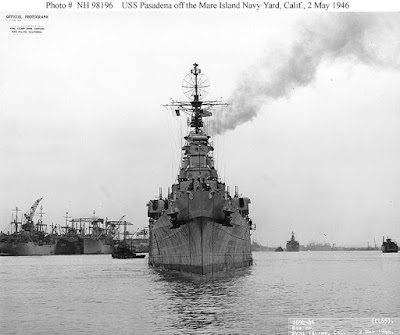
To begin, here’s a photo of the USS Pasadena, a Cleveland class cruiser.  The superstructure, at its base, extends around half the width of the ship and narrows quickly as it rises.  Most of the superstructure is around a half to a quarter of the width of the ship.  Also note that the structure height (not the mast height) is relatively low compared to the height of the hull as seen at the bow. 


 Next, here is a photo of an unidentified crusier.  Again, note the skinniness of the superstructure which occupies perhaps half the width of the hull and, again, narrows quickly;  not a lot of weight high up.


Now, let’s take a look at some of today’s ships.


Here’s a Burke class destroyer.  Note the massive size of the superstructure which extends all the way to the extreme edges of the ship and rises nearly vertically.  That’s a lot of weight!


Here’s a view of a Freedom class LCS.  The superstructure extends the width of the ship is just massive compared to the hull.


Next is a view of a Ticonderoga class cruiser and the USS Long Beach.  Again, they just look immensely top heavy, don’t they?


I don’t have metacentric height data for the ships so this is just a visual impression of top heaviness but it’s quite instructive, nonetheless.  How stable do you think these ships will be after they’ve taken some damage and taken on water?  We’re building in the tendency to capsize!  We’ve got to radically rethink our ship designs on so many levels.  When we lost BuShips, we lost our ship design compass and institutional knowledge..