One of the common rejoinders employed by battleship critics
is that modern anti-ship missiles would quickly and easily sink a
battleship. Of course, this statement is
made with zero supporting evidence. On
the contrary, there is much evidence that suggests – but does not explicitly
prove – that battleships would be largely immune to anti-ship missiles.
Battleship critics have suggested two modes of ‘killing’ a
battleship:
Outright sinking using modern anti-ship cruise missiles
Mission killing due to destruction of top side electronics, sensors, and weapons
We’ll examine each of those modes but, first, let’s
understand some underlying concepts.
Relevant Concepts
Armor Piercing Shells – A battleship’s main weapon
was the 16”+ gun firing 2500 lb armor piercing (AP) or high explosive (HE/HC)
shells travelling at velocities of Mach 2+.
For example, the Iowa’s 16” AP/Mk8 weighed 2700 lb and had a muzzle
velocity of 2425 ft/sec (1653 mph, Mach 2.1).
What is an armor piercing (AP) shell?
U.S.
Navy World War II nomenclature uses the words "Armor Piercing" (AP)
to mean that the base-fuzed, hard-nosed projectile so labeled has a thick,
steel AP cap designed to allow intact penetration through some thickness of
Class "A" (face-hardened) armor plate.[1]
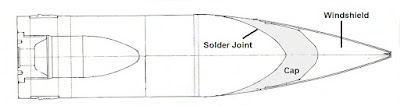 |
| AP Shell Mk 8 |
Armor piercing shells were designed, as the name implies, to
penetrate a ship’s armor. This was
accomplished by placing a heavy, solid metal cap over the explosive shell. Grossly simplifying, the cap was a
sacrificial ‘point’ that would penetrate the armor allowing the explosive shell
behind it to enter the ship intact and functional before exploding.
Armor – A battleship’s armor (we’re talking about US
battleships in this post) is intended to protect vital equipment. Any equipment not protected is not vital –
useful, undoubtedly, but not vital. As a
general statement, battleship armor was designed to provide immunity to another
battleship’s weapons which means 16”+ shells.
It is noteworthy that the Iowa class was designed to be immune to 16”
plunging fire.
Armor was not, as so many people believe, simply thick
plates of steel attached to the sides of the ship. Instead, it was a sophisticated system of
plates, layers, carefully calculated void spaces, differing materials and
treatments of steel, calculated angles (obliquity), etc. all working together
to defeat attacking shells.
The main mechanism of armor protection was the act of
decapping incoming AP shells before they could penetrate the armor. In other words, the armor was designed to
strip the armor piercing cap off the incoming shell before penetration could
occur. If the shell could be decapped,
the shell’s penetration would be prevented or severely limited. Navweaps website has articles by Nathan Okun
that go into much greater detail, for those interested.[1,2]
Armor
penetration requires a rather lot of information, but decapping of the
projectile by breaking the rather weak solder and/or mechanical bond between
the nose and cap base is very, very simple:
0.08-0.08049-caliber
thickness of any kind of homogeneous iron or steel plate has a 50% chance of
decapping any kind of capped projectile over 40mm in diameter under ANY impact
condition, penetrating or not.
0.0805-caliber
and up thickness always decaps the projectile, penetrating or not.[2]
The
USN Iowa and South Dakota class battleships have an internal inclined main
armor belt. What isn't well known is that they also have a shell plating
outside of this belt that acts as a decapping plate. On the South Dakota's,
this shell plating is 1.25" thick (3.2 cm) and on the Iowa's it is
1.5" thick (3.81 cm). Using Nathan's formula above, the South Dakota's
plating would be sufficient to decap any projectile up to 15.5" (39.4 cm)
and the Iowa's plating would be sufficient to decap any projectile up to
18.6" (47.3 cm). This would imply that the Japanese Type 91 18.1" (46
cm) APC projectiles fired by the Yamato would be decapped by the Iowa's shell
plating before they reached the main armor belt. Decapping an AP projectile
greatly decreases their armor-penetration ability against face-hardened naval
armor (unprotected projectile nose now shatters into pieces) at under 45°
impact obliquity angle.[2]
The angle of impact (obliquity) of a shell on armor was also
immensely important. A perfectly
perpendicular strike on armor was the most difficult to defeat while angled
impacts acted to disperse the force parallel to the armor, causing a ricochet
or greatly reduced damage. This is why
armor was angled when possible and where appropriate. Again, I’m grossly simplifying the physics
and mechanics of this.
Another important factor that most people are unaware of is
just how extensive the armor coverage was.
For example, the conning tower of the ship was heavily armored as
opposed to today’s ships whose bridge superstructures are not armored at all
and consist of what amounts to thin aluminum foil, for all practical combat
purposes. Note the thickness (17.3”) of
armor around the conning tower of the New Jersey in the photo below.
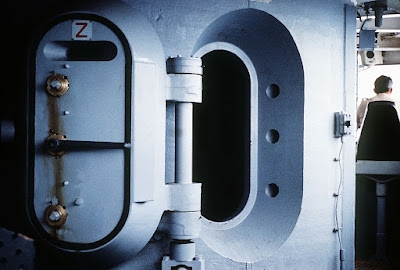 |
| Armored Conning Tower |
Critics who think a battleship’s topside would be destroyed
by missiles are unaware of the extent of armor.
WWII ships were built with armored structures and equipment that we
don’t even consider for armor today. The
topsides, while not protected as heavily as the hull, were still heavily
armored.
One of the common misguided notions is that anti-ship
missiles will conduct pop-up attacks and strike the vulnerable decks from above
where the battleship is helpless. Battleships were design to defeat plunging
fire. From Wikipedia,
The
deck armor consists of a 1.5-inch-thick (38 mm) STS weather deck, a combined
6-inch-thick (152 mm) Class B and STS main armor deck, and a 0.63-inch-thick
(16 mm) STS splinter deck. Over the magazines, the splinter deck is replaced by
a 1-inch (25 mm) STS third deck that separates the magazine from the main
armored deck.[3]
Thus, overhead strikes were well accounted for with the upper
deck providing the decapping function and the underlying deck providing the
main resistance against whatever penetration did occur. Of course, if it were established that
overhead attacks were a common staple of missile attacks, a modern version of a
battleship could easily redesign the armor to beef up that area.
Anti-Ship Missiles - Now that we understand what is
required to have a chance of penetrating battleship armor (meaning an AP shell)
and how the armor acts to protect the ship, let’s look at the modern ‘shell’
which is, of course, the anti-ship missile (ASM). ASMs can be crudely grouped into two
categories:
Light – typified by the Harpoon (1500 lbs, 490 lb warhead),
Exocet (1700 lbs, 360 lb warhead), and C-80x family (418 lb warhead), among
others. These are relatively small,
light, generally subsonic, and have warheads in the few hundred pound range.
Heavy – typified by the BrahMos (6600 lb, 660 lb warhead),
P-700 Granit (15,400 lb, 1650 lb warhead), and P-800 Oniks (6600 lb, 660 lb
warhead). These missiles are relatively
large, heavy, generally supersonic, and have warheads in the 600-1000+ lb
range. Some of these missiles are described
as semi-armor piercing, whatever that means.
Shell-Missile
Comparison
The obvious next step is to understand how shells and
missiles compare as far as their ability to penetrate battleship armor.
Skin – A key characteristic of shells and missiles is the
thickness of their ‘skins’. A missile,
even the largest, has relatively very thin skin amounting to no more than that
necessary to hold the internal components in place and provide an aerodynamic shape. In contrast, naval shells have very thick
walls which both aid in penetration and serve to contain and compress the
explosive chemical reaction (the blast).
Penetration – The common, light ASMs are not generally claimed to be armor
piercing and are, conceptually, simply explosives and motors contained in a
very thin skin of aerodynamically shaped sheet metal. They have no armor piercing capability
whatsoever beyond their inherent kinetic energy which is woefully insufficient
to penetrate significant armor. The
armor would not even need to perform its de-capping function since the missiles
have no armor piercing cap. The missile
would simply explode against the outside of the armor, doing little more than
scratching the paint.
Several decades ago, I read reports of tests by the Navy
involving launches of anti-ship missiles against armor plates. Unfortunately, at the time, I did not save
the reports and have been unable to find them now. As I recall, the missile was the
Harpoon. I do not recall the armor plate
thickness or composition. Regardless,
the result was that the missile achieved no penetration and did no damage.
As noted, some missiles claim to be ‘semi-armor piercing’
but I’ve seen no description or definition of what that means. Presumably, it means it might be able to
penetrate some small degree of armor but, unless the missile contains true
armor piercing caps equivalent to 16” battleship shells and the rest of the
missile body is encased in a thick shell, the missile will have no chance of
penetrating any significant degree of armor.
Few – I actually don’t know of any – anti-ship missiles have
actual AP noses. Battleship armor is
designed to decap heavy, large caliber shells so, logically, an AP missile, if
such existed, would also be decapped and prevented from penetrating.
I am unaware of any credible testing of anti-ship missiles
against armor. There have been Russian
claims but they are unverifiable and Russian claims are almost invariably
greatly exaggerated, as the Russian performance in Ukraine has demonstrated.
Discussion
We noted that battleship critics claim two modes of
‘destruction’ of battleships: Let’s
consider the two modes.
Sinking – In order to achieve a sinking, an ASM would
have to penetrate multiple layers of armor to reach vital internal areas. Even then, that would not open holes for
water ingress. Fire, of course, is
always a threat to ships but with vital equipment protected, armor abounding,
and extensive compartmentation, it would be very difficult to achieve a
sinking.
Mission Kill – As noted, topside equipment is subject
to damage but nothing topside is vital.
Battleships were designed with armored sensors and had multiple
redundant and backup systems so significant impairment of a battleship’s
function via topside damage would be extremely difficult to achieve. A modern version of a battleship would have
its various radar, electro-optical, infrared, and electronic warfare sensors
housed in armored structures as the WWII battleships did with their various
radar, fire control, and optical sensors.
A modern version would have many isolated self-defense
weapons (SeaRAM, CIWS) each of which has its own self-contained radar. A single
hit could not damage much of a ship's defensive weapons. Besides, defense is
what escorts are for. Citing the fact that a battleship was sunk somewhere in
history does not invalidate the power and survivability of the type.
No ship is invulnerable but a battleship is the least
vulnerable ship ever built. A battleship group with Aegis escorts would be an
exceedingly difficult group to defeat.
Some might say that this entire discussion is pointless because
we are never going to bring battleships back.
Well, that may or may not be true but there is a larger point to this
and that is the role and value of armor.
Whether that armor is applied to a true battleship or to some other type
of ship, this discussion reminds us that armor serves an invaluable purpose and
should be part of every warship design.
________________________________
[1]NavWeaps website, “Decapping Revisited”, Nathan Okun,
http://www.navweaps.com/index_tech/tech-085.php
[2]NavWeaps website, “The Armor Thickness Necessary to Decap
an APC Projectile”, Nathan Okun,
http://www.navweaps.com/index_tech/tech-045.php
[3]https://en.wikipedia.org/wiki/Iowa-class_battleship#Armor