Showing posts with label Chinese Navy. Show all posts

Friday, June 28, 2024

Constellation – Type 054B Comparison

The United States and China are both in the process of building a new class of frigate.  The US is building the Constellation class frigate and China is building the Type 054B which is an evolutionary advance on the Type 054A.  China has built/building 50 Type 054A and an unknown number of Type 054B for a total of, perhaps, 70 some Type 054 frigates.  In contrast, the US plans to build 20 Constellation class ships.
 
Let’s take a look at the cursory specs and see how they compare.


Type 054B Launch


As the specs demonstrate, the Constellation is just a bit inferior in several respects with the only advantage being a greater number of anti-ship missiles.  The Chinese frigate has better stealth, a more powerful gun, ASW torpedoes, and an extra close in weapon.  Based just on these specs, the Type 054B is the superior vessel.  That’s a disappointing commentary on ship design and the underlying combat-mentality that went into each country’s design.
 
The US had an opportunity to produce a modern, state of the art, optimized frigate and instead opted for an obsolete base design some 20 years old.  As with the Burke Flt XXIV, or whatever they’re up to now, the Navy has opted for the illusion of a safe design instead of a modern combat capable and survivable design.  China, on the other hand, has opted for a state of the art modern frigate.

Friday, May 17, 2024

New Chinese Corvette

Naval News website reports that a new Chinese corvette has begun sea trials.[1]  The vessel has an extreme (think Visby) stealth design, what appears to be some sort of water jet propulsion, and a Zumwalt-type stealth mounting for the forward gun.  The ship is likely a one-off prototype.


This is what a modern ship should look like.  I’d reduce the superstructure significantly but what’s there is clearly designed for maximum stealth.  There are almost no protruding objects to cause an increase in the ship’s radar (and visible) stealth signature.  This is easily up there with the Visby as regards stealth.  Compare this design to our newest ships, the Constellation and Burke Flt III.  Both are radar beacons compared to this.  We’re so locked into obsolete designs that, for all practical purposes, we’re giving future naval victories to the Chinese.


The other noteworthy aspect of this is China’s willingness to construct one-off prototypes to explore new designs.  Compare this to our recent new ship designs such as the LCS where we committed to 55 ships before the first was even designed or the Constellation where we committed to 20 ships before the first was even designed or the Burke where we’re committed to a never ending number of ships because we so terrified of a new design failure (with good reason but infinite stupidity!).
 
China is doing its naval buildup correctly and quickly.  In comparison, we are decommissioning ships at a faster rate than we build new ones and are shrinking the fleet. 
 
China is screaming warnings at us and we’re flat out ignoring them.
 
Nothing good will come of this.


________________________
 
[1]Naval News website, “Chinese Experimental Corvette Starts Sea Trials”, Alex Luck, 17-May-2024,
https://www.navalnews.com/naval-news/2024/05/chinese-experimental-corvette-starts-sea-trials/

Sunday, June 26, 2022

Liaoning Photo Analysis

It’s always good to know the enemy’s capabilities and equipment so let’s take a quick look at some photos of the Chinese ski ramp aircraft carrier Liaoning and see what it can tell us about Chinese ship design philosophy.  As a reminder, the Liaoning is the former Soviet Kuznetsov class ship, Varyag, which was stripped down after the collapse of the Soviet Union, acquired by the Chinese, and completely overhauled and rebuilt.  Here’s a photo of the carrier:
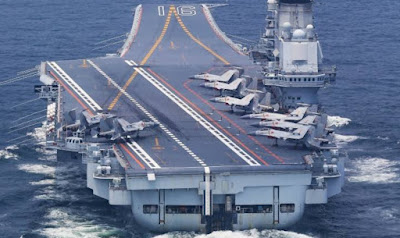
 

Liaoning - Stern View


Let’s look at some aspects of the ship that offer insights into Chinese naval philosophy and ship design.


Copy - The first thing that jumps out is that the Chinese rebuilt the ship as a near carbon copy of US aircraft carrier design to the extent possible for a ski ramp variant.  Aside from the obvious direct copies of the angled deck, starboard side midships island, stern sponsons port and starboard, smaller forward sponsons, four arresting cables, and bow and waist ‘catapults’ (take off spots), there are other, smaller duplications.  The optical landing system on the port side is a carbon copy of US systems in design, function, and location.  The flight deck lighting scheme appears to be a direct copy.  There even appears to be a copy of the US standard stern debarkation platform. 


China has produced no visually unique design features.  There is no evident innovation.  This kind of blind copying is illegal (patent and other infringements) and unethical – which China doesn’t care about in the least – but, worse for China, bypasses all the learning that led to the end result.  That learning is also called institutional knowledge.  Yes, by stealing and copying the designs of others, China has leaped to the desired end point but has done so without the intervening steps which produce underlying knowledge and expertise.  This deprives them of actual design understanding and experience and makes future modifications and improvements difficult, if not impossible.  Bad for them, good for us.


The Chinese have so committed to matching the US Navy that they’ve adopted literal copying as the path to achieving that match.  While this may, indeed, result in matching, or overmatching based on numbers of ships, it precludes them from true naval innovation.  They won’t/can’t come up with a truly unique naval design that might give them a decided advantage.  In contrast, the US has attempted to develop unique designs and technologies such as the Zumwalt, LCS, unmanned vessels, EMALS, Advanced Arresting Gear, and so forth.  Of course, most of those attempts have been dismal failures but the attempts were there.  China appears to have limited themselves to outright copying.  Again, bad for them, good for us.


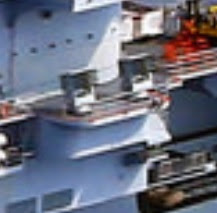
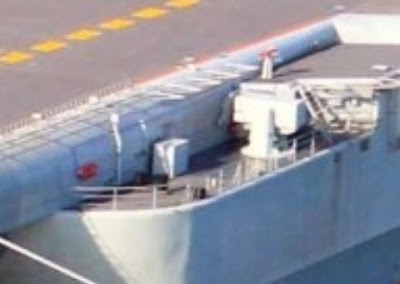
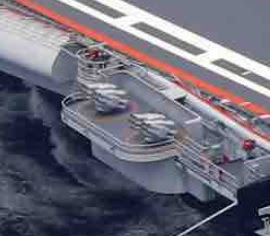
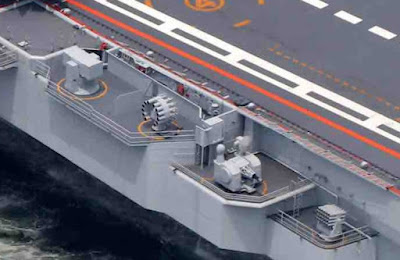
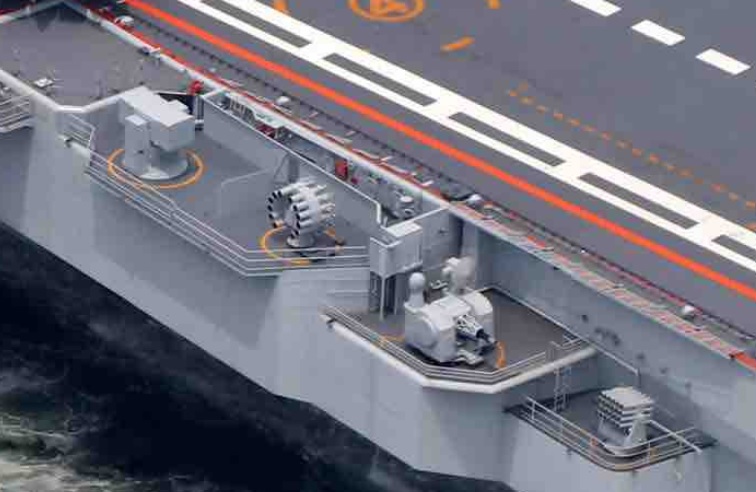
Weapons Fit – One noteworthy point of departure from US carrier design is the ship’s weapons fit.  The Chinese have a clear philosophical leaning towards a more robust defensive weapons fit.  Here’s the defensive weapons fit for the Liaoning (note, photos show the weapons fit varying over time so this is a typical, recent fit):


  • 3x HHQ-10, 18-cell short range anti-air missile (3 x 18 cells = 54 missiles)[a]
  • 3x Type 1130, 30 mm CIWS
  • 2x 12-barrel RBU ASW rocket depth charge launcher
  • 4x Decoy/Chaff launcher (24 barrels ea)
  • 4x 16-tube ???? (port and starboard midships, function/type unknown)

 [a]Reports list 4x HHQ-10 but I’ve only been able to verify 3x in photos


Here's some photos of the various weapons and locations:
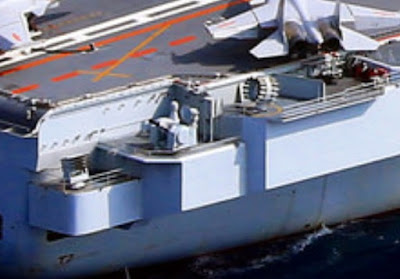
 

Weapons Fit - Starboard Stern


Weapons Fit - Starboard Amidships


Weapons Fit - Port Forward


HHQ-10 Launcher


Weapons Fit - Port Amidships


Weapons Fit - Port Stern


By comparison, a typical US Nimitz class has the following typical defensive weapons fit:


  • 3x Sea Sparrow, 8-cell anti-air missile (3 x 8 cells = 24 missiles)
  • 3x 20 mm CIWS
  • 4x SRBOC (Super Rapid Bloom Offboard Chaff), 6-barrel (4 x 6 barrel = 24 barrels)


Clearly, the Chinese believe combat is inevitable and that more robust fits are the way to emerge victorious.  In this, they are correct.  US ship designs have become positively anemic regarding weapon fits. 


Consider the weapons fit on WWII carriers.  They were crammed with weapons of all types.  Of course, there is no direct comparison between the weapons of WWII and today but there most certainly is a direct and valid comparison in the density of weapons and, in that, today’s ships and carriers are woefully lacking.  The Chinese design, while it pales compared to WWII designs in weapons fit, is still an improvement over our carriers.


What this demonstrates is that the Chinese are serious about combat and we are not.  They expect their carriers to fight and be exposed in combat and are attempting to provide the weapons to enable their ships to survive.  The US, on the other hand, has designed carriers so expensive and so bereft of weapons that it is unlikely that we will even risk our carriers in combat and, if they do engage in combat, they have a reduced likelihood of survival.


Philosophy – The photos show a complete, fully functional carrier, albeit one that has no front line future in the Chinese navy due to its ski ramp and the evident desire of the Chinese to move beyond ski ramp carriers and on to conventional, large, ?nuclear?, carriers.  Why would the Chinese spend the money and resources on producing a carrier that they knew would not hold a front line position for very long?  Not only that, but they also built a brand new carrier, the Type 002 Shandong, which is a functional carbon copy of the Liaoning.  What does this imply?


The implication is that the Chinese are deadly serious about developing carriers that are equivalent (or superior !) to the Nimitz/Ford designs and that they want to do so as quickly as possible.  Thus, the Liaoning and Shandong are temporary vessels intended to develop carrier construction techniques and manufacturing infrastructure and to gain operating experience while the succeeding conventional carriers were being built and outfitted.  Ponder the immensity of that … the Chinese built/rebuilt two entire, large carriers just to operate them for a few years in order to gain experience!  That speaks to a focus, intensity, and drive to achieve military superiority that we utterly lack.  Can you imagine the US building an entire carrier just to operate it for a few years to gain experience?  It’s outside of our mindset to even contemplate that.


The other telling implication is the mere fact of the carrier’s existence.  While we are debating the usefulness of carriers and many US naval observers are calling for further reductions – or outright elimination ! – of carriers, the Chinese are pushing as hard as they can to build a carrier fleet.  That tells us that the Chinese see great value in a carrier fleet and that, alone, should serve as a strident warning to us as we steadily reduce our carrier power.  We’re debating carriers while the Chinese are building them as fast as they can!  That strongly suggests that the Chinese envision an eventual head-to-head carrier battle with the US and are working to ensure that they come out the winners. 


Alternatively, they may envision a future where we have reduced our carrier fleet to the point of impotence and, when that happens, the Chinese intend to be right there, dictating naval supremacy with a powerful carrier fleet that will vastly overmatch whatever remnants of a carrier fleet we leave ourselves.


The Chinese have seen the lesson of WWII in which powerful, roving carrier groups were able to control the seas – and thus control the land ! - and they see the obvious application of that lesson to today’s battlefields.  We, on the other hand, have bought into the network/data approach which sees no great value in firepower.  The Chinese have placed their bet on firepower while we have bet on data.  I know which I think is the winning hand.


The Chinese are coming for us and they’re not even pretending otherwise.  We need to take heed.


Friday, June 18, 2021

Chinese Type 056 Corvette

The Chinese Type 056 corvette is a numerous series of general purpose, lower end ships – as the name, corvette, implies – that is suited for operations in and around the first island chain where long range and endurance are not a requirement.  Reports put the number built at around 72 during the period 2012-2019; an impressive production run that ended in Dec 2019.  Contrast that to the anemic US LCS production run.


Type 056 Corvette


Type 056 Corvette Specifications

Length, m (ft)

90 (295)

Displacement, tons

1500

Speed, kts

25

Range, nm

3500 @ 16 kts

Crew

78


Armament

AK-176 76 mm gun


4x YJ-83 (C-803) anti-ship cruise missile


8-cell FL3000N anti-air SAM


2x triple 324 mm torpedos


2x 30 mm


Aviation

Flight deck for 1 medium Z-9 size helicopter


Sensors

Type 347G fire control radar


Bow sonar


The vessel has a compact, stealth design that, visually, appears fairly uncluttered and should be fairly stealthy.  The ship uses diesel power and the stern has a waterline mounted ‘ducktail’ flap, similar to that installed on US ships, which improves fuel efficiency.


Various electronics include multiple decoy launchers, jammers, and optical sensors.


The armament and sensors of this small vessel puts the LCS, which is twice the size of the 056, to shame and reveals what a waste of money and resources the LCS is.


8-Cell SAM Launcher

 A second version of the 056, the 056A is specialized for anti-submarine (ASW) duty with the addition of towed array and variable depth sonar (VDS) and looks to be fairly close to what ComNavOps has called for in the form of a small, dedicated ASW corvette.  The degree of quieting applied to the ship is unknown.  Wikipedia lists 50 of the total 72 corvettes as being the 056A ASW version.  Such a fleet of vessels, operating in the somewhat restricted waters inside the first island chain will make it challenging for US subs to operate in the area.


YJ-83 Anti-Ship Missile Launcher


Other variants include Coast Guard and export versions.


Summary


The 056 corvette is a well designed ship which is especially suited for patrol activities inside the East and South China Seas.  The armament is quite respectable for the ship’s size.  The ASW version is nicely equipped with towed array, VDS, hull mounted sonar, ASW torpedoes, and a helo.  Considering the quantity of ASW versions built, this ship will make it difficult for US submarines to operate inside the first island chain.


While we can’t know, for sure, the Chinese intentions, this appears to be a ship that was designed as a E/S China Sea patrol and ASW vessel and the design appears to be well suited to the purpose.  This is a good example of defining a role (CONOPS) and then designing the ship to fit that role – exactly how ship procurement should happen.  This class can stand as a lesson to US Navy leadership about how to design and build a ship.


Wednesday, October 23, 2019

Chinese Type 22 Missile Boat

Today we’re going to take a look at the Chinese Type 22, Houbei class missile boat.  It is a small, fast, stealthy assassin with massive firepower relative to its size.  The class has been built in large numbers (Wiki cites 83 boats currently built and active) which suggests that it will operate in squadrons, allowing it to mass its firepower.  Properly used, this is a formidable threat.

Let’s take a closer look.


Type 22 Missile Boat


Size - The vessel is a 140 ft long catamaran design with a 220 ton displacement and a crew of 12 (1).  For comparison, this puts it at around 1/3 the length of the LCS and a 1/16 the displacement.

Propulsion - Four waterjets give it a speed of 36 kts. 

Number - Wiki cites 83 boats currently built and active.

Range - Range is a potential issue with suggestions of a 300 mile range based on similar civilian craft. (1)

Sensors - Sensors are an issue but operating within the A2/AD zone may greatly mitigate sensor limitations.  It has a Type ESR-1 362 surface search radar plus a Fenis-ME electro-optical tracker and a Kolonika II low-light-level optical director and backup CIWS fire control director, on top of the bridge.  A mast-mounted Type 765 I-band navigation radar rounds out the sensor fit. 

Armament - It carries 8x C-802/803 anti-ship missiles with a range of 100-125 miles depending on variant, an AK-630 (30 mm) CIWS, and a small FLS-1 surface-to-air launcher for QW series missiles. (1)  The Type 22 has extensive communications and data link equipment which suggests the capability for off board control of the missiles.


As noted, this vessel is a combat vessel with firepower far out of proportion to its size.  Add to that, numbers and stealth and you have a vessel that will be hard to detect and can operate in squadrons for concentrated missile salvos – a formidable naval force, to be sure!

The number of vessels built, 83, is magnified by the small operating area that the boats will operate in.  Unlike a 300 ship US Navy which is spread over an entire world, the entire Type 22 fleet of 83 boats is concentrated in the relatively small East or South China Seas.  This has the effect of magnifying the vessels firepower because it automatically concentrates it.

This also suggests that the Chinese will use it as an anti-access/area denial (A2/AD) asset to keep US naval forces out of the South and East China Seas.  This also suggests a defensive mindset as opposed to an open ocean, long range naval hunter vessel.  If true, this in turn suggests how the Chinese view the S/E China Seas – essentially, they act as a buffer zone or ‘moat’ around the mainland.  The Chinese are clearly working toward becoming a global naval/military force but this suggests that they are not there, yet, and that their current focus is defensive.

There is also some suggestion that the Type 22 has a shore bombardment role in support of amphibious operations in addition to the anti-ship role. (1)  If true, this would give the Chinese a small, stealthy, hard to hit fire support vessel – a capability that would be unmatched in the world.

It is difficult to talk about the Type 22 without comparing it to the American LCS.

The obvious conclusion is that this is one version of what the LCS could have been.  The LCS tried to be and do everything and failed to be or do anything.  Had the LCS concept been more focused, the Type 22 is one version of what might have been – a small, lethal, stealthy, fast, focused, anti-surface craft cheap enough to be acquired in large numbers and operate in massed squadrons.

The US Navy talks incessantly about distributed lethality.  Unfortunately, the LCS is a poor fit for the distributed lethality concept.  Further, many observers and some naval officers have talked about the LCS as a modern PT boat.  Again, this is utterly ridiculous, for reasons we’ve previously discussed.  The irony is that the Type 22 actually fills the role of a modern PT boat and distributed lethality asset quite well.  Again, this is a version of the LCS that could have been.

A Type 22 swarm attack against a US carrier group would be unstoppable although it is difficult to imagine how such a swarm would even get close enough to launch an attack.  ‘Swarm’ in this scenario is radically different than the Iranian type swarm.  In this case, it would amount to a long range missile swarm as opposed to a short range rocket attack.  That said, I don’t believe the Chinese view the Type 22 as a viable carrier attack asset although if the chance presented itself …

In summary, the Type 22 appears to be a defensive, A2/AD asset intended to prevent US naval entry into the S/E China Seas.  Its stealth, cheapness, and numbers make it the distributed lethality asset that the US Navy wants but has failed to develop.  This is the distributed threat that will ‘confuse and complicate’ our operational and tactical thinking just as we hoped that distributed lethality ships would confuse Chinese naval commanders.  The difference is that the Chinese actually have a suitable vessel for distributed lethality operations whereas we do not. 

The Type 22 is also a good representation of the Hughes concept of small, distributed naval forces – a concept that ComNavOps disagrees with, at least, for the US – and, again, ironically, it is the Chinese that have developed it.


______________________________


Monday, March 4, 2019

Chinese Amphibious Capabilities

In our recent post about the Chinese Type 075 LHD (see, “Chinese Type 075 LHD”), the discussion turned (okay, I nudged it towards) to the role of Chinese amphibious forces and the need for major amphibious ships and forces.  As we examine Chinese amphibious capabilities, it is wise to note that air force and naval power can deny an enemy access to territory but only ground forces can seize and hold territory.  Thus, the ultimate purpose of amphibious forces is to seize and hold territory.  Yes, they can conduct raids, rescues, embassy security, and other missions but the main mission is seizing territory.  This is the lens through which to view Chinese amphibious capabilities.

With that in mind, it is important to recognize the purpose of China’s amphibious forces as opposed to the US.  We are tempted to compare the raw numbers of ships and Marines and conclude that China is only a minor amphibious threat.  This conclusion, however, fails to grasp the purpose behind China’s amphibious force (as well as their amphibious force growth rate!).  Remember that the US has military commitments and presence all over the world.  Whether that’s wise is a subject for another time.  It means, though, that the US has amphibious forces in the Middle East, Pacific, or anywhere else at any given moment.  Also, the US operates far from home waters. 

In contrast, the Chinese amphibious force operates only in the very localized home waters of the recently annexed South and East China Seas.  Whereas the US needs several amphibious groups to cover all its potential commitments, the Chinese only need one or two to cover their limited region. 

Because of the distances involved and the time required to prepare for, and deploy to, the areas of concern, the US is compelled to maintain a force of 30+ amphibious ships in order to provide a constant forward presence of two or three Amphibious Ready Groups.  In contrast, the Chinese amphibious force is based in their home waters and can almost instantly transition between maintenance, training, and deployment as desired.  Thus, they do not need the 30+ ships of the US amphibious force in order to accomplish the same degree of ‘forward’ presence.

We also need to understand the missions that the Chinese amphibious force is intended for.  The US amphibious force, while theoretically capable of a wide range of missions throughout the combat level spectrum, is intended for major assaults during high end combat.  That we can’t actually execute that mission is irrelevant for this discussion.  In contrast, the Chinese amphibious force is not intended to conduct major assaults against the US.  The Chinese amphibious force is intended to support their low end annexation efforts against the various territories surrounding the South and East China Seas.  This does not require the 30+ amphibious ship fleet of the US.

It is also important to understand that China views military-enabled territorial expansion as perfectly legitimate and acceptable.  In other words, their amphibious force is intended to be used whereas the US force is intended, ideally, to be an unused deterrent.  Even unused, there is a difference.  China’s amphibious force is intended to intimidate as opposed to the US intention of deterrence and, increasingly, humanitarian assistance.

Chinese Amphibious Light Tanks


As we contemplate a map of the East and South China Sea regions and the pattern of expansionist behavior of China, it is clear that it is only a matter of time until China begins knocking on the doors of the various small countries bordering the E/S China Seas.  When China knocks, standing right behind the smiling Chinese face at the door will be the amphibious force, ready to kick the door in if they don’t get what they want.

I think this leads to another aspect of Chinese amphibious operations philosophy and that is the use of overwhelming force.  I strongly suspect that the Chinese have observed the US example/lesson of the use of overwhelming force as exemplified by Desert Storm and the various Iraq/Afghanistan operations.  They’ve seen that the best results are obtained when the attacker has massively superior power.

We’ve seen hints of this in recent Chinese actions.  They send three ships when one is sufficient.  Their interactions with Vietnam, Philippines, and others are executed with vastly superior force when possible.  I think this is an operational tendency that is going to become more pronounced as their naval assets increase in number.  Thus, the Chinese may view a full up amphibious ship and amphibious group as desirable for actions that the US would be content to use a single, lesser ship or group for.

Finally, it is important to note that while the anticipated US opponents are peer or near-peer enemies which would require large amphibious forces to attack with, the Chinese anticipated opponents are far less capable.  While China’s eventual goal is to confront the US, toe to toe, the nearer term use for their amphibious force is against second or third rate militaries such as Vietnam, while they expand and consolidate their periphery around the South and East China Seas.  Thus, for the near to moderate future, China does not require as large an amphibious force as the US because their opponents are far less powerful and capable.

We see, then, that the US and Chinese amphibious forces have very different reasons for existing.  With this understanding, we can now better assess the Chinese amphibious force rather than just, simplistically, comparing it by the numbers to the US amphibious force.

___________________ 

The link below (1) offers an excellent summary of Chinese amphibious capabilities although the article is strongly pro-Chinese/anti-American.


__________________________________________

(1)South Front website, “Military Analysis: Chinese Amphibious Capabilities”, Brian Kalman, 10-Mar-2016,
https://southfront.org/military-analysis-chinese-amphibious-capabilities/

Wednesday, February 27, 2019

Chinese Type 075 LHD

It’s always good to review a potential enemy’s weapons, platforms, and systems.  Today, let’s take a look at one of China’s latest amphibious assault ships, the Type 075 Landing Helicopter Dock (LHD).

As the name implies, the ship will feature an amphibious assault combination of helicopters and landing craft launched from a well deck.  The design includes Command and Control facilities.  The ship is expected to be launched in 2019 and enter service in 2020. 

The Type 075 is reported to be around 40,000 tons, 820 ft long, and capable of carrying 30 helos with six operating spots (2).  The ship, as described, is very similar in size and capability to the US Wasp class LHD-1 which is 843 ft long and can carry around three dozen helos and Harriers in various combinations along with three LCACs and 1900 troops.  One key difference is that the Chinese do not, as of yet, have a Harrier/F-35B STOVL or MV-22 type aircraft in operation.  Unconfirmed reports, however, suggest that they are developing such aircraft and, given the demonstrated speed of their military development programs, should have the capability within five years.

Wiki reports that armament is limited to a pair of short range HQ-10 SAMs and a pair of point defense CIWS.


Type 075 LHD


The LHD will complement the Type 071 Landing Platform Dock (LPD) amphibious ships which are analogous to the US San Antonio class LPD-17.  The combination will provide the Chinese with a very credible amphibious assault capability.

This begs the question, why is this ship needed?  Here’s the official Chinese answer.

“The South China Morning Post reported earlier this month, citing military sources, that the navy planned to increase the size of its marine corps from about 20,000 to 100,000 personnel to help protect its increasing interests overseas.” (1)

Okay, that states the obvious that more ships are needed to carry more marines but it doesn’t say why a large amphibious assault force is needed to begin with.  This is simply more evidence that China is gearing up for a major war.  This kind of ship is not defensive in nature.  China is preparing for major offensive amphibious operations.  While the obvious targets are Taiwan and neighboring countries, China may also be planning amphibious operations in Africa and other world wide locations.  As I’ve repeatedly said, China has aspirations of global domination.

In any event, this ship class provides a significant increase in vertical assault capability and mobile, close air support for ground troops.  Such capabilities can be especially useful in intimidation actions by the military aimed at neighbors such as Vietnam.

The US is engaged in a military arms race whether they want to be or not and, while still ahead, are losing ground rapidly.


_____________________________________

(1)South China Morning Post website, “China building navy’s biggest amphibious assault vessel, sources say”, Minnie Chan, 30-Mar-2017,
http://www.scmp.com/news/china/diplomacy-defence/article/2083109/china-building-navys-biggest-amphibious-assault-vessel

(2)The National Interest website, “China's New Amphibious Assault Ship: A Big Waste of Time?”, Dave Majumdar, 31-Mar-2017,
http://nationalinterest.org/blog/the-buzz/chinas-new-amphibious-assault-ship-big-waste-time-19961

Saturday, March 10, 2018

Combat Fleet Count - China vs. U.S. Comparison

I’m beginning a combat fleet count for China to use as a comparison to ours.  I’ll use the same criteria for inclusion.

To refresh your memory, the combat fleet is composed of carriers, cruisers, destroyers, frigates, submarines, and amphibious ships (CVN, DDG, CG, FFG, SSN, SSBN, SSGN, LHA, LHD, LPD, and LSD).  Vessels like patrol ships, minesweepers, hospital ships, tugs, salvage ships, and ships whose designation starts with “T” or “A” are not counted as part of the combat fleet.  Yes, I know that China doesn’t necessarily use the same designations we do but I’ll do my best to apply the same categorization regardless of what the Chinese designations are.

I’ve included the Chinese missile boats (Fast Attack Craft – FAC) due to their heavy offensive firepower which makes them a significant battle fleet asset.  This is a reasonable inclusion but it does distort the total fleet size number comparison so take that into consideration.

Here are the numbers and breakdown as of the start of 2018

                  China(1)    U.S.

SSN                    14      51
SSBN                    5      14
SSGN                    0       4
SSK                    58       0
CV                      1      10
LHA                     0       1
LHD                     0       8
LPD                     4      11
LSD                     0      12
LST                    32       0
LSM                    31       0
CG                      0      16
DDG                    29      66
FFG                    49       0
FS (Corvette)          39       0
FAC (Missile Boat)    203       0

Total                 474     193


Here’s a few noteworthy considerations:

  • The U.S. has more “heavy” ships such as carriers, cruisers, and high end destroyers and, therefore, retains a firepower advantage.
  • The U.S. Navy has a huge advantage in carriers and, therefore, mobile aerial firepower but the Chinese have begun an aggressive carrier construction program and will likely match the U.S. carrier fleet in about 10 years.
  • China has a heavy investment in lower end ships such as frigates, corvettes, and missile boats, all of which are heavily armed for their size and would constitute a significant firepower threat.  This is the U.S. Navy’s vaunted distributed lethality realized.  We’re talking about it and the Chinese have done it!  So, all the U.S. Navy’s claims of disproportionate impact that distributed lethality will have on the enemy’s operational complexity and confusion, the Chinese have already applied against us many times over.  ComNavOps has severe doubts about the validity of distributed lethality but according to the U.S. Navy’s claims, China has already hugely overmatched and beaten us in this arena.
  • China’s fleet is, for the most part, new and getting newer all the time.
  • The U.S. fleet still possesses as qualitative advantage in technology although this gap is shrinking rapidly. 

I’ll continue to update this from time to time.


__________________________________

(1)Wiki, "List of active People's Liberaton Army Navy ships", retrieved 12-Mar-2018,
https://en.wikipedia.org/wiki/List_of_active_People%27s_Liberation_Army_Navy_ships