Showing posts with label Fletcher Class Destroyer. Show all posts

Monday, January 17, 2022

Fletcher in the Fleet

We’re not done with the Fletcher, yet!


In various posts and comments, we’ve discussed both a literal version of a modernized Fletcher (see, “Knee Jerks and Paradigms”) and a conceptual version of a modern Fletcher.  Just for fun, let’s see what an exact copy of a Fletcher would offer the US Navy, if anything. 


For this conceptual exercise, a WWII Fletcher is magically transported to today and incorporated into the fleet.  What, if anything, would such a ship be good for, today?  What missions/tasks could it usefully perform?  Does it have anything to offer?  Bear in mind that a typical Fletcher might have 10x 40 mm, 7x 20 mm, and 5x 5”/38 guns.  Let’s see what a Fletcher might do …
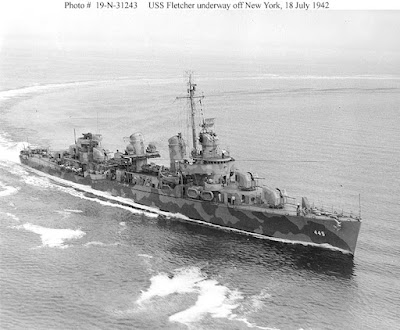

Fletcher Class DD - It's No LCS or Zumwalt !


Peacetime Missions


Anti-UAV (thanks to G2mil) – The Fletcher’s numerous 20 mm, 40 mm, and 5” guns can throw up a wall of lead that no tactical UAV would have a chance of penetrating.


Anti-Swarm – Iran has not been shy about aggressively exercising its swarm boats and a Fletcher would be ideal for disrupting those exercises.  If events escalated, the Fletcher’s firepower would make short work of any swarm boats.


Anti-Piracy – A Fletcher, while still a vast overkill, is at least a smaller vessel than a Burke and with outstanding speed and firepower would be highly effective at disrupting pirate activities.


Contesting China’s Coast Guard and Militia – China’s ‘fishing fleets’, protected by their coast guard, have been used to establish false territorial claims.  An armored and heavily armed Fletcher would be ideal for disrupting those attempts.


Freedom of Navigation (FON) – While FON exercises are worse than useless, the Navy seems determined to conduct them.  That being the case, there would be no better suited ship than a Fletcher.  Every time we do a FON, the Chinese show up to try to intimidate us into leaving (often successfully, in that we perform the operation and quickly leave).  A Fletcher, armored and packed with guns would have no reason to be intimidated and would be well suited to protect itself while taking its time on the mission.


Special Operations Support – A Fletcher would be ideal for special operations work.  It is small, fast and has enough firepower to support operators ashore, if needed.


Presence – Nothing says presence like a lot of highly visible guns on a ship with armor.  A Fletcher is just plain intimidating by today’s milquetoast standards!


Of course, peacetime missions are only as effective as the fortitude of nation and Navy.  If we won’t let our ships confront enemies then we don’t really need a Navy, at all, do we?


War Missions


Blockade – One of the problems current navies face in executing a blockade is that they don’t actually have much in the way of ship-sinking capability.  A Fletcher, armed with 10x heavy torpedoes, is a legitimate ship-killer.


UAV Screening – For the types of small, slow, tactical UAVs routinely encountered by our ships, a Fletcher would be a devastatingly effective anti-UAV screen.  The focused attention of dozens of guns of all sizes would create a literal impenetrable wall of lead.


Anti-Swarm – The problem with fighting swarms is dwell time.  It takes far too long for a single weapon to achieve a demonstrable kill so that it can move on to the next target before the rest of the swarm closes in.  A Fletcher’s firepower can quickly blot out small boats.  Consider the LCS whose job is anti-swarm and is equipped with a single 57 mm gun and two 30 mm guns (and maybe, someday, Hellfires?).  Compare that to the Fletcher’s dozens of guns.  Which would you rather have protecting you from a swarm?


Anti-Ship - Very few ships today could stand in a toe-to-toe fight with a Fletcher, if the Fletcher can reach gun range.  A Fletcher would be ideal for engaging the Iranian navy, the NKorean navy (such as it is), or Russian or Chinese ships in confined waters.


Special Operations Support – As noted above, the small size, speed, and firepower of a Fletcher would be a boon to special operations.


Naval Gunfire Support – While 5” guns are not the ultimate in naval gun support, the Fletcher’s 5x 5” guns represent potent fire support by today’s standards and is the equivalent of five Burkes, each with their single 5” gun.


Convoy Escort – Though lacking long range anti-air capability and today’s ASW sonar, a Fletcher would still make a useful general purpose convoy escort.


ASW – Though lacking today’s sonar capabilities, a Fletcher, working with another sensor asset, would provide significant ASW firepower in the form of depth charges to deal with the ubiquitous SSK submarines.


Finally, consider these general characteristics of a Fletcher as compared to today’s ships of whatever size:


  • Great range
  • Great speed; as much or more than the LCS
  • Armor; nothing today matches it
  • Overwhelming short range firepower


That’s not a bad set of WARship characteristics, is it?  Discouragingly, none of our current surface ships can come close to matching that combination.  What does that say about our current ships?


The conclusion is inescapable.  A Fletcher, unaltered from WWII, would still be a highly useful vessel in today’s fleet, if properly used.  In particular, the combination of armor and firepower would be extremely useful in contesting Iranian and Chinese provocations … if we would begin contesting instead of appeasing.


Firepower is always useful and the Fletcher represents a concentration of firepower not seen in today’s ships.


That one could even imagine an actual Fletcher being not only useful today but, quite likely, far more useful and valuable than an LCS or Zumwalt is a scathing indictment of our ship design efforts over the last several decades.

Thursday, January 13, 2022

Fletcher Program Lessons

The Fletcher class destroyers were numerous and highly successful.  We’ve noted various ship design elements that contributed to their success, such as the prevalence of their armor and density of their firepower.  Beyond that, however, there are additional, more general, lessons to be derived from their production and it’s those that we’ll look at today.


There is no better introduction to these lessons than the opening statement from the General Board about the Fletcher destroyer program,


The Board asked all concerned to think in terms of keeping displacement, and thus size, to ‘the practicable minimum in order that they may present minimum targets and that ratio of cost to number may be as great as possible.’ [1, p.80]


Right there … the very first statement from the Board sets a design philosophy that is the very antithesis of today’s programs.  The Board recognized that when prosecuting a war, numbers of ships were of critical importance and the way to achieve that was to keep size to the practical minimum. 


Consider the size of the Fletcher versus our current ‘small’ warship, the Constellation frigate:


Fletcher

Constellation

Lenth, ft

376

496

Displacement, ton full load

2500

7300


We instantly see that the Constellation is 32% longer and 192% heavier for a ship, a frigate, that is supposedly smaller than a destroyer!  We built 175 Fletchers and are planning to build 20 Constellations.  That discrepancy in production numbers totally encapsulates the General Board’s concern about cost and numbers and we are violating the Board’s wisdom every time we begin a new shipbuilding program.  As a result, we are witnessing a non-stop decline in the number of ships in the fleet.


One could not ask for a more graphic example of the General Board’s concern.


If you’re going to fight a war, you need numbers.  The General Board knew this.  We’ve forgotten this most basic of requirements.


Now let’s look at other lessons offered by the Fletcher program.


Shipyards – Consider the following list of companies that built Fletchers during the war:


Federal Shipbuilding and Drydock Company, Kearny, New Jersey
Bath Iron Works, Bath, Maine
Boston Navy Yard
Charleston Navy Yard
Consolidated Steel Corporation, Orange, Texas
Gulf Shipbuilding Corporation, Chickasaw, Alabama
Bethlehem Steel Corporation, Staten Island, New York
Bethlehem Shipbuilding Corporation, San Francisco, California
Bethlehem Steel Company, San Pedro, California, Terminal Island
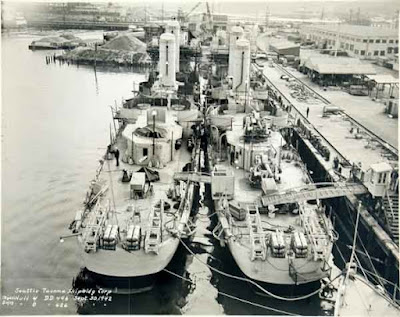
Seattle-Tacoma Shipbuilding Corporation, Seattle, Washington
Puget Sound Naval Shipyard


The lesson is blindingly obvious.  We don’t have enough shipyards.  During war, shipyards will not only have to provide new construction but will be overwhelmed with battle damage repair efforts.  We don’t have enough shipyards to do either task, let alone both simultaneously.


Destroyers Under Construction At Tacoma Yard


Standardized Design – The reason why we could have eleven shipyards all build Fletchers was because we had a standardized design.  With that, it was just a matter of distributing construction drawings to the yards.  Today, we keep changing the basic designs, non-stop, in an effort to insert a constant stream of new technology.  There’s nothing wrong with periodically inserting new technology but not on a continuous basis.  Save up changes and then occasionally do a technology insert.  Honestly, I doubt there’s even a reason to do a technology insert.  A much better approach is to occasionally design a new ship that can incorporate the backlog of new technologies.


Short Production Run – The reason we didn’t need radical new technology inserts during the Fletcher production run is that the run was short.  The entire production run lasted only two years!  You just can’t get too out of date in just two years.  Contrast that with the Burke production run which began in 1988, has lasted 34 years, and shows no sign of stopping!  The Navy trumpets that fact proudly when, in reality, it’s an embarrassment and indictment of our entire naval design and production system.


At the end of the Fletcher production run, we began the Sumner/Gearing programs which incorporated the lessons of the war.  The Fletcher’s short production run gave us the flexibility to design new destroyers that better met our needs.  Contrast that with the latest Burkes.  Because we’re unwilling to terminate the obsolete Burke design, we’re being forced to settle for sub-optimal radar outfits and performance in the new Flt III Burkes.  The WWII ship designers dealt with sub-optimal situations by designing a new class of ship.  Today, we accept and embrace sub-optimal because we’re too frightened (and incompetent!) to start a new class with a new design.  Even the concept art that has been floated showing the next generation destroyer shows what is, essentially, a Burke with a few tweaks.


Cost – We are far too focused on construction costs, today, and with good reason.  Our construction costs have ballooned because we’ve ignored all the lessons of wise and proper ship design.  This has led to runaway costs which then become the primary driver of ship design.  We should be designing to combat-requirements but, instead, we’re designing to business cases, cost constraints, and fear-induced conservatism.


WWII Chief of Naval Operations, Adm. Harold Start, had this to say about the Fletcher ship costs,


He did not think individual ship costs were critical: ‘the best possible vessel should be designed without consideration of this relationship.’ [1, p.80]


Combat Performance – The Fletcher achieved armor, speed, firepower, and range all in a single design.  Today, we seem to believe that none of those are achievable individually, let alone as a group in a single design.  At best, we treat those criteria as a ‘pick one’ type of design limitation.  We’ve forgotten what we once routinely accomplished in ship design.  If we wanted, we could design a destroyer with 10,000 nm range, 35+ kt speed, multiple inches of armor, and more firepower than anything we have today and all in a Fletcher size ship.  We’ve just forgotten how.


Summary


The General Board of WWII knew exactly what they were doing when it came to warship design.  They didn’t hide this knowledge; it’s readily available for our enlightenment if only we’ll accept it and avail ourselves of it .. but, we steadfastly refuse.


Arguably, the most important of the various lessons is that of short production runs.  From that flows all manner of good program characteristics.  A two year production run does not allow for any significant obsolescence and, therefore, does not require that we build in a single iota of ‘future proofing’ or modular updating which are all the rage today.  Short production runs encourage (nay, demand!) continuous new classes of ships that can then incorporate technological upgrades – there’s your future-proofing!  With no need to overbuild for future considerations, costs and size are kept to a minimum.


We need to return to the wisdom of the General Board, acknowledge the lessons they offer, and put them into practice.  A 40 some year run of Burkes is an abomination and an acknowledgement that we don’t know our ship designs from a hole in the ground and that we have no clue how to run a successful ship program.


_________________________________________


[1]Reilly, Jr., John C., United States Navy Destroyers of World War II, Blandford Press, Dorset, UK, 1983, ISBN 0 7137 1026 8


Monday, January 27, 2020

Knee Jerks and Paradigms

The knee jerk reactions to the recent destroyer post (see, "The Missing Destroyer") have highlighted the phenomenon of paradigms.  So many people instantly decided that the specified weapons and sensors couldn’t fit on a destroyer with the specified size.  Why?  For no reason other than because they’re not used to seeing densely packed ships.  Today’s ships are, literally, designed for almost everything but combat.  They’re designed to be roomy and comfortable for 6-8 month deployments with every imaginable crew comfort and convenience.  They’re floating hotels with a few weapons attached as an afterthought.  Our expectation, our paradigm, today, is comfort not combat.  It’s that paradigm that made so many people instantly claim the proposed destroyer couldn’t be built with the specified weapons.

Armor was another knee jerk reaction.  So many people think that if we add armor the ship will either sink outright under the weight or, at best, be reduced to a 5 knot barge, nearly unable to move.  Those people are ignoring the fact that every WARship built in WWII had heavy armor, appropriate for their size, and yet managed to not only float but sail around at 30+ knots and carry a weapons fit that puts our modern designs to shame and all on hulls that were much smaller than today’s ships.  Armor can be done.  We routinely did it.  We’ve just forgotten that it can be done because our paradigm, today, is unarmored ships.  It’s that paradigm that made so many people instantly claim the destroyer couldn’t be armored.

Crew comfort was also a popular knee jerk reaction.  Many people seem to feel that if today’s crew doesn’t have luxurious five star accommodations they’ll either die or flee the ship.  The fact that tens of thousands of sailors fought for four years in WWII under spartan conditions seems lost and forgotten.  We not only managed to operate ships with minimal crew comforts but we actually won an entire war while doing so!  It’s only today’s paradigm of cruise ships masquerading as WARships that have conditioned people to think luxury comforts are necessary.  It’s that paradigm that made so many people instantly claim the proposed destroyer couldn’t be crewed with only minimal comforts.

Paradigms … they really restrict our thinking, don’t they?


Let’s try a paradigm-breaking exercise.  Let’s imagine taking a WWII Fletcher and simply replacing its weapons with modern equivalents.  Specifically,

  • Leave 5” gun mounts number 1 and 5
  • Replace 5” gun mounts number 3 and 4 each with a 8-cell VLS
  • Replace 5” gun mount number 2 with a CIWS
  • Replace the aft 40 mm with a CIWS
  • Replace the 4x port/starboard midships 20 mm guns with a SeaRAM port/starboard
  • Replace the torpedo tubes between the stacks with 2x 8-cell VLS
  • Leave the aft set of torpedo tubes
  • Replace the port/starboard deck edge depth charge launchers with an RBU port/starboard
  • Replace the bridge top fire control/range finder with a TRS-3D radar
  • Replace the stern depth charge racks with a towed array sonar

Fletcher Class Destroyer - Visualize the Modern Replacements


Hey, that’s everything I specified for the modern destroyer except for the hangar and flight deck!  And all on a 376 ft hull !  With an additional 50-60 ft to play with, as specified for the modern destroyer design, and a little rearranging (weapons on top of the hangar, for example, as on the Perry and Burke) we can easily accommodate the hangar and flight deck.

And, we still had the 2x forward 20 mm gun spaces that we can use for still more weapons/sensors!  Hmm … I may have oversized the spec on the modern destroyer length!

Further, a modern destroyer would have a wider beam than the 39 ft wide Fletcher – probably something around the 45 ft beam of the Perry class (Burkes have a 66 ft beam).  That gives even more space for weapons.  We could probably fit the 32 VLS cells in the space of the forward torpedo tubes and retain the 5” gun mounts number 3 and 4 – everything I specified plus two additional 5” guns for a total of 4 !!!!!

You see what can be achieved if you’re not constrained by paradigms?  Anytime you have an instantaneous reaction (especially a negative one), stop and ask yourself why?  It might be for a good reason but often it’s because you’re subject to a paradigm that you didn’t even realize you had.