Showing posts with label General Board. Show all posts

Thursday, January 13, 2022

Fletcher Program Lessons

The Fletcher class destroyers were numerous and highly successful.  We’ve noted various ship design elements that contributed to their success, such as the prevalence of their armor and density of their firepower.  Beyond that, however, there are additional, more general, lessons to be derived from their production and it’s those that we’ll look at today.


There is no better introduction to these lessons than the opening statement from the General Board about the Fletcher destroyer program,


The Board asked all concerned to think in terms of keeping displacement, and thus size, to ‘the practicable minimum in order that they may present minimum targets and that ratio of cost to number may be as great as possible.’ [1, p.80]


Right there … the very first statement from the Board sets a design philosophy that is the very antithesis of today’s programs.  The Board recognized that when prosecuting a war, numbers of ships were of critical importance and the way to achieve that was to keep size to the practical minimum. 


Consider the size of the Fletcher versus our current ‘small’ warship, the Constellation frigate:


Fletcher

Constellation

Lenth, ft

376

496

Displacement, ton full load

2500

7300


We instantly see that the Constellation is 32% longer and 192% heavier for a ship, a frigate, that is supposedly smaller than a destroyer!  We built 175 Fletchers and are planning to build 20 Constellations.  That discrepancy in production numbers totally encapsulates the General Board’s concern about cost and numbers and we are violating the Board’s wisdom every time we begin a new shipbuilding program.  As a result, we are witnessing a non-stop decline in the number of ships in the fleet.


One could not ask for a more graphic example of the General Board’s concern.


If you’re going to fight a war, you need numbers.  The General Board knew this.  We’ve forgotten this most basic of requirements.


Now let’s look at other lessons offered by the Fletcher program.


Shipyards – Consider the following list of companies that built Fletchers during the war:


Federal Shipbuilding and Drydock Company, Kearny, New Jersey
Bath Iron Works, Bath, Maine
Boston Navy Yard
Charleston Navy Yard
Consolidated Steel Corporation, Orange, Texas
Gulf Shipbuilding Corporation, Chickasaw, Alabama
Bethlehem Steel Corporation, Staten Island, New York
Bethlehem Shipbuilding Corporation, San Francisco, California
Bethlehem Steel Company, San Pedro, California, Terminal Island
Seattle-Tacoma Shipbuilding Corporation, Seattle, Washington
Puget Sound Naval Shipyard


The lesson is blindingly obvious.  We don’t have enough shipyards.  During war, shipyards will not only have to provide new construction but will be overwhelmed with battle damage repair efforts.  We don’t have enough shipyards to do either task, let alone both simultaneously.
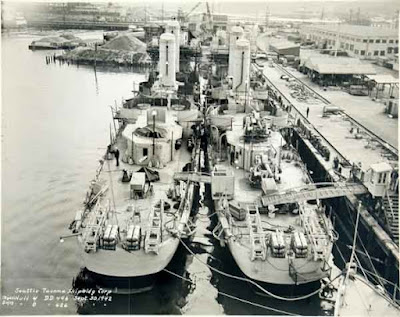
 

Destroyers Under Construction At Tacoma Yard


Standardized Design – The reason why we could have eleven shipyards all build Fletchers was because we had a standardized design.  With that, it was just a matter of distributing construction drawings to the yards.  Today, we keep changing the basic designs, non-stop, in an effort to insert a constant stream of new technology.  There’s nothing wrong with periodically inserting new technology but not on a continuous basis.  Save up changes and then occasionally do a technology insert.  Honestly, I doubt there’s even a reason to do a technology insert.  A much better approach is to occasionally design a new ship that can incorporate the backlog of new technologies.


Short Production Run – The reason we didn’t need radical new technology inserts during the Fletcher production run is that the run was short.  The entire production run lasted only two years!  You just can’t get too out of date in just two years.  Contrast that with the Burke production run which began in 1988, has lasted 34 years, and shows no sign of stopping!  The Navy trumpets that fact proudly when, in reality, it’s an embarrassment and indictment of our entire naval design and production system.


At the end of the Fletcher production run, we began the Sumner/Gearing programs which incorporated the lessons of the war.  The Fletcher’s short production run gave us the flexibility to design new destroyers that better met our needs.  Contrast that with the latest Burkes.  Because we’re unwilling to terminate the obsolete Burke design, we’re being forced to settle for sub-optimal radar outfits and performance in the new Flt III Burkes.  The WWII ship designers dealt with sub-optimal situations by designing a new class of ship.  Today, we accept and embrace sub-optimal because we’re too frightened (and incompetent!) to start a new class with a new design.  Even the concept art that has been floated showing the next generation destroyer shows what is, essentially, a Burke with a few tweaks.


Cost – We are far too focused on construction costs, today, and with good reason.  Our construction costs have ballooned because we’ve ignored all the lessons of wise and proper ship design.  This has led to runaway costs which then become the primary driver of ship design.  We should be designing to combat-requirements but, instead, we’re designing to business cases, cost constraints, and fear-induced conservatism.


WWII Chief of Naval Operations, Adm. Harold Start, had this to say about the Fletcher ship costs,


He did not think individual ship costs were critical: ‘the best possible vessel should be designed without consideration of this relationship.’ [1, p.80]


Combat Performance – The Fletcher achieved armor, speed, firepower, and range all in a single design.  Today, we seem to believe that none of those are achievable individually, let alone as a group in a single design.  At best, we treat those criteria as a ‘pick one’ type of design limitation.  We’ve forgotten what we once routinely accomplished in ship design.  If we wanted, we could design a destroyer with 10,000 nm range, 35+ kt speed, multiple inches of armor, and more firepower than anything we have today and all in a Fletcher size ship.  We’ve just forgotten how.


Summary


The General Board of WWII knew exactly what they were doing when it came to warship design.  They didn’t hide this knowledge; it’s readily available for our enlightenment if only we’ll accept it and avail ourselves of it .. but, we steadfastly refuse.


Arguably, the most important of the various lessons is that of short production runs.  From that flows all manner of good program characteristics.  A two year production run does not allow for any significant obsolescence and, therefore, does not require that we build in a single iota of ‘future proofing’ or modular updating which are all the rage today.  Short production runs encourage (nay, demand!) continuous new classes of ships that can then incorporate technological upgrades – there’s your future-proofing!  With no need to overbuild for future considerations, costs and size are kept to a minimum.


We need to return to the wisdom of the General Board, acknowledge the lessons they offer, and put them into practice.  A 40 some year run of Burkes is an abomination and an acknowledgement that we don’t know our ship designs from a hole in the ground and that we have no clue how to run a successful ship program.


_________________________________________


[1]Reilly, Jr., John C., United States Navy Destroyers of World War II, Blandford Press, Dorset, UK, 1983, ISBN 0 7137 1026 8


Tuesday, February 21, 2017

Right All Along

The Navy has finally and officially acknowledged that ComNavOps was right all along.  Of course, ComNavOps is right about everything, so what, specifically, is the Navy acknowledging that ComNavOps was right about?  - The need for in-house naval engineering to design and oversee ship acquisition programs.

ComNavOps has long preached that the Navy abdicated its responsibilities by abolishing BuShips and turning over design and construction responsibility to the manufacturers.  This began with the Spruance class, which actually turned out quite well, and has culminated the LCS, LPD-17, Ford, and Zumwalt fiascos.

Now, the Navy has recognized that the lack of in-house engineering expertise is at the root of these acquisition disasters (1).  How bad had the engineering loss gotten?

“Vice Adm. Tom Moore, commander of Naval Sea Systems Command, said NAVSEA’s engineering directorate (SEA 05) had dropped to a fifth of its size from 1990 to 2005.”

“…in SEA 05, where there had been 1,292 engineers in 1990 and only 251 in 2005 …”

The Navy is now looking to hire engineers with a goal of 750 by 2025.  Of course, that’s still only around half of what they had in 1990 and none of those new hires will have naval warship design and construction experience so there won’t be any quick turnaround in design and construction expertise.  Still, it’s a step in the right direction.

Unfortunately, the Navy is only looking to go half way to solving the problem.  The full solution requires reconstituting BuShips and the General Board.  The Navy, however, is only going to add engineers without the BuShips organization that made the warship design process so effective and without the General Board that made warship conceptual designs so linked to operational needs.

Why did the Navy go down the ill fated path that they did?

““In one of our many eras of acquisition reform – and at that time, the vogue in acquisition reform back in the mid-90s was, hey, industry knows best, just throw it over the fence to them and let them build the ships and we’ll be fine …”

I know, it sounds idiotic, doesn’t it?  Unfortunately, the concept went even further off the rails when the Navy not only threw the responsibility over the fence to the manufacturer but they threw it to companies that had never built a warship before.  Neither Lockheed Martin nor Austal had built a warship before they started building the LCS.  What did the Navy think was going to happen?

I’ve never built a nuclear reactor before.  What do you think will happen if you hire me to build one?

You know, there’s some failings that are obvious in hindsight but may not have been obvious at the time and then there’s ideas that are so blindingly stupid that hindsight is not required:  non-warship companies building warships, minimal manning, deferred maintenance, and so on.  It was obvious from the start that abdicating design responsibility would not turn out well. 

While it’s good that the Navy is finally recognizing the error of their ways, that error has cost the Navy an entire generation of flawed ships.  The LCS will never be useful.  The LPD-17 was a quality control disaster whose effects are still being felt (and we’re using it as the basis for future ship classes!!!!).  The Ford is an unaffordable budget disaster that is sounding the death knell of carriers.  The Zumwalt is the poster child for “I don’t really know what I want” and cost the Navy an entire generation of cruisers.

Make no mistake.  This decades long disaster lies squarely with Navy flag leadership.  The extent of their incompetence is/was staggering and will continue to be felt for decades to come.


____________________________

(1)USNI website, “Navy to Impose More Rigorous Oversight in New Ship Classes; Will Hire More Engineers”, Megan Eckstein, February 20, 2017,


Wednesday, March 20, 2013

General Board and BuShips

Once upon a time (hey, that’s how any good fairy tale starts), the Navy designed ships in-house.  They debated needs and requirements, collected opinions from the fleet, settled on specifications, and drew up designs.  The designs were then offered to industry to bid on the actual construction.  Along the way, the Navy’s in-house experts monitored the progress of construction, compared the product to the specifications, and eventually passed judgment on whether the product quality was acceptable.  Because of the in-house knowledge and expertise, the Navy knew exactly how the ship should be built, what materials were appropriate, and how the ship would perform.  There were two groups largely responsible for this approach to ship procurement:  the General Board and BuShips.

The General Board of the Navy was established as an advisory group in 1900 and disbanded in 1951 by order of then CNO Forrest Sherman.  The board consisted of senior admirals and others, often near the end of their careers or retired who had a wealth of experience, relatively little politicking left to do, and sufficient time to consider issues facing the Navy.  While they were tasked with contemplation of any issue brought before them, their greatest value lay in the guidance and direction they provided for the Navy’s shipbuilding programs.  Anyone who has read any of Norman Friedman’s series on the design history of the various classes of ships will be well familiar with the role the General Board played in evaluating the various ship design proposals and then establishing the final requirements.  It is worthwhile to note that the General Board was abolished by the office of the CNO which viewed the Board as a threat to the CNO’s power.

The General Board - The Navy's Best Hope?


The Navy’s Bureau of Ships (BuShips) was established by Congress in 1940 and consolidated the Bureau of Construction and Repair and the Bureau of Engineering.  The Bureau was responsible for the design, construction, procurement, maintenance, and repair of ships as well as establishing relevant specifications for materials, fuel, etc.  BuShips was eliminated by order of the Dept. of Defense in 1966 as part of a general reorganization of the Navy and was replaced by what is now known as the Naval Sea Systems Command (NAVSEA). 

Beginning somewhere around the time of the Spruance class procurement, the Navy decided to farm out its design responsibilities to industry.  The Spruance was the result of a general set of wishes provided to industry with industry allowed to design the ship.  On the plus side, the Navy hoped that this would lead to more unconventional designs and cost savings.  On the minus side, there was no guarantee that any of the industry designs would turn out to be acceptable.  As it happened with the Spruance, a fairly good design did result.  Also on the minus side was the loss of ship design expertise and familiarity with the specifics of the design.  Thus, the Navy no longer had in-house experts who could evaluate a design and recognize good from bad.  Further, the Navy had no person or group intimately familiar with the details of a given ship class’ design.  The Navy would have to depend on industry to understand the details – the Navy knowingly and willingly abandoned the concept of attention-to-detail.  This trend of farming out design responsibilities to industry has continued to this day and has given us the LCS, LPD, DDG-1000, and other notable failures.

Here’s a simple and minor example of what happens when no one inside the Navy is responsible for, and knowledgeable about, ship design.  The Navy just recently announced that it would retrofit bridge wings to the LCS-2’s that have already been built or are under construction.  Apparently, bridge wings are necessary for vision when maneuvering the ships in tight spaces.  Of course, every sailor since Columbus has known this and yet the Navy failed to include bridge wings in the LCS-2 design.

Not to pick on the LCS, but consider the corrosion problems due to galvanic corrosion, a phenomenon that has been well understood for centuries.  The lack of in-house naval engineers with responsibility for the design led to a fundamental oversight that shouldn’t have happened.

I could go on with example after example but you get the point.

The lack of in-house technical and engineering expertise is bad enough but there is another, equally serious, problem resulting from the absence of a dedicated design group.  The people who are nominally in charge of developing requirements and overseeing the ship designs don’t stick around long enough to see their work through and take responsibility for it.  Instead, they serve their short term assignment and move on.  The people supposedly responsible for the LCS are long gone.  There is no continuity or accountability and attention to detail suffers.  Wouldn’t we all like to ask the originators of the LCS design what they were thinking?  Compare that model of ship design to the BuShips approach.  With BuShips, the designers worked in the Bureau for years and were readily accountable for their designs.  Further, for naval engineers BuShips represented the pinnacle of their careers rather than a short term stop on the way to other career paths.

I mentioned NAVSEA which replaced BuShips.  Shouldn’t they be performing the same responsibilities?  Sadly, no.  NAVSEA does not design ships.  In fact, as I understand their function, they don’t even get involved with a ship design until it’s already built.  NAVSEA verifies that the newly constructed ships meet the contract specifications but by then it’s too late to improve the design.  Worse, NAVSEA doesn’t even do this properly.  The first few LPDs were accepted by NAVSEA despite the fact that the ships weren’t even remotely close to being completed – they required thousands of post-acceptance man-hours just to physically complete the construction.  Similarly, the LCSs have been accepted with entire compartments incomplete.  NAVSEA’s acceptance evaluations have become a joke and a political and public relations tool of a politicized Navy leadership.

The Navy urgently needs to reconstitute both the General Board and BuShips if it is to have any hope of living happily ever after.