Showing posts with label Pacific Pivot. Show all posts

Saturday, August 30, 2025

7th Fleet and Deterrence

Despite having thoroughly discredited the notion of deterrence (see, “Forward Presence Deterrent EffectDisproved”), there is a faction of naval observers who continue to insist that deterrence is real and works despite the overwhelming evidence of China, Russia, Iran, and NKorea’s expansionism, terrorism, and general disregard for international laws, treaties, and norms which more than disproves the validity of deterrence.  In fact, many of these people believe that the only thing wrong with the Navy’s approach to deterrence – if there is anything wrong – is that we aren’t devoting enough ships to it.  If only we’d use even more ships our deterrence would be even more effective, they say.
 
Well, it’s time to take an analytical approach to the Navy and deterrence as regards our main enemy, China.  Is deterrence working?  What assets are we devoting to deterrence?  Do we need more? 
 
Is deterrence working?  -  Well, this one is easy to answer.  China has, for all practical purposes, annexed the entire South and East China Seas despite them being mainly international waters.  They’ve built illegal artificial islands and militarized them.  They’re continually encroaching on the territorial waters and air space of Taiwan, the Philippines, Vietnam, and other countries in the region.  They’ve made public claims about ownership of Japanese territories and most or all of the second island chain.  There are even reports stating that China has made claims on a third island chain which includes Hawaii and most of the Pacific.[2]
 
In addition to territorial expansion, China has also engaged in the seizure of US military assets and ignores the UNCLOS treaty to which it is a signatory (demonstrating that China’s word is worthless).
 
 
What assets are we devoting to deterrence?  -   The US Navy’s entire 7th Fleet is devoted to deterring China.  As a reminder, 
 
It is headquartered at U.S. Fleet Activities Yokosuka, in Yokosuka, Kanagawa Prefecture, Japan. It is part of the United States Pacific Fleet. At present, it is the largest of the forward-deployed U.S. fleets, with 50 to 70 ships, 150 aircraft and 27,000 sailors and marines.[1]

Seventh Fleet includes a permanently forward deployed aircraft carrier, currently the USS George Washington, CVN-73.  Yokosuka, alone, typically includes a command ship, an aircraft carrier, Ticonderoga class cruisers, and a dozen or so Burke class destroyers.
 
In addition to the 7th Fleet, numerous other carriers, ARG/MEUs, and aircraft regularly rotate into the 7th Fleet’s control.
 
We are devoting an enormous number of ships, aircraft, and personnel to deterring China.
 
 
Do we need more?  - 
 
The facts are crystal clear.  If the 50 to 70 ships, 150 aircraft and 27,000 sailors and marines aren’t deterring China, no additional forces will suddenly, magically alter the situation.  Think about it, though, that’s a lot of ships, aircraft, and personnel.  Why isn’t China deterred?  Why aren’t they behaving very cautiously, in not cowering?  The answer is simple and painfully obvious:  China does not believe we’ll use our forces.  If your enemy does not believe you have the will to act, no amount of forces in the region will alter their thinking.  We could pack the entire US Navy into the South China Sea and it wouldn’t deter China for one second.  They believe, correctly, that we won’t use our force so any gathering of naval forces is a hollow, empty gesture.
 
The only force we’ve ever used in peacetime is against third rate countries and China does not see themselves as a third rate country.  In fact, history proves their view of things is correct.  China has seized US military aircraft and drones while they were in use, disrupted naval operations, successfully threatened and chased away US ships in international waters, established and militarized illegal islands while the US Navy stood back and watched, enforced illegal territorial water claims, violated the air space of Taiwan, etc.  All the while, the US Navy did nothing.  Ironically, the only substantive action the US Navy has taken, Freedom of Navigation exercises according to the conditions of UNCLOS Innocent Passage, has only reinforced the validity of China’s illegal territorial water claims!
 
No will to act means no deterrence and no amount of additional forces will change that.


______________________________
 
[1]Wikipedia, “United States Seventh Fleet”, retrieved 18-Aug-2025,
https://en.wikipedia.org/wiki/United_States_Seventh_Fleet
 
[2]The National Interest website, “China’s Next Territorial Claim: Hawaii and Almost the Entire Pacific Ocean?”, Harry J. Kazianis, 10-Sep-2016,
https://nationalinterest.org/blog/buzz/chinas-next-territorial-claim-hawaii-almost-the-entire-17658

Tuesday, August 29, 2023

A Pacific [Baby] Step in the Right Direction

In 2011, then President Obama announced the Pacific Pivot to address the growing Chinese threat.  This led to … well … almost nothing.  Instead, the US watched as the Chinese continued to expand their holdings and influence, annexing the entire East and South China Seas, and making inroads on various Pacific countries and island nations. 
 
Notably, China established military agreements with Solomons Islands and others.  This was not particularly surprising as the US had made very little effort to confront China diplomatically.  The Solomons agreement seemed to finally awaken the US and spur at least some effort, minimal as it’s been.
 
Now, however, there are some small but potentially positive developments for, and by, the US. 
The United States signed a new agreement with Palau that gives American ships the authorization to unilaterally enforce maritime regulations in the tiny Pacific island nation's exclusive economic zone, the U.S. Coast Guard said Tuesday.[1] 
It is unclear whether this is an extension of the previous Compact of Free Association or whether it is an entirely new agreement. 
In the agreement, concluded a week ago, U.S. Coast Guard ships can enforce regulations inside Palau's exclusive economic zone on behalf of the nation without a Palauan officer present … [1] 
This would appear to give the US the right (and responsibility?) to confront China when it violates Palau territorial waters and economic zones.
 
In other developments, 
The U.S. has countered with diplomatic moves of its own, including opening an embassy in the Solomon Islands.
 
The agreement with Palau is similar to one concluded with the Federated States of Micronesia at the end of 2022, following which the U.S. Coast Guard has conducted boardings for the Pacific nation.
 
The U.S. also signed a bilateral defense agreement in May with Papua New Guinea, which will allow the U.S. Coast Guard to conduct boardings alongside its local counterparts in Papua New Guinea's exclusive economic zone for the first time later this year.[1] 
These recent agreements could be good, however, it depends on whether we’re willing to actually take action.  Will we forcibly remove Chinese ships that are violating protected waters or will we just stand by and do nothing as we’re doing in the Middle East where we just stand by and watch the Iranians attack and seize merchant ships?  Will this be another red line in the sand which, when crossed, we do nothing about?  Agreements mean nothing without force and action backing them up.  This is an opportunity for us to begin standing up to China with concrete, meaningful actions (unlike the worse-than-useless Freedom of Navigation exercises).
 
This is potentially a good step but I’m highly dubious that we’ll use the ability effectively.  This is most likely a tool that will remain in the toolbox, unused, as so many of our tools do.


___________________________
 
[1]Newsmax website, “US Given OK to Enforce Maritime Law Around Palau”, Copyright 2023 The Associated Press, 29-Aug-2023,
https://www.newsmax.com/world/globaltalk/u-s-pacific-palau/2023/08/29/id/1132492/

Tuesday, August 30, 2022

Solomon Islands Issues Moratorium on US Naval Vessels

The recent denial of a scheduled port call by a US Coast Guard vessel (see, "US Denied Solomons Port Call") has now expanded to a blanket moratorium on visits and port calls by US naval vessels.


The US government was notified by the Solomons on Monday of a “moratorium on all naval visits, pending updates in protocol procedures,” … [1]


China signs a security pact with Solomons and suddenly the US is banned from port calls in the Solomons.  It doesn’t take a genius to see the connection. 


Chinese vessels, of course, are permitted by the recently signed security pact between Solomon Islands and China.


China has masterfully achieved a takeover of the Solomons and now calls the shots there.  The Solomon Islands are now a vassal state of China.  China will begin militarizing the islands in short order, no doubt.


China is conquering the Pacific without firing a shot while the US watches.  If the US doesn't start engaging diplomatically, the Marines are going to have to set up their small missile-shooting units along the coast of California!


[1]https://www.bloomberg.com/news/articles/2022-08-30/us-disappointed-after-solomons-ignores-coast-guard-request

Friday, August 26, 2022

US Denied Solomons Port Call

We recently noted that the Chinese have secured the Solomon Islands as part of their expansion into the Pacific (see, “Chinese Seizure of Solomons Islands”).  Newsmax website reports that a US Coast Guard vessel was denied access to a scheduled port call at Guadalcanal in the Solomons for refueling and reprovisioning.


A U.S. coast guard cutter conducting patrols as part of an international mission to prevent illegal fishing was recently unable to get clearance for a scheduled port call in the Solomon Islands … [1]


Who do you think made that decision:  Solomons or China?  This was China’s way of demonstrating to the US who controls that area of the Pacific … and it’s not the US.


The Coast Guard vessel was forced to divert to Port Moresby, Papua New Guinea.


Apparently, the Chinese are also excluding the Royal Navy.


… reports that the HMS Spey, also taking part in Operation Island Chief, was also denied a port call in the Solomon Islands.[1]


Solomons appears well on its way to becoming a Chinese vassal state and a forward base for Chinese military operations.


China seized the entire South and East China Seas without firing a shot and appears well on its way to seizing the Pacific.  In addition to having seized the Solomons, in 2019 China re-established an embassy in Kiribati (Tarawa) which severed long-standing ties with Taiwan in favor of China.  Kiribati is the site of a Chinese satellite tracking station which, presumably, has been re-activated.  China is pushing hard to make inroads in Papua New Guinea, offering security, trade arrangements, and military training and aid.  Chinese medical teams have been dispersed throughout the Pacific and China is pursuing trade arrangements with almost every Pacific island nation.  Guam is being slowly isolated and surrounded as we speak.


_________________________________


[1]Newsmax website, “Report: US Coast Guard Ship Denied Port Call in Solomons”, 26-Aug-2022,

https://www.newsmax.com/newsfront/u-s-coast-guard-solomon/2022/08/26/id/1084721/


Monday, August 15, 2022

Forward Bases in the Pacific

One of the common refrains from military observers is that we should be establishing forward bases in the Pacific as a way of dealing with China.  There are, however, a few problems with forward bases that must be addressed and overcome in order for them to be viable options.


We’re going to take a two-part look at the issue of forward bases beginning with a general examination of the concept in this, the first part, and followed by a specific example in the second part.


Definition


One of the problems in a discussion of forward bases is that no two people can agree on what constitutes a forward base.  What is the definition of a forward base?  Just as with phrases like ‘sea control’ or ‘littoral’, everyone has their own idea of what a forward base is.  A base one mile ahead of a main base is technically a forward base but that’s obviously not what we’re talking about.  For our discussion purposes, a forward base is defined as a permanent facility of moderate or large size located in enemy controlled – or at least highly contested – waters that serves the purpose of providing support and staging for further operations. 


It is the location in enemy controlled/contested waters that makes it ‘forward’. 


The permanence of the base is what separates a forward base from, say, the Marine’s fantasy of secret platoon size units that temporarily occupy a location and then move on to sow destruction and confusion among the enemy.


Challenges


As noted, forward bases face a variety of challenges that must be overcome to make them viable.


History - The first obstacle to overcome is history.  History strongly suggests that forward bases almost invariably wind up being lost to the enemy.  The one glaring exception in history is the string of forward bases established by the US during the WWII Pacific campaign as the US island hopped its way to Japan.  It is noteworthy, however, that the pre-WWII forward bases established by the US as a means of deterrence and forward defense were all lost to Japan during the early months of the war.


Now, consider the history of Japan’s forward bases in the Pacific.  At their peak, Japan had an extensive network of powerful bases throughout the Pacific.  It didn’t matter how strong the individual bases were, they all fell.  Consider the example of Truk, the Japanese Gibraltar of the Pacific.  It was considered nearly impregnable and unapproachable.


At the height of the atoll’s life as a Japanese base area, as many as 1,000 ships were on occasion to be found in the lagoon.[1]


The Japanese garrison peaked at 27,856 naval personnel …and 16,737 army personnel … [1]


Other defensive efforts included:


  • coast-defense artillery
  • remote controlled mines
  • 40 anti-aircraft guns


Base facilities included,


… roads, trenches, bunkers and caves. The whole defensive complex included five airfields, seaplane bases, a torpedo boat station, submarine repair facilities, a communications centre and a radar station.[1]


Despite this collection of base force and firepower, Truk was easily attacked, destroyed, and then bypassed by US forces.


Isolation – The pre-war US forward bases and Japan’s forward bases all fell because they were isolated and, generally, separated from each other by great distances.  The bases were unable to mutually support each other and were subject to local massing of numerically superior enemy forces with greater firepower at a time of the enemy’s choosing.


In fact, one could logically argue that Japan’s scattered, forward bases were actually detriments to Japan’s overall military objectives because each base represented a ‘penny packet’ of force that had no hope of accomplishing anything, was doomed to defeat in detail, and drained forces from the overall military effort and geopolitical objectives.


The lesson is that if you can’t successfully defend a base (and history suggests that’s a very difficult thing to do) then you’re just throwing away resources.


Sea Control – As noted, isolation is a major challenge and the only way to overcome it is to maintain control of the connecting seas.  Reinforcement and resupply can only occur by sea.  When control of the sea is lost, so too, is the forward base.  During the pre-war and early months of war, Japan was able to exercise control of the sea and its forward bases were viable.  Once control of the sea was lost, Japan’s bases were doomed even if it took the US a few years to systematically destroy them.


Similarly, when the US lost control of the seas, its forward bases (Wake, Philippines, etc.) were doomed.  Once the US re-established control of the seas in the later years of the war, it was able to establish a string of forward bases that were viable.


Location and Purpose - It is vitally important to understand what a forward base really is.  To begin with, it’s not forward!  It may begin life at the forward edge of battle but by the time it becomes operational and useful, the forward edge of battle has moved on and the base is rendered a rear area support and staging facility.


As the American example of WWII demonstrated, forward bases work only when they are part of a coordinated, overall effort and then only when they are not actually at the forward edge of battle.  For example, each island base the US seized began as the forward edge of battle but became an operational base only when we moved on, rendering the base a rear area support facility.  Indeed, that is what a ‘forward’ base is:  a rear area support facility from which to stage and launch future actions.


Forward bases that are actually forward – meaning at the leading edge of battle or actually in enemy territory – are generally either ineffective (Guadalcanal while the island was being contested) or lost.


Conclusion


The fantasy of a forward base, existing and operating inside an enemy’s sphere of influence and control, is just that … a fantasy.  The reality is that an operationally useful forward base is, in reality, and by necessity, a rear area support and staging facility.  We need to recognize and accept that.  Every dollar and every hour spent attempting to implement forward base fantasies is another dollar and hour lost to efforts that are actually productive and effective.


We also have got to come to grips with the imperative to establish and maintain control of the sea   Without control of the sea, Guam (or any other base) is just a useless, doomed facility waiting to die.  Unfortunately, we are currently in the process of knowingly and willingly ceding control of the seas to China.  The relative naval and air production rates of the US and China guarantee eventual Chinese control of the sea.


___________________________________


[1]https://cmchant.com/japans-pacific-base-truk-atoll/


Monday, July 18, 2022

Chinese Seizure of Solomon Islands

The Chinese just completed a security agreement with Solomon Islands which gives China’s military access to the islands.  What, specifically, does the agreement allow?  No official copy of the agreement has been released but a leaked ?draft? copy reveals,


A draft of the deal leaked online said it would allow China to send armed forces to the Solomon Islands to protect Chinese investments. Chinese warships would also be permitted dock on the islands.[1]


Prime Minister Mannesseh Sogavare told his parliament in Honiara a day later that [the security agreement] will allow China to send police and military personnel to the Solomon Islands “to assist in maintaining social order”. Chinese warships also could stop in port there for “logistical replenishment.”[2]


According to the draft text, the agreement would allow China to “make ship visits to, carry out logistical replenishment in, and have stopover and transition in Solomon Islands”, leading to fears that China could secure a naval base less than 2,000km from Australia’s east coast.[3]


“The agreement states that China may, according to its own needs and with the consent of the Solomon Islands government make ship visits to the Solomons and carry out logistical replenishment and stopover and transition in the Solomons.”[4]


The above is bad.  It gives China the opening it needs to begin establishing a permanent naval base.  However, far worse is the following passage from the document:


… the relevant forces of China can be used to protect the safety of Chinese personnel and major projects in Solomon Islands.[5]


This passage gives China carte blanche to establish a permanent military presence in the Solomons in the name of ‘protecting the safety of Chinese personnel and major projects’.  How flimsy of an excuse would the Chinese need to justify bringing in military forces?  The thinnest of excuses would suffice.  Given the blatant lies the Chinese routinely engage in, they won’t hesitate to concoct some ‘safety’ issue when the time comes to establish their base.


Does anyone recall the Chinese assurances that the illegal artificial islands in the South China Sea would not be militarized?  Of course, they were militarized in short order.  China’s word means nothing and China has a habit of militarizing everything it touches.  There is absolutely no doubt that China will construct a naval base in the Solomons under the guise of ‘logistical replenishment’ facility improvements.


There is also a confidentiality clause in the agreement which prohibits either party from publicizing any of the terms or actions related to the agreement without the other’s consent.[5]  This provides further cover for the Chinese to act clandestinely.


So, what has been America’s response?


A high-level American delegation will go to the Solomon Islands next week.  The United States said it will re-open its embassy in Honiara, which has been closed since 1993.[1]


Talk about closing the barn door after the horse has got out! 


The US has talked about a Pacific Pivot but has utterly failed to do anything.  We haven’t substantially increased our military presence.  We haven’t made any significant attempt to conduct a political campaign in the region.  We’ve exerted no economic influence.  And so on.  Clearly, we’ve ignored relations with the various Pacific countries. 


Sending a delegation to the Solomons after the fact is simultaneously useless, embarrassing, and humiliating.


At this point, one might ask whether a Chinese base (and there will be one) in the Solomon’s is a serious concern for the US.  After all, the Solomons are around 3970 miles from the Chinese mainland coast, depending on exactly where one measures from.  Isn’t that an awfully distant and isolated base for China?  Is it really a threat?


A Chinese base in the Solomons gives them their Pearl Harbor … their far forward base to support deep Pacific air and naval forces in both times of war and times of war.  Huh?  Did I just repeat myself?  Don’t I mean times of war and times of peace?  No, I don’t because, for China, there is no difference between war and peace.  For China, peace is just the non-shooting portion of the war.  They are already at war with us and they’re winning.  We’re steadily retreating and appeasing.  They’re achieving all their objectives and we’re failing ours, to the extent that we even have any objectives. 


In the mind of the Chinese, peace and war are the same thing.  There’s no difference other than methods and means.  China is at war and we’re just sitting back in a Chamberlain appeasement mode.  A base in the Solomons gives the Chinese a resupply and support facility to further their expansion efforts.


Just for fun, let’s check the distance from Pearl Harbor to San Francisco … it’s 2400 miles.  That’s awfully isolated and far from the US mainland and resupply.  So, if the isolation/distance argument is valid for China in the Solomons, it’s also valid for the US and Pearl Harbor.  Of course, Guam is even more isolated and far from the US and resupply at 5800 miles.  On a related note, the distance from Pearl Harbor to Guam is 3800 miles.  So, as China acquires bases in the Pacific, who’s more isolated and distant? 


Consider these distances: 

  • Distance from Chinese coast to Solomon Islands = 3970 miles 

  • Distance from San Francisco to Solomon Islands = 5960 miles
  • Distance from Pearl Harbor to Solomon Islands = 3560 miles
  • Distance from Guam to Solomon Islands = 1914 miles
  • Distance from Darwin to Solomon Islands = 2000 miles


It is the US that has far flung and isolated bases.  With a couple more security agreements with other Pacific island nations, it will be the US in the position of being isolated and unsupported in the Pacific.


Aside from Japan, the only other Pacific military of any note is Australia and they are an extremely small force.  For example, the entire combat fleet of the Australian navy[6] consists of :


  • 8x Anzac frigates
  • 3x Hobart destroyers
  • 6x Collins submarines


That’s not a significant naval force. 


The US currently has a significant advantage in terms of global geopolitics, finances, economics, presence, and military force.  However, we are doing very little to maintain those advantages and almost nothing to enhance them.  Meanwhile, China is expanding their influence in all those areas at a breathtaking pace.  They are expanding and winning;  the US is shrinking and losing.


A Chinese Pearl Harbor in the Solomons is just the next step in China’s plan to conquer the Pacific.


We need to recognize that we are at war with China and start fighting back.


_________________________________


[1]VOA News website, “Solomon Islands Sign Security Pact With China”, Phil Mercer, 20-Apr-2022,

https://www.voanews.com/a/solomon-islands-sign-security-pact-with-china-/6537279.html


[2]https://www.channelnewsasia.com/world/solomon-islands-china-pact-has-us-riled-2642971


[3]The Guardian website, “China requested heavily armed security team be sent to Solomon Islands, leaked documents reveal”, Kate Lyons, 12-Apr-2022,

https://www.theguardian.com/world/2022/apr/12/china-requested-heavily-armed-security-team-be-sent-to-solomon-islands-leaked-documents-reveal


[4]https://asiapacificreport.nz/2022/03/25/leaked-draft-china-solomon-islands-security-pact-causes-pacific-stir/


[5]https://www.michaelsmithnews.com/2022/03/text-of-whats-reportedly-a-securitymilitary-cooperation-agreement-between-china-and-solomon-islands/comments/


[6]https://www.navy.gov.au/fleet/ships-boats-craft/current-ships


Wednesday, June 8, 2022

RIMPAC 2022

The 2022 iteration of RIMPAC (Rim of the Pacific), the international Pacific naval exercise, will get underway soon.  This is the 28th iteration and this year’s exercise will consist of


… 26 nations, 38 surface ships, four submarines, nine national land forces, more than 170 aircraft and approximately 25,000 personnel … [1]


The 26 nations and 38 ships is an average of 1.5 ships per nation.  Is that really an effective and worthwhile exercise when each nation commits a mere one or two ships to the exercise?


I don’t know, yet, how many US ships will be involved.  The absolute US maximum if each nation contributed just one ship is 12 ships, so it’s much less than that but it won’t be many.  Among the US ships will be the unmanned trimarans USV Sea Hunter and USV Seahawk along with two Ghost Fleet support vessels Nomad and Ranger so there’s at least four US ships that are not fleet combat vessels.


How does it prepare our 290 ship fleet for combat when half a dozen or so ships are all that participate?


Our job, as a Navy, is not to make other, smaller countries feel good about themselves.  Our job is to prepare for high end, all out war.  RIMPAC does not do that for us.


Who is planning, hosting, and subsidizing the lion’s share of this exercise?  That’s right … the US.  We’re paying for this exercise.  That’s money we don’t have being spent on an activity that does almost nothing to enhance our combat capability.


Fight like you train … train like you fight.


We’re not going to fight with a couple of ships and a flotilla of other country’s small fry vessels so why are we training that way?


RIMPAC planning has been on-going for the last two years.  If we’re going to take the time and spend the money to dedicate staffs for two years to prepare for a major exercise [does it really require two years to plan an exercise?  we planned full blown amphibious assaults in WWII in a matter of months], shouldn’t it be one that reflects exactly how we’ll fight in a real war and shouldn’t it involve every US ship in the Pacific?


I have no problem with the occasional port visit to a foreign navy or the occasional officer exchange.  It doesn’t do anything for us but it doesn’t cost us much, either.  However, when the biggest exercise in the Pacific accomplishes almost nothing for us, I do have a problem.


Stunningly, Taiwan, arguably the focus of the Pacific pivot and China’s main objective in any war, has not been invited to participate.  Let me see if I understand this    we want to train for war with China (as predicted by the US Navy to be imminent) and Taiwan will be the focus of that war but we don’t include Taiwan in the training?  What single digit IQ moron thought that was a good idea?


Let’s face it, RIMPAC is just a giant photo op with very little relevant combat enhancement for the Navy.  At a time when we’re early retiring ships left and right due to budget concerns and we’re cutting 10,000 sailors from the force while we’re gapped several thousand at-sea billets, is this really the best use of our limited training time and budget?


When are we going to get serious about preparing for war?


_________________________________


[1] https://breakingdefense.com/2022/06/us-prepares-for-rimpac-exercise-against-backdrop-of-russian-chinese-tensions/


Wednesday, May 18, 2022

Scrap Two Carriers – Part IV - New Airfields in the Pacific

Continuing his series, guest author Carlton Meyer returns to discuss Pacific basing and war operations for land based naval air wings.  Enjoy !


________________________________


In previous blog posts, I suggested that operating eleven supercarriers has become so expensive that it left our Navy imbalanced, with too few aircraft and surface combatants. This could be corrected by downsizing to nine carriers (see, “Scrap Two Carriers! – Part 1”), which will probably occur anyway because of the flawed USS Ford program. I suggested this loss could be offset by establishing two shore-based overseas Carrier Air Wings (see, “Naval Air Wings, Scrap Two Carriers – Part 2”). These could be called Naval Air Wings (NAW) and absorb Marine Corps aviation assets to support Navy sea control missions from existing American airbases. There are several basing options for a NAW in the Mediterranean as explained in a past blog post (see, “A Naval Air Wing in the Med, Scrap Two Carriers – Part 3”). However, there is only one main useful airbase in the Central and South Pacific – Anderson Air Force Base on Guam.[3]


It will take at least four months for the US Navy to form a huge naval task force in the Pacific to confront China. Meanwhile, American airbases within range of Chinese fighters and short-range missiles will be destroyed within the first couple days. China’s primary concern is keeping sea lanes open for its commercial ships to Africa and the Middle East. The obvious strategy is to quickly dispatch a huge naval task force to seize Guam, which then turns south to clear threats in northern Australia, perhaps causing that nation to seek peace. This may seem ambitious, but the Japanese successfully conducted a similar campaign in 1942 that led to a disastrous Allied defeat known as the Battle of the Java Sea.[1]


The mission of a Pacific NAW is to combat a Chinese fleet. The US Navy can instantly create a Pacific NAW by redesignating Carrier Air Wing 5 at MCAS Iwakuni, Japan that could absorb the two Marine Corps Fighter-Attack squadrons at that same base. However, Iwakuni is in the northern Pacific among substantial Japanese and US Air Force bases and airpower. Okinawa, Japan has two American airbases but those will be destroyed by Chinese airpower the first day of a war. Anderson airbase on Guam is an ideal location where some Navy aircraft are already based, but the US Air Force has plans to surge squadrons to that base during wartime. Australia is a close ally and has offered use of some airfields. The Philippines allows access to several of its airfields, but most are too close to China and that nation may declare neutrality in a war. Here is a proposed laydown for a Pacific NAW.


NAF Atsugi – Leave the Navy HSM squadron here to support the four destroyers and help guard Tokyo Bay/Yokosuka from submarine incursions. The Navy already has an HCS squadron on Guam with 14 MH-60S that becomes part of the NAW, so the HSC at Atsugi is disbanded. During a war, these helicopters will disperse to other bases to conduct vital search and rescue of downed pilots.


NAF Anderson Air Force Base – The HCS squadron is already based here. This is the ideal location for the NAW headquarters. The Air Force has no airborne radar or dedicated electronic warfare aircraft on Guam, so should not object to hosting the VAW and VAQ squadrons that only add nine aircraft to the base. The Air Force should be supportive after space at MCAS Iwakuni is offered to Air Force squadrons.


MCAS Kaneohe Bay - Most of the Pacific NAW should move from Iwakuni to Hawaii to keep aircraft and families far from the danger of Chinese air and missile attack. These relocations will be expensive, but remember that billions of dollars will be saved by scrapping two aircraft carriers. The two Marine and two Navy fighter-attack squadrons can be based here, where a VMM squadron and VMGR (KC-130 squadron) already exist to support the NAW. The Marines will need to move the other VMM squadron stateside to make room. If more space is needed, perhaps squadrons can operate from new facilities at Hickam airbase or the Coast Guard airfield at Barber’s Point. 


Billions more dollars can be used to establish several austere Naval Air Facilities (NAF) in the Pacific to where NAW fighter squadrons can deploy once the smoke clears from the first week of missile bombardment. There are several civilian airports in the region from which naval aircraft can operate. They’ll need dispersed and protected fuel storage since existing fuel tanks may be destroyed during a war and fuel resupply may take months. They’ll need stocked munitions bunkers and military airfield support equipment, and access to housing, food, and medical care. Facility staff may include just a dozen servicemen and two dozen local civilians, but will need a surge plan to accommodate up to 500 additional military personnel during training exercises or war. Housing may be provided by local hotels, military barracks, or warehouses and tentage.


Airfield support squadrons should be formed to deploy to each NAF during wartime to provide more security, rapid airfield repair, and miscellaneous base support. This is ideal for US Marines who have embraced the idea of establishing austere forward bases. Some could be specially organized reserve units who deploy to their assigned bases for two weeks of training each year. Here are excellent sites for NAFs in the Central Pacific, see the map linked below.[2] All are American territory or secured via long-term base access agreements with reliable allies:


  • NAF Iwo Jima – Japanese military airfield
  • NAF Saipan – civilian airport in the Marianas
  • NAF Tinian - civilian airport in the Marianas
  • NAF Rota - civilian airport in the Marianas
  • NAF Agana - civilian airport on Guam that hosted a US Navy Air Station until 1995
  • NAF Palau - civilian airport whose government welcomes new US military bases[4]


There are three excellent NAF locations much further from China and beyond the range of its intermediate range ballistic missiles. These may be used as transit points, staging areas, or for combat operations should a Chinese advance prove successful. These bases should have a large naval magazine to resupply the forward NAFs and aircraft carriers.


  • NAF Darwin – Australian military airfield (already used by US Marines)
  • NAF Bucholz – US Army airfield, Kwajalein (Marshall Islands)
  • NAF Wake Island – US Air Force airfield (rarely used)


Should war with China become imminent, C-130s from Hawaii will fly Marine Corps airfield support squadrons to the NAFs and evacuate military families from Guam. Since Guam is a primary target for a Chinese missile barrage, NAW aircraft there will disperse to other NAFs. NAW fighters from Hawaii could deploy to NAFs, but it may be wise to deploy them only halfway, to Bucholz and Wake Island, until the initial missile barrage is over and maybe until the Chinese fleet deploys eastward. A Pacific NAW will present a major problem for the Chinese fleet and may be reinforced with more Navy and Marine Corps squadrons. Targeting NAFs with China’s limited number of expensive long-range missiles presents a problem. Currently, all can be directed at Anderson Air Force base, but including six NAFs makes the Chinese missile bombardment plan difficult. NAW fighters flying from NAFs may not stop the Chinese fleet, but will make operations bloody and complex during the first few months of a war.


___________________________________


Carlton Meyer is a former Marine Corps officer whose writings appeared in the Marine Corps Gazette, Naval Proceedings, and the Navy Times. He became irritated when some articles approved by editors never appeared after the Marine Commandant’s office and the CNO’s office began to preview publications and block articles they didn’t like. This explains why their articles have become bland. He began posting his ideas at www.G2mil.com in 2000.


____________________________________


[1]“Battle of the Java Sea”; short video; https://www.youtube.com/watch?v=_oKLSVvRsQY


[2]Map of allied airbases in the western Pacific; http://www.g2mil.com/kadena1.jpg


[3]Fact Sheet about Anderson Air Force base, Guam; August 2021; https://www.andersen.af.mil/Portals/43/Documents/Base%20Fact%20Sheet%202021-Andersen%20AFB-20210805.pdf?ver=GU5mj9wrNr0fj_wiBBxOWQ%3d%3d


[4]“Palau: U.S. Welcome to build military bases”; Indo-Pacific Defense; February 22, 2021; https://ipdefenseforum.com/2021/02/palau-u-s-welcome-to-build-military-bases-amid-prcs-influence-push/


Monday, February 24, 2020

Chinese Territorial Objectives

An anonymous commenter recently discussed war with China in relation to US Army operations and land operations.   I replied with a discussion about China’s land objectives in a war.  I think it’s worth a post to repeat the essence of that discussion since China’s objectives will determine, in large measure, what our objectives will be.

Looking at a map, China has two semi-exposed flanks: to the east is N/SKorea and to the south is Vietnam, Laos, and Myanmar with Thailand and Cambodia further on (Indochina). In the paranoid Chinese world view where everyone is potentially out to get them, these flanks are vulnerabilities and must be secured. Further, seizing Indochina solidifies their hold on vast sections of ocean and major shipping lanes in addition to resources.

Note:  I use the term "semi-exposed flanks". By this, I meant that the flanks are not under Chinese control but neither are they active threats - kind of like Mexico and Canada are semi-exposed flanks of the US - not controlled but not a threat (at least, not militarily). For the US, this means that we happily leave them alone. For China, being paranoid and having a global domination desire, semi-exposed flanks are unacceptable.


Taiwan, due to its proximity to China, represents another vulnerability as well as a long-stated political objective.  The seizure of Taiwan is a foregone conclusion on day one of any war.  China simply cannot allow Taiwan to exist as an enemy base that close to China’s mainland.  The Taiwan invasion will be massive and swift.  Taiwan will, undoubtedly, put up a good fight but will be swamped and the US will be unable to muster any significant assistance in time to do any good.  The most the US could hope to do is operate some Air Force stealth bombers in the area and attrite Chinese forces a bit.  It would be a useless gesture and would risk our very small fleet of stealth bombers for no strategic gain.

The Philippines are another enticing territory.  Control of the islands would provide the basing and staging to ultimately secure the South/East China Seas, expand into the Indonesian region, and roll back America’s Pacific presence.  At the moment, China is in the process of politically and culturally annexing the Philippines with the active support of the Philippine President.

Japan is the intriguing element in this analysis.  China desperately wants to eliminate Japan but Japan, supported by the US, represents a major military challenge.  Would China attempt to fight a war with the US without engaging Japan at the same time by politically maneuvering Japan into neutrality?  Undoubtedly, but given Japan’s attitudes towards China, it seems unlikely that would succeed.  Thus, any war China would initiate with the US almost automatically becomes a war with Japan, too.  Can China successfully fight Japan and the US? 

Much, much further in the future, China will want to deal with India, Russia, and the Middle East but those are a step too far for the moderate to near future.
Having some idea what China’s territorial objectives might be, we can begin to speculate about US reactions.  In other words, what territories would America fight for?

Taiwan is a near hopeless affair until the very end of a Chinese war.

Korea (South, at least) is defensible because Korea has significant armed forces of their own that could make a successful defense feasible.

Indochina is questionable. Would we care enough to commit to another Indochina war? I don't know but I suspect not.

These, then, are the possible areas where the US might engage in land combat during a war with China and, as such, are the areas where should be planning for operations and determining what force structure and size we need to be successful.

More importantly, we need to determine what naval and air forces we need since any China war will be primarily a sea and air affair.  While we may debate what exact force structure we need, there is no debate that the force we have now is not well suited for a China war.

For example, for an air war conducted over vast distances, if not intercontinental distances, we need long range, penetrating bombers and lots of them.  What do we have?  We have around 18-19 functional B-2s.  The proposed B-21 program is a step in the right direction but whether we can build the aircraft in useful quantities remains to be seen.  The Air Force “envisions” 175-200 bombers but the Air Force “envisioned 132 B-2s and we wound up with only 21 so …

We can go on and analyze what else we need but that’s not the point of this post.  Moving on …

This also demonstrates the need for a Pacific NATO-ish alliance.  Unfortunately, unlike NATO where several countries had credible, if small, militaries, there are only two such countries in the Pacific region:  South Korea and Japan.  Australia could build a credible military but has so far shown no great inclination to do so and has given very mixed messages about its desired relationship with China.  India, though somewhat outside the direct Pacific rim territory, would make a great addition for a Pacific NATO, having a credible military.  Unfortunately, the US and India have shown no great desire to engage closely with each other.  The US should seek to change that.

The main benefit to forming a Pacific NATO would not be the very small military force that most of countries could contribute but, instead, would be the basing opportunities they would, presumably, offer for the U.S.

Someday, someone will write about the future U.S.-Chinese war and state that the objectives and needs were evident in hindsight but no one could have foreseen them at the time.  Well, this is the time and hindsight is not required.  China’s objectives and our responses/needs are pretty evident.  Now, we just need to begin acting.

Thursday, February 20, 2020

Supply Class

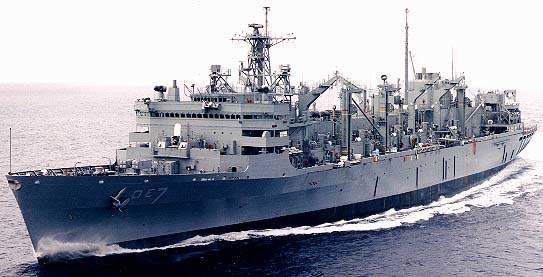
We’ve talked extensively about the Navy’s neglect towards the logistics aspect of naval warfare especially for a Navy that anticipates fighting in the far Pacific around China.  With that backdrop, let’s take a closer look at one of the Navy’s most capable supply ships, the appropriately named Supply class.

The four fast combat support ships of the Supply class provide underway replenishment for Navy ships and are the only such ships capable of keeping up with Navy surface/carrier groups. 

Supply Class


Around 2003, the ships were transferred from the Navy to the Military Sealift Command (MSC) and are now designated United States Naval Ship (USNS).

Bafflingly, the Navy has begun retiring them in a misguided attempt at cost savings because of their fuel consumption due to their turbine engines.  USNS Ranier and Bridge have been decommissioned and placed in reserve leaving the Navy with just two active fast combat support ships.


Ship
Hull Number
Commissioned
Status
Supply
T-AOE-6
1994
Active
Ranier
T-AOE-7
1995
Reserve
Arctic
T-AOE-8
1995
Active
Bridge
T-AOE-10
1998
Reserve


Here’s a few specs on the ships:

Displacement19,700 tons (empty), 49,000 tons (full)
Length754 ft (229.8 m) (overall)
Beam107 ft (32.6 m) (extreme beam)
Draft:  39 ft (11.9 m)
Maximum speed25 knots
Range :  6,000 nm
Crew :  160 civilian + 40 military
Propulsion4 x General Electric LM2500, 2 shafts, 105,000 hp
Aviation :  3x CH-46E Sea Knight or 3x MH-60S Seahawk (1)


Here’s a few specs on the cargo capacity of the ships:

Diesel Fuel Marine (DFM):  1,965,600 US gallons (7,441,000 l)
JP-5 fuel:  2,620,800 US gallons (9,921,000 l)
Bottled gas:  800 bottles
Ordnance stowage:  2,150 short tons (1,950 t)
Chill and freeze stowage:  250 short tons (230 t)
Water:  20,000 US gallons (76,000 l)


As built, the ships were equipped with several defensive systems:

1 x NATO Sea Sparrow Missile System (NSSMS)
2 x 20mm Phalanx Close-In Weapon Systems (CIWSs)
2 x 25mm Dual-Purpose (DP) autocannons
4 x 12.7mm Browning heavy machine guns
4 x Decoy Launchers
1 x NIXIE Torpedo Decoy System

Incredibly, the defensive systems were removed when the ships were transferred to the MSC.

Here’s a brief description of the ship’s cargo handling capabilities as described for Rainier:

To successfully handle their given resupply-at-sea roles, such ships as the Rainier were appropriately equipped with industrial-strength transfer equipment to move stores to recipient vessels. It was not uncommon to resupply ships to service up to three awaiting vessels simultaneously especially during wartime. Rainier was outfitted with a sliding padeye station allowing the receiving ship to transfer heavy loads and providing excellent control of the load during transfer. Between the bridge and the single funnel were 4 x 10-ton cargo booms, two located along portside and two along starboard. There were 3 x double-probe steam-powered fueling stations and two single-probe steam fueling stations - these stations able to pump water, ship diesel fuel or aircraft fuel simultaneously using different probes to the same ship. Her aft deck held a large helicopter flight deck connected to elevators able to bring freight from below to the surface so two of the three available CH-46E "Sea Knight" transport helicopters could deliver dry and refrigerated supplies (via cargo nets) under their fuselages (this particular delivery system recognized as "vertical replenishment"). A third CH-46E Sea Knight helicopter remained in hanger in reserve. (1)

What prompted the Navy to decommission two of the ships?  It was purely a budgetary cost savings measure.  According to USNI News website,

Supply-class ships USNS Bridge (T-AOE-10) will decommission in 2014 and USNS Rainier (T-AOE-7) and will decommission in 2015 based on the 2012 Navy Force Structure Assessment, Navy officials said. The FSA reduced the number of Fleet oilers from 19 to 17, leaving two Supply-class and 15 Henry J Kaiser class oilers. …

The decision to decommission the Supply-class ships was based on the higher operations and support costs for the class. The Navy estimated maintaining the ships would be $32 million more than the Kaiser-class support ships … (2)

So, for a measly $32 million savings (likely optimistic – probably much less) the Navy gave up two of the most valuable ships in the world.  And yet, the Navy doesn’t hesitate to spend $15B on a carrier or $600M on a worthless LCS.  Does this make sense in any sane reality?  The $32M isn’t even round off error in the Navy’s budget.  This is the kind of insane decision Navy leadership makes on a daily basis.

Hey Navy, how’s the logistical support planning for those far Pacific operations coming?


_______________________________

(1)Military Factory website, “USNS Rainier (T-AOE-7) / USS Rainer (AOE-7)”, JR Potts,
https://www.militaryfactory.com/ships/detail.asp?ship_id=USNS-Rainier-TAOE7

(2)USNI News website, “Navy to Decommission Two Oilers in Cost Saving Scheme”, Sam LaGrone, 29-Apr-2013,
https://news.usni.org/2013/04/29/navy-to-decommission-two-oilers-in-cost-saving-scheme