Naval gunfire capability has been absent since the last WWII era cruisers and battleships were retired. The fleet has had only 5" guns to support land operations despite the Marine Corp demands for effective support. No one, not even the Navy, claims that 5" gunfire is an effective support weapon. Sure, there may be small targets that a 5" gun can effectively service but naval gunfire lacks any serious punch and has for quite some time.
Supposedly, one of the reasons the Marines allowed the battleships to be retired without raising too much stink is that the Navy promised to develop new guns that were larger than the 5". However, budgetary pressures and, frankly, ill-considered decisions led to the cancellation of all gun programs before any could reach production.
Only now, with the advent of the Zumwalt's 155 mm AGS has the Navy returned even a bit of gun support to the fleet. Even so, the 155 mm (6") gun is not really adequate for larger or hardened targets. In addition, we've discussed the extremely high cost of development and production of the AGS and the fact that it requires a ship to be designed around it much like the Air Force's A-10 Warthog was designed around its gun. The AGS consumes enormous amounts of internal volume and ships services such as electricity. The AGS cannot be mounted on other ships in the fleet. Barring a new class of ship designed for the AGS, the gun will be limited to the three ships of the Zumwalt class which does not exactly constitute a readily available gunfire support capability.
We previously discussed the AGS in detail and concluded with the thought that perhaps the Navy should have looked at the Mk71 8” gun instead. Let’s look closer at the Mk71.
 |
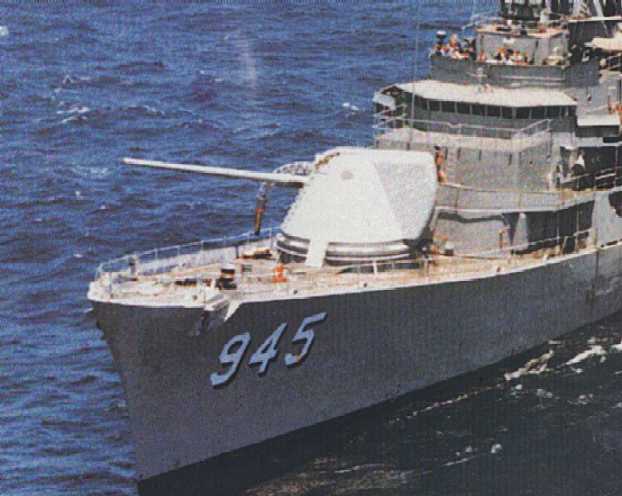
| Mk71 8" Gun - What AGS Should Have Been |
The Mk71 was the result of the Navy’s attempt to mount a major caliber gun on a small (destroyer size) hull. The gun was developed in the early 1970’s and a full scale prototype was produced, mounted on the Forest Sherman class destroyer USS Hull (DD-945), and test fired at sea in June of 1976. Both laser guided and unguided projectiles were test fired at ship and shore targets. The range of the gun was given as around 18 miles. Before anyone leaps for their keyboard to tell me that the Mk71 caused the Hull's hull to crack from the stresses, read this NavWeaps link carefully.
The gun eventually fell victim to budget cuts and misguided Navy priorities in the late 1970’s.
Interestingly, the Spruance class was designed to accommodate the Mk71 as was the USS Long Beach had she be upgraded as an Aegis cruiser. Further, studies were conducted that showed that Burke class destroyers could accommodate the Mk71 with some modifications.
The attractiveness of the Mk71 as compared to the AGS is due to
- Cost – when the Navy committed to the AGS the Mk71 development costs were already long since paid for. The gun was essentially free and a prototype had already been successfully tested. Advanced rounds, if desired, would have entailed additional costs just as for the AGS.
- Explosive Power – the 8” round is so much more effective than a 6”.
- Shipboard Impact – the AGS, as we’ve discussed has a major impact on ship design and ship utilities. The Mk71 is a simple gun and easily accommodated.
- Flexibility – the Mk71 is a general purpose gun capable of engaging both ship and shore targets unlike the AGS which has no anti-ship mode.
For reasons understood only by the Navy, gun support has been a virtually ignored capability for many decades. This is all the more puzzling given the ready availability of a fully developed and proven technology that would meet the vast majority of gunfire support requirements. Even now, the Mk71 seems a better choice for future applications than the AGS due to the enormous impact the AGS has on its ship.