The Fletcher class destroyers were numerous and highly
successful. We’ve noted various ship
design elements that contributed to their success, such as the prevalence of
their armor and density of their firepower.
Beyond that, however, there are additional, more general, lessons to be
derived from their production and it’s those that we’ll look at today.
There is no better introduction to these lessons than the
opening statement from the General Board about the Fletcher destroyer program,
The
Board asked all concerned to think in terms of keeping displacement, and thus
size, to ‘the practicable minimum in order that they may present minimum
targets and that ratio of cost to number may be as great as possible.’ [1, p.80]
Right there … the very first statement from the Board sets a
design philosophy that is the very antithesis of today’s programs. The Board recognized that when prosecuting a
war, numbers of ships were of critical importance and the way to achieve that
was to keep size to the practical minimum.
Consider the size of the Fletcher versus our current ‘small’
warship, the Constellation frigate:
|
|
Fletcher
|
Constellation
|
|
Lenth, ft
|
376
|
496
|
|
Displacement, ton full load
|
2500
|
7300
|
We instantly see that the Constellation is 32% longer and
192% heavier for a ship, a frigate, that is supposedly smaller than a
destroyer! We built 175 Fletchers and
are planning to build 20 Constellations. That discrepancy in production numbers totally
encapsulates the General Board’s concern about cost and numbers and we are
violating the Board’s wisdom every time we begin a new shipbuilding
program. As a result, we are witnessing
a non-stop decline in the number of ships in the fleet.
One could not ask for a more graphic example of the General
Board’s concern.
If you’re going to fight a war, you need numbers. The General Board knew this. We’ve forgotten this most basic of
requirements.
Now let’s look at other lessons offered by the Fletcher
program.
Shipyards –
Consider the following list of companies that built Fletchers during the war:
Federal Shipbuilding and Drydock Company, Kearny, New Jersey
Bath Iron Works, Bath, Maine
Boston Navy Yard
Charleston Navy Yard
Consolidated Steel Corporation, Orange, Texas
Gulf Shipbuilding Corporation, Chickasaw, Alabama
Bethlehem Steel Corporation, Staten Island, New York
Bethlehem Shipbuilding Corporation, San Francisco, California
Bethlehem Steel Company, San Pedro, California, Terminal Island
Seattle-Tacoma Shipbuilding Corporation, Seattle, Washington
Puget Sound Naval Shipyard
The lesson is blindingly obvious. We don’t have enough shipyards. During war, shipyards will not only have to
provide new construction but will be overwhelmed with battle damage repair
efforts. We don’t have enough shipyards
to do either task, let alone both simultaneously.
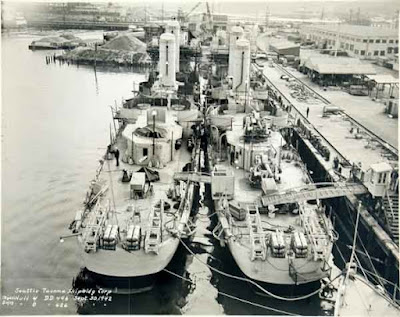 |
| Destroyers Under Construction At Tacoma Yard |
Standardized Design
– The reason why we could have eleven shipyards all build Fletchers was because
we had a standardized design. With that,
it was just a matter of distributing construction drawings to the yards. Today, we keep changing the basic designs,
non-stop, in an effort to insert a constant stream of new technology. There’s nothing wrong with periodically
inserting new technology but not on a continuous basis. Save up changes and then occasionally do a
technology insert. Honestly, I doubt
there’s even a reason to do a technology insert. A much better approach is to occasionally
design a new ship that can incorporate the backlog of new technologies.
Short Production Run
– The reason we didn’t need radical new technology inserts during the Fletcher
production run is that the run was short.
The entire production run lasted only two years! You just can’t get too out of date in just
two years. Contrast that with the Burke
production run which began in 1988, has lasted 34 years, and shows no sign of
stopping! The Navy trumpets that fact
proudly when, in reality, it’s an embarrassment and indictment of our entire
naval design and production system.
At the end of the Fletcher production run, we began the
Sumner/Gearing programs which incorporated the lessons of the war. The Fletcher’s short production run gave us
the flexibility to design new destroyers that better met our needs. Contrast that with the latest Burkes. Because we’re unwilling to terminate the
obsolete Burke design, we’re being forced to settle for sub-optimal radar
outfits and performance in the new Flt III Burkes. The WWII ship designers dealt with
sub-optimal situations by designing a new class of ship. Today, we accept and embrace sub-optimal
because we’re too frightened (and incompetent!) to start a new class with a new
design. Even the concept art that has
been floated showing the next generation destroyer shows what is, essentially,
a Burke with a few tweaks.
Cost – We are far
too focused on construction costs, today, and with good reason. Our construction costs have ballooned because
we’ve ignored all the lessons of wise and proper ship design. This has led to runaway costs which then
become the primary driver of ship design.
We should be designing to combat-requirements but, instead, we’re
designing to business cases, cost constraints, and fear-induced conservatism.
WWII Chief of Naval Operations, Adm. Harold Start, had this
to say about the Fletcher ship costs,
He
did not think individual ship costs were critical: ‘the best possible vessel
should be designed without consideration of this relationship.’ [1, p.80]
Combat Performance
– The Fletcher achieved armor, speed, firepower, and range all in a single
design. Today, we seem to believe that
none of those are achievable individually, let alone as a group in a single
design. At best, we treat those criteria
as a ‘pick one’ type of design limitation.
We’ve forgotten what we once routinely accomplished in ship design. If we wanted, we could design a destroyer
with 10,000 nm range, 35+ kt speed, multiple inches of armor, and more
firepower than anything we have today and all in a Fletcher size ship. We’ve just forgotten how.
Summary
The General Board of WWII knew exactly what they were doing
when it came to warship design. They
didn’t hide this knowledge; it’s readily available for our enlightenment if
only we’ll accept it and avail ourselves of it .. but, we steadfastly refuse.
Arguably, the most important of the various lessons is that
of short production runs. From that
flows all manner of good program characteristics. A two year production run does not allow for
any significant obsolescence and, therefore, does not require that we build in
a single iota of ‘future proofing’ or modular updating which are all the rage
today. Short production runs encourage
(nay, demand!) continuous new classes of ships that can then incorporate
technological upgrades – there’s your future-proofing! With no need to overbuild for future
considerations, costs and size are kept to a minimum.
We need to return to the wisdom of the General Board,
acknowledge the lessons they offer, and put them into practice. A 40 some year run of Burkes is an
abomination and an acknowledgement that we don’t know our ship designs from a
hole in the ground and that we have no clue how to run a successful ship
program.
_________________________________________
[1]Reilly, Jr., John C., United
States Navy Destroyers of World War II, Blandford Press, Dorset, UK, 1983,
ISBN 0 7137 1026 8


