Thursday, October 8, 2020

SSK Sinks Carrier

This keeps coming up in comments so I guess I have to address it. 


I’m sure that everyone has heard, by now, the near-legendary story about the Swedish diesel-electric submarine HSwMS Gotland that ‘sank’ the US carrier Ronald Reagan in an exercise, thereby conclusively and unequivocally proving that submarines are invincible and that carriers are just marking time until they will by 100% sunk within ten minutes of the start of a war – at least, that’s the conclusion that many have drawn based on one widely disseminated story.  Is that really the correct conclusion?  Let’s look just a bit beyond the sensationalistic story and see what the reality is.


As we know, the US Navy has no SSKs of its own and leased the services of the Swedish SSK Gotland from 2005-2007 for the purpose of study and exercises.  As far as the actual exercise in question, we have almost no information so almost everything that follows is speculation and reasoned logic.
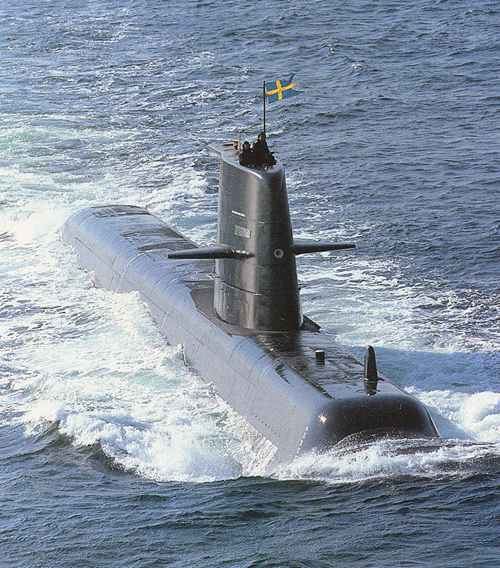


HSwMS Gotland, SSK


 Wikipedia states that the exercise in question involved Carrier Strike Group 7 (CSG 7) during the 2005 December pre-deployment Joint Task Force Exercise 06-2 (JTFEX 06-2) in the Pacific Ocean (probably in the California Operating Areas).(2)  As such, the exercise would have included all areas of the group’s mission capabilities with ASW being one check box on the list.  Note that the supporting citation in the Wiki article is irretrievable and unverifiable.


According to a Wikipedia article about CSG 7, the group consisted of the Reagan, a Ticonderoga, and 3 Burkes.(3)  This isn’t even remotely representative of a wartime carrier group so it follows that any exercise would not be representative of a wartime scenario.  That aside …


All right, that’s the end of what we actually know.  Now, let’s move into reasoned speculation.


The Navy’s purpose was to find out how stealthy the sub was and to study ways to detect and counter the sub.  Sinking it in an exercise was not the primary purpose.  Think about it … if you want to see how effective the sub is, you’d likely start it at different points, nearer and farther, to observe its characteristics.  In fact, you might intentionally refrain from ‘sinking’ it and allow it to approach as closely as possible to study the acoustic patterns as they vary with distance.


So, just as Top Gun aircraft instructors allow the students to shoot them down in order to learn, the Navy may have allowed the sub to sink the carrier to learn how it would be done. 


Now, let’s consider what an ASW exercise is. 


The number one attribute of an exercise is that it’s not realistic right from the start.  Out in the wild, it would be exceedingly unlikely for a sub to ever get within detection range of a carrier group.  The ocean is an incredibly vast place and the odds that a sub and a carrier would randomly cross paths is very low.  In an exercise, do we want to wait for months while a slow, limited sensor range sub searches for an ocean-roaming carrier?  Of course not!  So, we artificially constrain the exercise by confining the sub and carrier in close proximity to begin the exercise.  Thus, the sub has already, artificially, achieved detection and ‘maneuvered’ into weapons range.  The only remaining uncertainty is whether the defenders will detect the sub in the short time period before the sub achieves final firing position and that is probably unlikely.


Consider the history of WWII submarine-carrier encounters.  For all the millions of miles of carrier group travel, both Japanese and American, and all the millions of miles of submarine travel, how many encounters between carrier and submarine actually occurred?  I’m aware of a single Japanese sub encounter with an American carrier, the Wasp.  Another Japanese sub fired on the Yorktown but the Yorktown was already badly damaged and adrift, at that point, at the end of a battle.  On the other side, there were one or two encounters between American subs and Japanese carriers:  the Shinano was sunk by a US sub.  So, out of many dozens of carriers and many hundreds of subs criss-crossing many millions of miles of the Pacific ocean, only half a dozen or so sub-carrier encounters occurred.  That pretty conclusively demonstrates how unlikely SSK-carrier encounters would be in war.  Further reducing the likelihood of encounter is the fact that SSKs are littoral assets and stay relatively close to land while carriers seek out the deepest and most remote waters they can find.  The two are extremely unlikely to meet just due to their different preferred operating areas in addition to the simple statistical unlikelihood of a random meeting in the open ocean.


It is instructive to note that Gotland arrived at the start of the lease and returned to Sweden at the end of the lease via mobile dry dock (Norwegian semi-submersible heavy-lift ship, MV Eide Transporter,) rather than sailing under its own power.(1)  Modern SSKs are not generally open ocean assets.


The next noteworthy aspect of an ASW exercise is repetition.  If you’ve gone to the trouble and [staggering!] expense of assembling a sub and a carrier group for an ASW exercise, do you want to run one quick iteration and call it a day?  No!  You want to get your money’s worth.  You want to run and rerun the exercise to allow as many people and assets as possible to participate and learn.  In the course of numerous iterations, you would expect that the sub would ‘win’ some and the carrier would ‘win’ some.  Without a detailed listing of every iteration, the conditions, and the results, we can’t draw any conclusions.  Instead, what we get is a sensationalistic story about an invincible sub.  What we don’t hear about are the other twenty times that the sub lost because that’s not a sensationalistic story.


The Navy’s Top Gun school has used A-4 Skyhawks, T-38 Talons, F-16N (briefly), and F-5’s, among other types, as its adversary aircraft.  They have routinely ‘shot down’ student pilots.  Does this mean that those aircraft are superior to the front line US Navy aircraft?  Of course not.  It means that the adversary aircraft are used in such a way as to teach lessons to the students.  Similarly, the Gotland SSK was used to practice against and that may well have meant ‘losing’ for the US Navy participants so that they could learn.


In an actual combat situation, the carrier is going to be escorted by dozens of ships extending out for 20-50 miles in rings around the carrier (see, Escorts).  In addition, the group’s ASW helos will be scouring the sea 24/7.  The sub will have to penetrate fifty miles or so through dozens of escorts and constant helos to achieve a firing position.  In an exercise, as we noted, that entire phase is skipped and the sub is artificially placed inside the defensive layers.  We don’t even know whether any escorts or helos were used in the exercise in question.  It would seem reasonable that they were but perhaps they had other pre-deployment tasks to accomplish? 


In combat, the escorts will also be firing on any semi-possible contact just to be safe.  This will influence the sub’s behavior, knowing that either random chance or a momentary contact might result in a torpedo close enough to be a threat to the sub.  The sub will be more cautious and move less aggressively knowing that the alternative is death rather than a reset of the exercise.  In an exercise, the sub can take chances it wouldn’t take in real combat.


Carrier groups, historically, have had submarine escorts that, presumably, range far ahead of the group and ‘sanitize’ its path.  In an exercise, there is no far distant submarine escort that the attacking sub had to defeat/evade just to reach the surface escorts/helos and then then, ultimately, the carrier.  Again, another unrealistic aspect of the exercise.


In combat, the number one defensive tactic is to flee.  At the first hint of a sub threat the carrier would likely turn and run at 35 kts thus denying the sub firing position.  In an exercise, this is not an option.  As we noted, the sub and carrier are constrained to a fixed location.  The carrier is forced to allow the sub to approach.


So, what are we left with in the way of reasonable conclusions?


  • ASW exercises are utterly unrealistic
  • Every ASW exercise has both sides winning some and losing some
  • An ASW exercise is an artificially constrained tracking exercise rather than an ASW exercise
  • SSKs present a very unlikely threat to a carrier


Finally, let’s consider what an actual combat engagement between an SSK and a carrier would look like.


For starters, there would be no engagement.  The odds on an SSK intercepting a carrier group is infinitesimal.  SSKs are not deep ocean going subs, as a general statement, whereas carriers are only deep ocean platforms in a war.  The two would never meet.


Setting that aside, let’s assume that an SSK was cruising the open ocean.  Barring the million to one random chance encounter where a carrier group literally sails straight over top the submarine, an SSK could never detect and maneuver into a viable torpedo firing position.  The carrier group travels at 20+ kts with maximum speeds of 30+ kts.  By comparison, the SSK’s maximum, short duration speed is just 5-20kts, depending on power source.  The submarine does not have the speed to maneuver into an intercept position without giving away its own position.  SSKs depend on the prey coming to them, not the other way around.


None of the preceding should be taken to assert that submarines are not a threat.  They most certainly are!  The purpose of the post is to demonstrate just how unrealistic a pre-deployment ASW exercise conducted for a small carrier group is.  This should also demonstrate that the single sensationalistic story is just that – a single example from, likely, dozens/hundreds of exercises.  By itself, it proves nothing.  The SSK may well be, and likely is, a very difficult opponent to defeat but we’ve just demonstrated that the very notion of an SSK-carrier encounter is almost absurdly unlikely.


Side note:  Oct 2014, Sweden spent several days looking for a supposed Russian sub and found nothing.  Of course, there may not have been anything there to find but it suggests that the Swedish subs are not the all-seeing, all-knowing, invincible killers of the sea that popular media has portrayed them to be.


____________________________________


(1)https://foxtrotalpha.jalopnik.com/sweden-has-a-sub-thats-so-deadly-the-us-navy-hired-it-t-1649695984


(2)Wikipedia, “HSwMS Gotland (Gtd)”, retrieved 26-Sep-2020,

https://en.wikipedia.org/wiki/HSwMS_Gotland_(Gtd)#cite_note-15


(3)Wikipedia, “Carrier Strike Group Seven 2004–06 operations”, retrieved 27-Sep-2020,

https://en.wikipedia.org/wiki/Carrier_Strike_Group_Seven_2004–06_operations


Tuesday, October 6, 2020

Riddle Me This

Just  a quick thing to think about for all you naval observers who are eager for the Navy to increase its fleet size beyond the current 296 ships (196 actual combat vessels).  We’re hearing rumors from the various Navy force design studies and from SecDef Esper’s office that the Navy is going to shortly be proposing an increase to 350 – 500+ ships depending on which rumor you hear and whether you count unmanned canoes or not.  The fact that there is no funding for that level of shipbuilding is glossed over.  Setting that minor point aside, consider the following simple questions:


1.     Where will the shipyard building capacity come from?

2.     How will the Navy maintain all those extra ships?


Maintenance is the more important question.  Currently ships are sitting pierside, idle, for months or years (yes, years! – the USS Boise, SSN-764, has been sitting pierside for 5 years waiting its turn at overhaul and has long since lost its basic dive certification) at a time waiting for their turn at maintenance.  If we can’t maintain a 296 ship fleet, how will we maintain a 350-500+ ship fleet?  Until you can answer that, wishing for a larger fleet is pointless.

Saturday, October 3, 2020

Command and Control Are Opposites

The military has lots of acronyms, to put it mildly and politely.  Arguably, there is no more prevalent or important acronym than C2 (Command and Control), at least in the opinion of the higher levels of military leadership.  C2 has become not only a staple but almost a religion among leadership.  Even the acronym has grown!  It started out as just C2 but it grew into C2I (C2 + Intelligence) then C2ISR (C2 + Intelligence, Surveillance, and Reconnaissance).  Even that wasn’t enough.  C2ISR led to C3ISR (C2 + Communications + ISR).  Unbelievably, there’s now C4ISR (C2ISR + Computers).  … … …   Do I dare say it?  Is there a C5ISR?  Yes, there is!  It’s the Command, Control, Communications, Computers, Cyber, Intelligence, Surveillance and Reconnaissance (C5ISR) Center which is an Army applied research and advanced technology development center under the U.S. Army Combat Capabilities Development Command, or CCDC, which is a major subordinate command of the U.S. Army Futures Command.  And before you ask, yes, there is a C6ISR C6ISR (Command, Control, Communications, Computers, Cyber-Defense and Combat Systems, and Intelligence, Surveillance and Reconnaissance) being developed.  There’s also JADC2 (Joint All Domain Command and Control).  And the list goes on …


We can see, then, that C2 has expanded and grown to encompass … well … everything! 


So, what’s wrong with C2?  Isn’t that how we control battles and wars and fight efficiently?  Isn’t that a good thing?  We’ve previously discussed Command and Control (see, “Command and Control”) and the trend by today’s leadership towards ever greater levels of micro-managing under the guise of artificial intelligence battle management software.  Now, though, let’s step back and look at the fundamental concept of Command and Control.


To state the obvious, C2 consists of two words: ‘Command’ plus ‘Control’.  What do they mean?


Command is the formulation and conveyance of intent, in the form of orders, by the commander to his subordinates.  As we discussed in the previous post, the ideal form of this command is ‘Commander’s Intent’ whereby the commander issues the broad scope and thrust of his desires for his local commanders to execute as they see fit.


Control is the step-by-step, item-by-item direction of a subordinate’s actions.   


Let’s consider control ...  We all recognize that some degree of control is necessary.  Without it, units and individuals would act in an uncoordinated, almost random fashion which would negatively impact the desired outcome.  Units would fail to support each other and would likely interfere with each other.  However, the benefits of control are a function of distance from the controlled.  When the controller is in close physical proximity to the controlled, this is a beneficial operation.  An example would be a squad leader issuing commands to his squad.  In this example, both the controller and controlled are in the same location and experiencing the same situation.  As the controller becomes more and more removed from the controlled, the controller’s understanding of the local situation breaks down and the controller becomes both a burden to the controlled – due to incessant demands for information – and an impediment to swift and proper action  - due to the controller’s lack of understanding of the local situation and the time delays involved in obtaining information, debating alternative courses of action, and the issuance of orders.  An example is almost any operation today where the White House authority and Joint Chiefs sit around a war room monitoring and directing the moment by moment actions of an operation on the other side of the world.  President Lyndon Johnson personally setting target lists in Vietnam or President Carter directing the failed hostage rescue are examples.  There is an endless list of lesser examples of remote commanders directing moment-by-moment operations.


So, what do we immediately notice from the definitions of ‘Command’ and ‘Control’?  The obvious point that jumps out is that the two are opposites!  Command, properly executed, is the dispersal of authority to lower levels whereas ‘Control’ is the consolidation of authority to higher levels.  Polar opposites and yet our military has, illogically, combined them into one phrase and one concept!


We have grown so used to the combined phrase that we don’t even consider the incongruity inherent in the phrase.  Command and Control is an oxymoron and yet it is the foundation of our military leadership.  That’s a problem!


Facing a future war where our communications, in all forms, will be under constant attack, we need to recognize that our ability to issue orders will be severely degraded and that Control will, therefore, devolve to the local unit level whether we want it to or not.  That requires that we embrace the concept of Commander’s Intent and institutionalize the concept of local control.  We need to relentlessly practice it so that when we lose communications in combat, we’ll be comfortable with the situation and able to function effectively.


Command and Control are opposites and we need to start splitting them apart and practicing them separately.


Thursday, October 1, 2020

Esper and Rumsfeld

Secretary of Defense Donald Rumsfeld  (1975-1977 and 2001-2006) single-handedly instituted the policy of transformationalism whereby he forced the military to attempt to skip ahead a generation of technology development and to reject any weapon programs, developments, or upgrades that he didn’t deem sufficiently transformational.  This was, arguably, the beginning of the US shift from a focus on strategy to a focus on technology.  In the event, history has passed its judgment and found transformationalism to be a failure – one whose reach has negatively impacted even weapon systems being brought on line today. 


The purpose of this post is not to examine Rumsfeld or his failed philosophy but, instead, to examine the current Secretary of Defense, Mark Esper, in light of the Rumsfeld experience.  Huh?  How are the two related?  Let’s see.


Let’s start by examining a speech SecDef Esper gave on 16-Sep-2020 at the RAND corporation.(1)


What is Esper’s main focus?  He states it, clearly, himself:


I made clear that my highest priority would be the irreversible implementation of the NDS [ed. National Defense Strategy].


This strategy tells us that to be successful, we must follow three lines of effort: first, enhance our lethality and readiness across the force; second, strengthen our alliances and build partnerships; and third, reform the department to align our highest -- our resources with our highest priorities. (1)


Okay, that’s pretty generic but not terribly objectionable.  What are his somewhat more specific goals?  Esper cites a few goals he refers to as ‘lines of effort’.


Our first line of effort aims to maintain our warfighting advantages and continue outpacing the competition when it comes to lethality and readiness. To modernize our capabilities, we have successfully secured funding for game-changing technologies such as artificial intelligence, hypersonics, directed energy, and 5G networks. We have also made significant progress recapitalizing our strategic nuclear triad.


Our second line of effort builds on our relationships with other Nations, an asymmetric strategic advantage that no rivals can match.


Our third line of effort drives us to reform the department for greater performance and effectively manage our Fourth estate, which includes organizations such as the Defense Logistics Agency. (1)


Um … so … Esper believes we’ll be successful because of AI, networks, relationships, and the Fourth Estate (whatever he means by that since he lumps a non-media group in with it).  Where was any mention of combat firepower?


Esper might be just a little overconfident.  He says,


 I want to make clear that China cannot match the United States when it comes to naval power. Even if we stopped building new ships, it would take the PRC years to close the gap when it comes to our capability on the high seas.


Ship numbers are important, but they don’t tell the whole story.


They do not address the types of ships and the capabilities of the vessels being counted; the skill of the crews that operate them; the prowess of the officers that lead them; or the ways in which we fight and sustain them…just to name a few. (1)


Given the demonstrated collisions, groundings, surrenders, etc. one has to realistically assess the ‘prowess of the officers’ and the ‘skill of the crews’ as being decidedly lacking.  That being the case, it calls into question his assessment that ‘China cannot match the United States’ but let’s set that aside and move on.


What does Esper have to say about the Navy and its fleet structure?


That said, to compete in a 21st century high-end fight, we will need a future fleet that optimizes the following operational attributes: first, distributed lethality and awareness; second, survivability in a high intensity conflict; third, adaptability for a complex world; fourth, ability to project power, control the seas and demonstrate presence; and fifth, capability to deliver precision effects at very long ranges. (1)


Again, note that of his five operational attributes, none are directly related to firepower and only one or two are even indirectly related to firepower.


Now, the million dollar question and the heart of this post … how will Esper implement his vision?


This fleet will be made up of more and smaller surface combatants; optionally-manned, unmanned, and autonomous surface and subsurface vehicles; unmanned carrier-based aircraft of all types; a larger and more capable submarine force; and a modern strategic deterrent. (1)


We already knew this but there it is in plain English.  He wants to convert the Navy from traditional firepower to small, weak, unmanned vessels and unmanned aircraft.  He also mentions a larger submarine force, which is commendable, but I suspect he’s referring to the large displacement unmanned undersea vehicle (LDUUV), which the Navy has already begun the acquisition process for, rather than conventional submarines.


Taking all of the above statements from Esper, we see that he wants to move the Navy towards networks, AI, directed energy, hypersonics, unmanned ships and aircraft, and distributed operations.  What’s utterly lacking is firepower!


This is what I want to consider, today.  SecDef Esper is pushing the military and the Navy down a path of networks, unmanned, and data as a substitute for firepower.  SecDef Rumsfeld pushed the military and the Navy down a path of technological leaps that were simply not reasonable or feasible.  Do you get an eerie sense of similarity?  Both ignore(d) routine firepower in an attempt to ‘leap ahead’ on the technology development curve to gain an illusory advantage.  History has passed judgment on Rumsfeld and transformationalism.  Are we seeing the same judgment in the process of being passed on Esper?  A decade or so from now, will we look back and deem networks to be a failed effort and rue our lack of firepower due to the focus on data instead of explosives?  Is Esper the next Rumsfeld?  History will decide but it’s not looking good, at the moment.


______________________________________


(1)US Department of Defense website, transcript of speech at RAND Corporation, 16-Sep-2020,

https://www.defense.gov/Newsroom/Speeches/Speech/Article/2350362/secretary-of-defense-speech-at-rand-as-delivered/


Monday, September 28, 2020

Okinawa and Unmanned Vessels

The US Navy is building a fleet of small unmanned vessels to act as pickets and outer escorts for carrier and surface groups despite having no evidence, whatsoever, that the unmanned vessels can effectively carry out their task.  Since the Navy refuses to conduct any actual experimentation to validate the concept prior to committing to production, is there any other source of information that might allow us to assess the concept?  Of course there is and it’s our most reliable source … history!  Specifically, it’s the battle for Okinawa and the role of the Kamikaze and the US Navy picket ships.


Okinawa was a major battle for both the US and Japan.  US losses during the 3 month battle were steep with 768 aircraft lost in addition to staggering naval losses.(5)  From Wikipedia:


At sea, 368 Allied ships—including 120 amphibious craft—were damaged while another 36—including 15 amphibious ships and 12 destroyers—were sunk during the Okinawa campaign. The US Navy's dead exceeded its wounded, with 4,907 killed and 4,874 wounded, primarily from kamikaze attacks. (5)


Just as astounding to us, today, was the magnitude of the forces assembled for the battle.  Consider this partial Allied naval order of battle at Okinawa (1)


US Navy combat ships:

  11  fleet carriers

    6  light carriers

  22  escort carriers

    8  fast battleships

  10  old battleships

    2  large cruisers,

  12  heavy cruisers

  13  light cruisers

    4  anti-aircraft light cruisers

132  destroyers

  45  destroyer escorts


Amphibious assault vessels:

84  attack transports

29  attack cargo ships

LCIs, LSMs, LSTs, LSVs, etc.


Auxiliaries:

52  submarine chasers

23  fast minesweepers

69  minesweepers

11  minelayers

49  oilers


Royal Navy combat ships:

  5  fleet carriers

  2  battleships

  7  light cruisers

14  destroyers


The 265 US combat ships, alone, nearly equals the size of our entire present day fleet and that was just the force for a single operation. We’ve truly forgotten the size of the force necessary to wage total war.


Japan, too, fielded a large force, mainly aerial, along with the battleship Yamato, a cruiser, and several destroyers.  During the course of the battle, Japan launched 10 large scale kamikaze attacks against the US Navy Fifth Fleet guarding the Okinawa amphibious invasion fleet.  Each attack consisted of hundreds of aircraft.  For example, the first attack consisted of 355 kamikaze aircraft and 344 escort fighters and lasted for five hours.  The US Combat Air Patrol (CAP) did an amazing job but could not stop every attacker.


Twenty-two kamikazes penetrated the combat air patrol shield on April 6, sinking six ships and damaging 18 others. Three hundred fifty U.S. crewmen died. (2)


Only 22 attacking aircraft managed to penetrate the aerial defenses but the damage they did was enormous.


What was the overall result of the kamikaze attacks?


The Japanese fell short of their goal of “one plane one ship,” but sank 36 American warships, and damaged 368 other vessels at Okinawa. The Navy’s losses were the highest of the Pacific war: 4,907 sailors and officers killed, and 4,824 wounded. Japan lost an estimated 1,600 suicide and conventional planes at Okinawa. (2)


The sheer number of attacking aircraft represented what we would, today, call a saturation attack intended to overwhelm the defensive capacity of the US fleet.


The Navy’s answer to the kamikaze saturation attacks was to establish a ring of radar picket ships around the island and the invasion fleet extending out as far as 80 miles.  The pickets provided early warning, fighter direction, and direct engagement.  Each picket ship was tied to a circular station of 5000 yds radius.


Wikipedia describes the Okinawa radar picket system.


A ring of 15 radar picket stations was established around Okinawa to cover all possible approaches to the island and the attacking fleet. Initially, a typical picket station had one or two destroyers supported by two landing ships, usually landing craft support (large) (LCS(L)) or landing ship medium (rocket) (LSM(R)), for additional AA firepower. Eventually, the number of destroyers and supporting ships were doubled at the most threatened stations, and combat air patrols were provided as well. In early 1945, 26 new construction Gearing-class destroyers were ordered as radar pickets without torpedo tubes, to allow for extra radar and AA equipment, but only some of these were ready in time to serve off Okinawa. Seven destroyer escorts were also completed as radar pickets. The radar picket mission was vital, but it was also costly to the ships performing it. Out of 101 destroyers assigned to radar picket stations, 10 were sunk and 32 were damaged by kamikaze attacks. The 88 LCS(L)s assigned to picket stations had two sunk and 11 damaged by kamikazes, while the 11 LSM(R)s had three sunk and two damaged. (3)


Okinawa Picket Stations


Note:  Some picket diagrams show a 16th station located near station 12.


Understanding the basics of the situation at Okinawa, what can we learn that is applicable to today’s Navy?  The foundation of any analysis is the recognition that the Kamikaze was the functional equivalent of a guided anti-ship missile.  The guidance, obviously, was in the form of a human pilot and the ‘missile’ was very powerful, rivaling a modern guided missile in terms of destructive impact.  This functional equivalency allows us to assess the attacks and defense in modern terms.  Further, the dynamic of the Kamikaze and the picket ships gives us insight into the Navy’s plans regarding its unmanned picket/escort vessels.


As you recall from previous posts, the Navy intends to procure two types of unmanned vessels.  One will be a small version which is intended to act as a picket for a larger group by providing surveillance and reconnaissance – much the same as the picket ships did at Okinawa.  The second will be a somewhat larger vessel which is intended to stay with the main group and act as a missile barge. 


So, what does the Okinawa Kamikaze and picket ship scenario tell us about the Navy’s plans for its unmanned vessels today?  There are several lessons, factors, and considerations for us.


Lethality – We need to recognize that today’s anti-ship missile will be every bit as lethal, if not more so, than the Kamikazes.  In fact, the situation is far worse today due to the complete absence of armor on modern ships.  The Okinawa picket ships routinely absorbed multiple hits, kept fighting, and often survived.  Does anyone seriously believe that a Burke, FFG(X), or LCS can take multiple hits and not sink?  Astonishingly, one of those ships is actually designed to be abandoned at the first hit!  A missile attack against our ships will be devastating and we need to factor that into our ship designs and cost and we need to accept that naval battles will involve a significant degree of attrition.  The lethality will absolutely stun us.


Saturation – The Kamikaze was used as a saturation attack with each of ten major attacks consisting of several hundred aircraft.  This is a lesson we have completely forgotten.  Peer warfare requires huge numbers of munitions – dwarfing any estimates we may have.  This was demonstrated time and again in WWII and Korea where munition expenditures far exceeded predictions.  We’ve become so used to the small Tomahawk strikes against unresisting targets that we’ve come to believe that peer warfare will involve the same minimal usage of weapons.  Nothing could be further from the truth.  We’ll see unimaginably massive expenditures of weapons against us and unbelievable salvos launched against our fleets.  We absolutely must come to terms with this reality because it drives our ship design sensor and weapons density, fire control capacities, sensor design, armor considerations, etc.  Ships with one CIWS will not survive saturation attacks.  We must heavily arm our ships – far beyond anything imagined by today’s designers.


Defensive Guidance/Sensors - Defending ships at Okinawa did not possess any weapon guidance comparable to the Kamikaze pilots and this put them at a huge disadvantage.  The defending weapons were optically (and radar, to a degree) aimed and fuzed to a marginally successful degree.  The mismatch in technology between the advanced [human] guidance of the Kamikazes and the unguided defensive weapons mimics and demonstrates the consequences of a loss of defensive sensors and fire control in modern engagements.  Given the very limited number of sensors and fire controls on modern ships, it is all too easy to imagine a ship being blinded early in an engagement and being unable to continue fighting even though the weapons, themselves, might still be available.  We desperately need to increase the number of sensors (redundancy) and types of sensors on our ships.  For example, we should have much more extensive, physically distributed EO/IR sensors tied into the fire control system as well as a separate, technologically dissimilar type of radar as a backup to the Aegis arrays.  The Aegis arrays are large, exposed targets and likely to be seriously damaged and degraded from almost any hit.  Consider the Burke destroyer that was involved in the collision with a commercial ship.  One of its radar arrays was, apparently, rendered completely inoperative and that was from a waterline collision, not a missile hit.  In like fashion, the Port Royal’s arrays were reportedly rendered inoperative when it gently nosed aground off Pearl Harbor.  That doesn’t bode well for the combat resilience of the Aegis system.  We need sensor redundancy and backups.


Armament – The use of picket ships mimics the Navy’s desire for advanced screens of unmanned vessels.  The pickets succeeded in their mission but were devastated – what does that suggest for today’s unmanned vessel screens?  The picket ships were heavily armed and armored but were still devastated.  The Navy, in contrast, envisions the unmanned escorts being unarmed.  They’ll be quickly eliminated in any combat which will transfer the burden of their functions back to the manned escorts who won’t be trained or proficient at the functions and certainly won’t be properly positioned.


Armor – The Okinawa picket ships were all armored to varying degrees.  Again, the Navy envisions completely unarmored, unmanned vessels as pickets.  Not only will the unmanned vessels be quickly eliminated but the absence of armor ensures that weapon expenditure by the enemy to do so will be absolutely minimal.  One of the major benefits of the Okinawa pickets was that they soaked up so many of the Kamikazes.  Imagine if each picket had instantly sunk from a single hit.  The remaining Kamikazes would have been able to continue on to the amphibious ships, the true targets of the Kamikazes, instead of being wasted against the pickets.


USS Aaron Ward After 6 Kamikaze and 2 Bombs


Weapon Density – The number of weapons on the picket ships was incredible and that redundancy allowed the pickets to keep fighting even after taking multiple hits.  The USS Aaron Ward is an outstanding example of a ship that was able to keep firing despite taking half a dozen or so Kamikaze strikes and a couple of bomb hits.  Even the ships that would make up today’s core group have very limited numbers of defensive weapons.  While the VLS numbers are large, and quad packing makes the missile inventory numbers even larger, we’ve shown that the number of VLS weapons that are actually usable in an engagement is limited to around four.  Beyond that, the number of close in weapons is nearly non-existent.  Burkes have a single CIWS.  Many ships have a single RAM/SeaRAM.  We need to greatly increase the number of defensive weapons installed on our ships.


Picket Spacing – One of the aspects that jumps out from looking at the diagrams of the picket locations is the distances involved.  For those of us who have grown up looking at Navy PR photos of ships sailing side by side, the idea of spacing is foreign to us.  The Okinawa pickets were located 20-80 miles (mostly 50-80 miles) from the center of the defended area.  Translating that to modern terms is difficult but one way to sort of get a handle on it is to compare the Okinawa distancing to the speed of the incoming attackers.  Obviously, the faster the attacker, the farther out the picket has to be located in order to provide sufficient warning.  At Okinawa, the pickets were, generally, 50-80 miles from the center point of the defended area which puts them at distance equivalent to 25% - 40% of the attacking aircraft’s speed (assuming 200 mph).  For a modern high subsonic (assume 500 mph), anti-ship missile that would, proportionally, place pickets at 125 miles – 200 miles.  That seems unbelievable to us, today, but facing supersonic or high subsonic missiles, those are the kinds of distances required to provide sufficient early warning and engagement.


If the Navy intends, as they say, to place unmanned vessels as escort pickets for the main groups, the pickets will need to be 50-200 miles out which places them well beyond any AAW support from the core group.  As we stated earlier, being unarmed and unarmored, they’ll die quickly and easily.  I’m pretty sure the Navy hasn’t thought this through.


The Okinawa picket stations were positioned close enough to allow continuous tracking of attacking aircraft but were too far apart to provide mutual gun support.  Given today’s longer ranged anti-air missiles, mutual support may be possible but only if many, many more pickets are used due to the greater required distancing from the escorted group and only if the pickets are armed.  Again, this reminds us that we’ve completely forgotten just how many ships are required to form a survivable group.  We’ve grown up seeing a carrier escorted by three ships when the combat-reality is that we will need 30+ ships and that’s before we factor in any distant picket requirements.


Countermeasures - Japan did attempt radar countermeasures, employing chaff and radar reflective kites, though with limited success.  Today, sophisticated radar countermeasures would, undoubtedly, be employed and would greatly decrease the effectiveness of radar pickets.


Expendability - It was understood that the pickets would be spotted and attacked.  Recommendations were made that the picket ships be the smallest possible ship that could perform the function so as to make losses ‘acceptable’.(4)  This is a concern for us, today, given that our smallest surface ship is the multi-billion dollar Burke.  Even the future frigate is a billion-plus dollar ship and cannot be considered expendable.  The Navy’s vision of small unmanned vessels may be appropriate in terms of cost, if they can resist the temptation to gold plate them.


Summary


Future naval warfare will, without a doubt, feature massive, saturation missile attacks and the US Navy has not devoted any attention to the problem.  The Chinese Type 055 destroyer/cruiser, for example, has 112 VLS cells that can be loaded with anti-ship missiles.  Okinawa offers historical lessons that we can apply to our defensive efforts.  The Navy plans to employ unmanned picket vessels to accompany and escort carriers and surface groups but the pickets are going to be unarmed and unarmored.  A peer enemy will have hundreds or thousands of missiles available for attacks and unarmed/unarmored pickets won’t stand a chance and will be quickly eliminated leaving the core group with no early warning and no early engagement.


The Okinawa pickets provided early warning but also early engagement and fighter direction assistance.  In other words, the pickets were not just passive observers, they were active combatants and, as such, managed to tie up many of Kamikaze aircraft that penetrated the CAP screen.  We need to give serious thought to reconfiguring our pickets beyond their purely passive sensing role and make them combatants.  That requires arming them with short/medium AAW weapons and building them with an appropriate degree of armor.  The Okinawa pickets clearly demonstrated the value of armor.


Given the relatively small number of kamikaze aircraft that penetrated the CAP, the damage and destruction they wrought was stunning and modern anti-ship missiles are likely to be even more destructive given the unarmored and weakly built ships that make up today’s fleet.  We need to alter our ship design philosophy and start designing ships for combat, not peacetime cruises.


The Okinawa example pointed up the need for massive numbers of ships to stand up to high end saturation attacks and to compensate for sunk and damaged ships.  Okinawa, alone, involved over 600 ships, not counting hundreds of additional, lesser craft such as LCIs, LSMs, LSTs, LSVs, etc.  This one operation used 2-3 times more ships than the entire current US Navy.  We’ve forgotten what is required to wage high end war.


Frankly, the Navy’s vision of unmanned, unarmed, unarmored picket/escort ships is ludicrous and combat-useless.  They’ll be instantly eliminated in any attack without accomplishing anything.  Only if we can make them powerful enough and tough enough to survive long enough to accomplish their purpose will they be combat-useful.  However, this requires a complete rethink of the entire concept.  Unfortunately, just like the LCS, the Navy has already committed to the design and acquisition of a fleet of unmanned vessels without any understanding of their capabilities and vulnerabilities.  As with the LCS, we’re committed to buying a fleet of worthless vessels.  Is the Navy truly incapable of learning from their mistakes?  It would seem so.


____________________________


Related side note:


The radar picket system was established to provide early warning and early defense against the kamikaze saturation attacks.  The ultimate development of radar picket ships was the high speed, nuclear powered submarine USS Triton which could perform picket duty and dive when threatened.  The obvious problem with this tactic is that the pickets could be kept underwater and ‘mission killed’ by a single aircraft.  In addition, a submarine has no anti-air capability and cannot engage the attack, only warn of its approach.


____________________________________


(1)https://en.wikipedia.org/wiki/Okinawa_naval_order_of_battle


(2)History News Network website, “Kamikazes at the Battle of Okinawa”, Joseph Wheelan, 6-Mar-2020,

https://historynewsnetwork.org/article/174496


(3)https://en.wikipedia.org/wiki/Radar_picket


(4)Naval History and Heritage Command website, “Battle Experience Radar Pickets and Methods of Combating Suicide Attacks Off Okinawa”,

https://www.history.navy.mil/research/library/online-reading-room/title-list-alphabetically/b/battle-experience-radar-pickets.html


(5)https://en.wikipedia.org/wiki/Battle_of_Okinawa#Military_losses


Friday, September 25, 2020

Another Wasted Exercise

ComNavOps has often complained about the unrealistic, worthless exercises the Navy engages in and also the worthlessness of multi-national exercises.  Well, here’s yet another example.


Arleigh Burke-class guided-missile destroyer USS Barry (DDG 52) is scheduled to join the Royal Australian Navy (RAN), Japan Maritime Self-Defense Force (JMSDF) and Republic of Korea Navy (ROKN) during a multinational group sail from waters near Hawaii to Guam beginning Sept. 9, to conduct integrated, multi-domain operations. (1)


A group sail?  Is that like a group hug? 


A group sail from Hawaii to Guam?  Will they be serving Pina Coladas on the fantails during this photo-op, sightseeing, group hug cruise?


Why are we doing this cruise?


U.S. naval forces routinely participate in multinational group sails in order to operate alongside regional allies and strengthen our shared commitments to regional stability and a free and open Indo-Pacific through integrated training and cooperation. Operating together alongside allies from the RAN, ROKN, and JMSDF strengthens each nation’s collective commitment to international rules-based order. (1)


Well that was a lot of buzzword bingo that says nothing!


What will the participants in this group sail be doing, other than sunning on the fantail?


Throughout the group sail period, participants will operate and train together, exercising integrated maritime operations in a multi-domain warfighting environment. Professional integrated engagements allows the U.S. Navy and allies the opportunity to build upon existing strong relationships and improve collective readiness and response to any situation. (1)


Ah … okay.  We’ll be ‘exercising integrated maritime operations in a multi-domain warfighting environment.’  I should set up some kind of prize for any reader who can tell me what, specifically, that means.


USS Barry - Drinks On The Fantail


If we want this exercise to be worth anything – and the fact that it involves a single Burke says that even the Navy recognizes that the exercise is worthless – we should have a submarine intercept and attack the group and see if they can defend themselves.  And then, while the group is busy floundering around with a submarine, send a few dozen aircraft to conduct a no-notice attack and see how the group handles that. 


Anything less is an utter waste of time.


___________________________________


(1)Commander, US Pacific Fleet website, “U.S. Navy joins Australia, Japan, Republic of Korea for multinational group sail”, Lt. Mark Langford, 8-Sep-2020,

https://www.cpf.navy.mil/news.aspx/130720


Wednesday, September 23, 2020

Delusion Piled On Delusion

The magnitude of delusion that is required to believe in the Navy and Marine’s new vision of warfare is staggering.  Here’s yet more evidence.  From a Breaking Defense article,


“If we do come to blows with China it’s gonna be very confused for the first 30 or 45 days, and then we must fight in a distributed fashion,” King [Maj. Gen. Tracy King, the Marine Corps’ Director of Expeditionary Warfare] added. (1)


So … here’s a related question.  After those first 30-45 days, what are we going to have left in the way of assets to execute this ‘distributed fashion’ of warfare?  Surveillance, the foundation of distributed lethality warfare, will be hugely degraded because our satellites will be destroyed, UAVs will have been shot down, and any P-8 maritime patrol aircraft that ventured out will be gone.  On the firepower side of things, any LCSes that were in the area will have been sunk, any armed amphibious ships (‘if it floats, it fights’) will have been sunk, our Burkes will be tied up in large numbers escorting the carriers that we learned the hard way need to operate in groups of 4 and require 30 some escorts.  What will we have left to distribute?  To believe that we’ll skate through the first 30-45 days of high end, very high intensity combat and then begin distributed warfare is delusional.


Tell you what, though, let’s go ahead and delude ourselves about what will happen and just move on.


The Marines seem to vaguely grasp the problem with China’s military rise.  Consider this statement,


“The most destabilizing event in the 21st century is going to be when China can achieve conventional parity at a time and place of its choosing,” Maj. Gen. Tracy King, the Marine Corps’ Director of Expeditionary Warfare said during an online event today. “These war games are reinforcing that fact. So when they are able to do that, and when they can decide whether or not we’re going or fight or not, that’s going to be extremely destabilizing.” (1)


So, the Marines recognize that parity confers the ability to choose the time and place of engagement which, as history and military theory notes, is a huge advantage in achieving victory.  However, the Navy and Marines then conclude that the way to prevent parity and loss of initiative is to make our own forces smaller and less capable!!!!!!!!!


In an attempt to forestall parity, the Navy and Pentagon leadership are working on a force structure plan that includes more unmanned ships, smaller vessels that would be harder to hit … (1)


Even the Navy has acknowledged that the unmanned vessels they’re calling for will be individually weaker than the manned vessels they’ll be replacing and yet they’re doing it anyway in the delusional belief that somehow these individually weaker elements will form an aggregate that is greater than the sum of the parts.  That’s some first class delusion going on there.  Taking that concept to its logical conclusion, we’d be better off with ten thousand combat canoes than a fleet of carriers and Burkes.


Wait, though, it gets better.


Having entered the realm of delusion, the Marines are not only holding firm to their delusional ideas but expanding on them!  To whit,


“We’re gonna have Marines out there sinking ships,” King said. “You know I’ve even talked to our undersea guys about Marines out there sinking submarines so some of our inside forces can stay hidden and let our adversary worry about me and my hundred guys running around crazy on some island, instead of these capital assets that are really the heart and soul of the joint force.”  (1)


Yep, not only will the Marines sweep the seas of Chinese surface naval forces but they’ll wipe out the Chinese submarine fleet, too – and the Chinese will never find them!  Is there anything those hundred Marines can’t do?  Even the Spartans needed 300 warriors but the Marines will only need 100!


The really striking aspect of all this, aside from the sheer magnitude of the Navy and Marine’s delusion, is that their own studies and war games show that they’re wrong!  Read the following statement and read between the lines.


While not going into detail about the force structure study, Schlise [Rear Adm. Paul Schlise, the Navy’s Director of Surface Warfare] said the war games taking place to guide it are showing “the value of some of the manned/unmanned force packages that we’re talking about, but also the value of our legacy forces.”


‘… the value of some of the unmanned’?  ‘… also the value of our legacy forces’?  Just read between the lines.  The war games, even heavily slanted to produce the desired outcomes favoring small, unmanned vessels, are still showing that traditional, heavy firepower forces are far more valuable.


Why are the Navy and Marines embarking on this delusional path?  I honestly don’t know or understand the degree of delusion our military leadership is demonstrating but a major chunk of it is certainly budget related.


More unmanned ships, smaller frigates, and other relatively inexpensive vessels would allow the Navy to blow past its previous goal of 355 ships, a number Esper [Secretary of Defense Mark Esper] has already said is too low. (1)


Ahh, there it is  …  budget.  More ships.  The Navy doesn’t care whether those ships are combat effective.  They just care that they can use them to justify a bigger budget slice.


Ten thousand combat canoes … it’s coming!  The biggest (and most impotent) fleet the world has ever seen!


Delusion piled on delusion.


The New Capital Ship Of The Navy


____________________________________


(1)Breaking Defense, “DoD War Games Predict ‘Extremely Destabilizing’ Chinese Military Parity ”, Paul McLeary, 27-Aug-2020,

https://breakingdefense.com/2020/08/dod-war-games-predict-extremely-destabilizing-chinese-military-parity/