Monday, November 21, 2022

Carrier Dry Docks – Ours and Theirs

The US Navy is embarked on the Ford class carrier construction program.  Setting aside any misgivings about the value of the Ford class, another issue is that the Navy lacks dry docks capable of supporting the carrier.  Only one dry dock is even theoretically capable of handling the Ford class and even that’s not actually possible without future modifications.


Only one of the Navy’s 18 dry docks used for maintaining the nuclear-powered carrier fleet can support a Ford-class carrier, Navy officials told USNI News.


Dry Dock 8 at the Norfolk Naval Shipyard can handle a Ford-class carrier, but only after a temporary cooling water systems is set up. A permanent cooling water system and other upgrades to Dry Dock 8 are scheduled to occur before USS Gerald R. Ford (CVN-78) enters its first planned dry dock availability, Anna Taylor, a Naval Sea Systems Command spokeswoman, told USNI News in an email.


The Navy also plans to upgrade a West Coast dry dock to handle the future USS John F. Kennedy (CVN-79), Taylor added.[1]


Dry dock 8, by the way, opened in 1942.


Perusing the various dry dock related contracts, it appears that 2026 is the earliest date that dry dock 8 would be Ford-capable and schedules always slip.


In contrast, China has built a brand new carrier dry dock complex at the Sanya naval base in Hainan.  The dry dock is sized to accommodate the upcoming Type 003, Nimitz/Ford type carriers.  They’ve built the dry dock before they built the carrier.  Amazing!  An astounding example of basic common sense that eludes the US Navy.


Sanya Dry Dock

China appears to be correctly and wisely addressing its support needs as it builds its navy.  The US, on the other hand, is depending on hundred year old dry docks although the recently begun 20 year renovation program offers some relief if the program is continued from one budget year to the next for 20 years – a dubious proposition, to say the least.


__________________________________


[1]USNI News website, “Navy to Update 2 Dry Docks to Accommodate Ford-Class Carriers”, Ben Werner, 30-Aug-2019,

https://news.usni.org/2019/08/30/navy-to-update-2-dry-docks-to-accommodate-ford-class-carriers#:~:text=Only%20one%20of%20the%20Navy%E2%80%99s%2018%20dry%20docks,a%20temporary%20cooling%20water%20systems%20is%20set%20up.


Friday, November 18, 2022

Recruiting

The various branches of the military are experiencing recruiting difficulties.  For example,


The Army has announced that it will have to cut its size by 12,000 troops due to the inability to fill its ranks and, after five months into the year is at only 23 percent of its goal.[1]


The Air Force’s top recruiter has declared “warning lights are flashing” for meeting 2022 goals. The Marine Corps, which normally has little problem meeting and exceeding its goals this fiscal year, is likewise falling short of needed personnel. A recent Department of Defense poll asked young adults ages 16-21, “How likely is it you will serve in the military?” Approximately only 11 percent responded “definitely or probably.” And that is trending down, precipitously.[1]


Unfortunately, most people have no idea why we’re experiencing a recruiting failure.  Here’s an opinion piece whose author, a retired Navy Rear Admiral, completely misses the mark regarding the solution to recruiting.


The clearest way to enhance both recruiting and retention is through pay raises.[2]


No, this isn’t the clearest way to fix the recruiting problem.  The fix is to stop screwing around with the military, trying to turn it into a social platform instead of a finely honed, killing machine.  Give recruits a worthwhile goal and they’ll come running, with or without pay raises.  People want challenges.  They want adventure.  They want soul-satisfying rewards.  They’ll gladly accept money but that’s not what motivates the kind of people the military should be recruiting.


We also need to come to grips with the fact that, by definition, the military is not, and cannot be, a reflection of society.  What we ask the military to do is the antithesis of what we want society to do (whether we have the right expectations for society is a topic I’ll leave for other blogs) and, therefore, the military cannot be a reflection of society and still be effective.  We need to accept this as a fact. 


If the result of that recognition is that our military is disproportionately composed of young men from rural Idaho towns then so be it.  If it means the military is disproportionately composed of fifty year old, former small business owners then so be it.  What I’m saying is that the military needs to be composed of people who meet the mental, emotional, motivational, and physical requirements for combat and the reality is that group of people will not reflect the gender or racial mix of society at large and that’s perfectly fine and should be accepted and embraced.  The military is about combat and killing, not social experimentation and equity.


What is the Air Force approach to recruiting challenges?


The [Air Force] recruiting branch acknowledged it needs to come up with new strategies and marketing to connect with Americans who are eligible for or interested in military service.


In particular, the Air Force wants to emphasize “shared values, versatile career options and personal development opportunities within today’s military,” spokesman Randy Martin said.[3]


‘Shared values’ ?

‘Versatile career options’ ?

‘Personal development’ ?


Are you kidding me?  Those aren’t challenges that attract tough, fighting recruits.  Those are namby-pamby, wishy-washy, feel-good inducements that, at best, will attract pacifists interested in goals other than combat.  More likely, the people who would be attracted to those inducements will go elsewhere where they can work from home, join social causes, and complain about life.


China doesn’t need to worry about destroying the US military, we’re doing the job for them.  Sociology and social experimentation is destroying the military and the tip of that spear of destruction is our recruiting.  We’re recruiting the wrong segment of society.  We need to recognize what the military is – a killing machine – and recruit people who fit that mold and stop worrying whether the military perfectly reflects the gender and racial makeup of society at large.


____________________________________


[1]Redstate website, “THE BUZZ CUT: Biden’s Military in Crisis”, Buzz Patterson, 8-Jul-2022,

https://redstate.com/buzzpatterson/2022/07/08/the-buzz-cut-bidens-military-in-crisis-n590813


[2]The Hill website, “The military has a serious recruiting problem — Congress must fix it”, Tom Jurkowsky, 21-Jun-2022,

https://thehill.com/opinion/national-security/3527921-the-military-has-a-serious-recruiting-problem-congress-must-fix-it/


[3]https://www.airforcetimes.com/news/your-air-force/2022/01/21/air-forces-enlisted-recruitment-pipeline-is-drying-up-general-warns/#:~:text=Yet%20enlisted%20recruiting%20targets%20remained%20essentially%20flat%20between,stressed%20that%20the%20targets%20will%20not%20be%20quotas.


Wednesday, November 16, 2022

Claims

As we discuss ship and aircraft design, we often repeat statements we hear and read from various sources and then proceed to make arguments to support or refute those statements.  We typically pick and choose specific features of the given weapon system or platform that we favor and use those specifics to batter detractors into submission.  That’s fine.  It’s fun and it keeps blogs in business.  However, if we’re interested in serious discussions and want to actually learn rather than just engage in arguments and try to chalk up “wins”, it’s vitally important to recognize where the various claims that we rely on come from.  The claim is only as good as its source – that’s a variant of the venerable programming adage, Garbage In, Garbage Out (GIGO).


Regarding weapon system claims,


-       the only reliable source of claims is from authenticated combat reports.

-       the second best source of claims is from rigorous, systematic, statistically based, realistic testing such as that conducted by DOT&E.

-       the most common source of claims is manufacturers.

-       the least reliable source of claims is US Navy program managers and spokesmen.

-       blogs vary widely in the reliability of their claims but the good ones are far more accurate than the Navy’s official claims.


Here’s some examples of wildly exaggerated claims that never panned out:


  • VDS – The LCS VDS was going to revolutionize anti-submarine warfare – ignoring the fact that VDS systems have been around for decades – and yet the LCS ASW function has been officially terminated.
  • Modular warships – Modularity was going to revolutionize warfare, allowing ships to convert from one function to another in a matter of hours.  Of course, the Navy abandoned that when it was found to be impractical.
  • Distributed lethality – Small, isolated, forward deployed ships with a handful of weapons would wreak havoc on enemy navies.  We’ve discussed the folly of that claim and the reality of war waits patiently to further emphasize the folly.
  • Anti- Torpedo System – The anti-torpedo system was a proven system developed as an urgent need program and was claimed to provide protection for carriers.  It was installed on a carrier and quickly shown to be a complete failure and removed from service.
  • Amphibious Escorts – The Navy claimed to have discovered that escorted amphibious ships would be more survivable than unescorted ships;  a fact known since the earliest sailing days.
  • IRST – The Hornet’s IRST was going to revolutionize aerial warfare, again ignoring the fact that it has been around for decades.
  • Networks – Networks are claimed to allow us to compensate for lack of firepower and quantity.  Reality has demonstrated, however, that we can’t even keep track of giant, hulking cargo ships, reefs, and Iranian territorial waters.
  • Lasers – Fully functional, instantaneously destructive lasers have been claimed to be just around the corner … and have been for several decades, now.
  • Rail Guns – These were going to revolutionize warfare by causing the unstoppable, instantaneous destruction of any enemy asset, at near zero cost.  The Navy has terminated the rail gun effort.
  • Zumwalt AGS – The Advanced Gun System was going to allow the Navy to provide pinpoint naval firepower 70-100 miles inland.  Of course, the AGS was cancelled after its one-of-a-kind munition reached the $1M per round cost and it failed to come anywhere near its claimed range or accuracy.


Keep the source and credibility of claims firmly in mind as you evaluate and discuss various systems.


Monday, November 14, 2022

Be Careful What You Sign

Japan has protested the passage of a Chinese ship through Japan’s territorial waters. 


The [Chinese] Shupang-class survey ship was sighted sailing northeast through Japan’s contiguous zone west of Gaja Island and entered Japan’s territorial waters southwest of Kuchinoerabu Island at 12:10 a.m. local time on Wednesday. The ship departed Japan’s territorial waters after three hours of operating near Yakushima Island and sailed southeast. According to Japanese officials, the transit was the fourth intrusion of a foreign warship this year, marking a record high.


Japan has lodged a diplomatic protest over the incident.[1]


The only problem is that passage is legal according to international treaty as specified in the United Nations Convention on the Law of the Sea (UNCLOS) to which Japan is a signatory, having ratified the treaty 20-Jun-1996.


The right of innocent passage is described in the UNCLOS agreement in Part 2, Section 3., Articles 17-32.  It describes the right of another country’s ship to pass through the territorial waters of a signatory under certain conditions and with certain constraints on what kind of actions the passing ship can engage in during the passage.


Whether the Chinese ship obeyed all the restrictions was not publicly disclosed by Japan.  I suspect the Chinese ship did obey the requirements or else Japan would, presumably, have loudly proclaimed the violations.  If the Chinese ship met the passage requirements then Japan has no legal basis for protest.


The larger point is that the right of innocent passage does exist and Japan agreed to the legal process.  If Japan didn’t want foreign ships in its waters, it shouldn’t have signed the treaty.  The lesson is, be careful what you sign. 


This is a variation of, be careful what you wish for.  There are always unforeseen consequences.  So many treaties the US signs seem to limit us more than the other party.


On a related note, the US has never ratified the UNCLOS treaty and is not bound by it although we tend to observe its requirements.


On a further related note, despite being a signatory, China has violated the UNCLOS treaty in multiple instances and in multiple ways, the most famous of which is ignoring an UNCLOS tribunal ruling, in a dispute between China and the Philippines, that ruled in favor of Philippines and found Chinese actions and claims in the South China Sea to be unfounded and illegal.


This should serve as a warning to the US not to ratify the treaty since China does not feel bound to obey it.  Ratification would serve only to limit the US while China freely ignores the treaty. 


_____________________________________


[1]USNI News website, “Tokyo Protests Chinese Surveillance Ship Transit in Territorial Waters, Japan Prepares for Fleet Review”, Dzirhan Mahadzir, 4-Nov-2022,

https://news.usni.org/2022/11/04/tokyo-protests-chinese-surveillance-ship-transit-in-territorial-waters-japan-prepares-for-fleet-review


Wednesday, November 9, 2022

Crossed Missiles

We’ve all seen the photos of deck mounted racks of anti-ship missiles, right?  It’s almost always two 4-cannister racks mounted in a side-by-side, criss-cross arrangement so that the two racks point in opposite directions.


NSM Launcher Racks


This arrangement is neat, compact, and efficient … and idiotically foolish from a combat perspective.  It puts the ship’s entire dedicated anti-ship weaponry in one location, susceptible to a single hit which would eliminate the ship’s entire anti-ship capability.


Worse, on the Independence LCS variant, a single hit on or near the missile racks would also likely destroy the 57 mm gun since neither the racks nor the gun are armored.  Simple shrapnel would destroy both missiles and gun.


NSM Launchers on Independence Class - Note Proximity
to 57 mm Gun


The Freedom variant LCS has a proposed slightly different Naval Strike Missile (NSM) rack arrangement with the two racks separated a bit.  I haven’t actually seen a photo of a Freedom variant with installed NSM racks yet so that arrangement is only speculative.  Still, as seen in the photo below, the racks are not far apart and are even closer to the 57 mm gun than on the Independence variant.  A single hit in that area would certainly destroy the two missile racks and the gun.


NSM Launchers - Note Proximity to 57 mm Gun and 
Vulnerability to a Single Hit


It’s not just the LCS.  Below is a photo of criss-crossed Harpoon racks on a Burke class destroyer.


Harpoon Racks on Burke Class


The criss-cross arrangement has always been a characteristic of US ships.  Below is a photo of criss-crossed Harpoon racks on the stern of a Ticonderoga class cruiser.


Harpoon Racks on Stern of Ticonderoga Class


One of the tenets of combat effectiveness and survivability is separation of equipment.  In other words, don’t put all your eggs in one basket.


It’s bad enough that our ‘ship of the line’ Burke class destroyer would mount only eight dedicated anti-ship missiles - a woefully small amount for naval combat – but to risk losing all of them to a single hit is sheer idiocy that violates common sense combat design principles.  The missile racks need to be separated, as far apart as possible.  In general terms, one rack should be located forward and the other aft, either on the centerline or staggered offset to port and starboard.


________________________________________


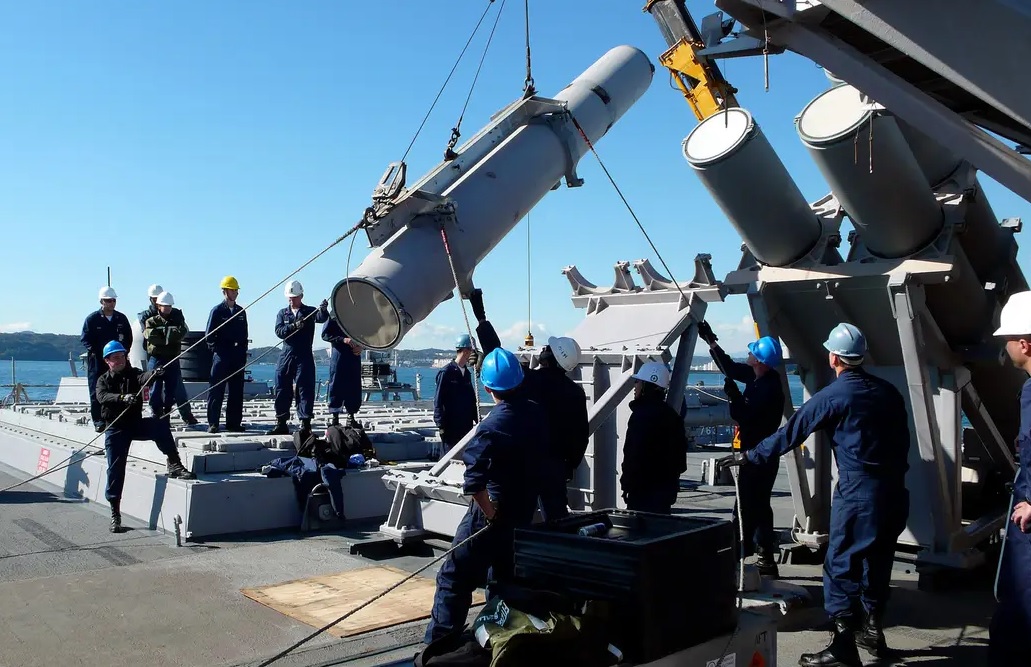
On a related note, below is a photo of a Harpoon canister being loaded on a rack, for those of you who are wondering about reloading at sea during a battle.  Sorry, can’t be done with the current arrangement. 


Harpoon Canister Being Loaded Onto Rack


On a related, related note, you may recall that the Perry class frigate’s Mk13 single arm missile launcher had a 40-missile magazine that could accommodate a mix of Standard and Harpoon missiles.  That old, obsolete ability to carry a large number of anti-ship missiles is starting to look pretty good, now, isn’t it?


Perry Class Mk13 Missile Launcher


Monday, November 7, 2022

Pounce

The Captain of the Independence variant LCS was frustrated and angry and he was taking it out on the poor radar operator.  The ship had been hiding amongst the Philippine islands for the last six days, searching for a target and had found nothing despite the heavy Chinese presence.  The LCS was part of the Navy’s distributed lethality operation and pre-war distributed lethality doctrine had assured the Captain that networked regional surveillance assets would provide situational awareness and targeting data without the LCS needing to conduct active searches. 


Reality, however, disagreed with the Navy’s plan.  The UAVs and P-8 Poseidons that the Navy had counted on for surveillance and targeting were being shot down as quickly as they arrived in the operational area and the Navy had now suspended aerial surveillance operations.


Prior to the Taiwan invasion which had kicked off the war, the Chinese had taken a page out of the US Marine’s book and established numerous bases on Philippine islands with the intent to use the Philippines as an outpost to guard the southern approaches to Taiwan thereby cutting off any attempt by the US to flank the invasion. In a master-stroke, the Chinese had persuaded (coerced?) the Philippines to ban US presence or overflights during the run up to war and the Chinese had used the time and freedom from observation to pre-position base materials at numerous locations throughout the islands.  The Chinese now had multiple radar, IR, optical, and sonar observation posts set up throughout the islands.  In addition, Chinese aircraft were operating from their few carriers and from Philippine civilian airports which the US refused to attack for political reasons.  Unlike the Marine’s plan, the Chinese had control of the sea and the sky and were, thus, able to support their forward bases.


The LCS was part of the Navy’s distributed lethality operation aimed at neutralizing the Chinese naval presence in and around the Philippines and opening up the southern approach to Taiwan.  So far, however, this particular LCS had been searching for targets with no success.  The radar operator went over the difficulties of their situation yet again with the Captain, explaining that the very islands that interfered with Chinese search radars and protected the LCS from detection also prevented the LCS from seeing beyond and around the islands for targets.  In addition, the ship’s radar could only be operated in very short ‘bursts’ or else it would be detected and pinpointed.  It was far more likely that any detections by either side would be from optical sensors rather than radars.  Of course, optical sensors were just as impaired by the surrounding islands as were the radars. 


While the Captain understood the search challenges of the situation, he couldn’t help but wish that he had more skilled sensor operators.  The unfortunate reality was that, like all LCS crewmen, the sensor operators were cross-trained and had multiple job responsibilities.  This meant that their training and time on task was necessarily limited.  The operators were competent but not experienced or exceptionally well trained and in this kind of life and death situation, merely competent wasn’t good enough.  Exceptional was the only passing grade in combat.  This was an unforeseen detrimental effect of the Navy’s decision to pursue minimal manning for the LCS.  The saying, jack of all trades and master of none, certainly applied to the LCS crew, in general, and the sensor operators, in particular, and, unfortunately, ‘master of none’ was not the path to success in combat.


The LCS had only one more day left on station before it would be forced to retire for scheduled maintenance.  The LCS maintenance model of returning to port every couple of weeks was proving to be a severe limitation and liability in war.  The Navy had, initially sent two LCS ‘tenders’ – actually, Puller class Afloat Forward Staging Bases – to service the LCS vessels so as to enable them to stay in the operating area longer but, being non-stealthy and having no credible self-defense capability, both ships had been quickly spotted and sunk.  Now, with Guam having been rendered inoperable in the first hour of the war, the nearest maintenance and resupply location was Northern Australia, some 2000 miles to the south.


Cognizant of his ship’s time constraint and sensor limitations, the Captain decided to take a calculated risk and venture out from the relative safety of the island shore the ship was currently nestled up against.  Venturing out would offer an improved field of view for his sensors but it would equally offer the Chinese sensors a better view of the LCS.


LCS Hiding Near Island

As night fell, the LCS slowly sailed out into more open waters.  While darkness did not provide the concealment that it once did, the Captain felt that his ship would have a bit of an advantage when it came to optical detection since it was somewhat smaller and, thus, harder to detect than the larger Chinese destroyers believed to be operating in the area.


As the hours ticked by, tensions aboard the LCS rose.  The crew had been at their battle stations almost continuously since entering the operating area six days ago.  The LCS minimal manning concept was proving incompatible with wartime operations.  The crew was exhausted and beginning to lose concentration and they were making mistakes – yet another reason to return to base soon.


Despite the fatigue and strain, the Captain’s gamble paid off.  An electro-optical sensor operator spotted the faint shadow of a ship against the horizon, some 15 miles distant.  Maneuvering to keep the now distant island at his back in order to hide the LCS silhouette, the Captain began to stalk his target, trying to obtain visual identification.  While any ship in this area was certainly an enemy, he wanted to have some idea of what type of ship it was so that he could tailor his attack to maximize his chances while also trying to minimize his weapons expenditure.  The LCS only had eight Naval Strike Missiles (NSM) and using them all on, say, a small patrol boat would be a waste that could come back to haunt him if another target appeared.


The Captain slowly closed the distance and at around 12 miles, he was fairly certain the target was a Chinese Type 052D destroyer.  It was time to attack.  Besides, he felt he had pressed his luck far enough.  This would be a full salvo of the LCS’ 8 NSM anti-ship missiles.  The destroyer was approximately the equivalent of a Burke and possessed an Aegis-type defense system.  Even 8 missiles might not be enough to achieve a hit but the Captain hoped the element of surprise at such a short range would ensure success.


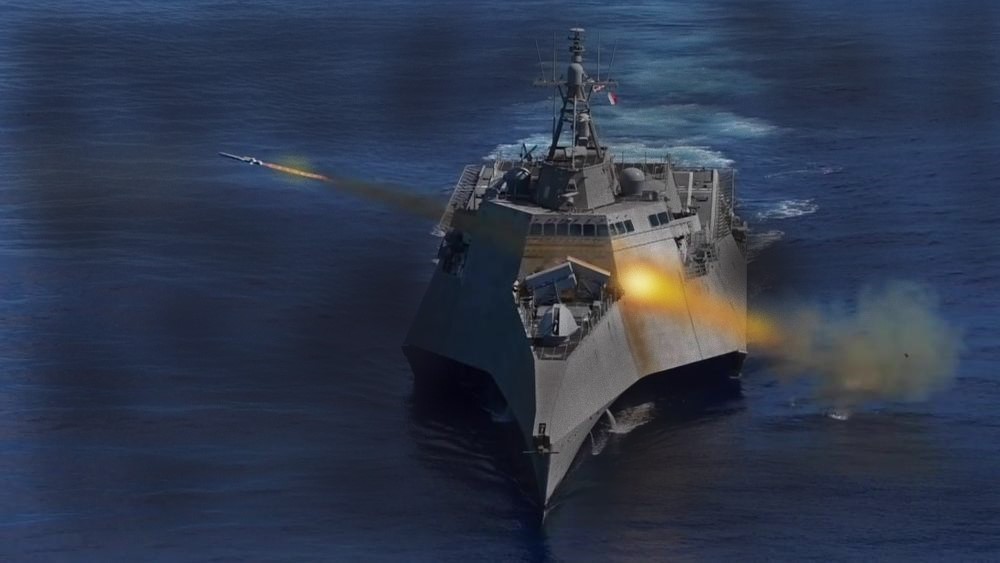
The NSM’s in the rack mounted canisters received the targeting data and launch commenced.  This was a short range, straight-on attack. The flare of each successive missile launch announced the presence of the LCS to the surprised destroyer.  However, the Chinese ship’s combat software had a fully automatic operating mode, like the US Aegis system, and it was not capable of being surprised.  It began to react even as the first US missile cleared it’s launch rack.  The destroyer’s HQ-10 short range surface to air missile system - equivalent to the US RAM - trained to the incoming threat and began launching.  In addition, the destroyer’s 30 mm CIWS trained around and began firing as the chaff/flare dispensers started spewing their decoys into the air and the ship’s electronic jamming emitters activated and focused on the incoming missiles.


LCS Launching NSM at Chinese Destroyer


Only the electronic ‘reflexes’ of a fully automatic defensive system could have reacted to the attack in time.  The Chinese did not believe in a man-in-the-loop concept in wartime and this attack demonstrated the wisdom of that belief.


The first missile, benefiting from the slight delay as the destroyer’s weapon and decoy systems trained and launched, was able to lock on the destroyer and impacted the side of the hangar.  Being thin-skinned and largely open space, the missile nearly passed straight through and out the other side but, instead, managed to explode on the far side of the hangar, blowing a hole in the side and venting much of the explosive force outward rather than having it concentrated inside the hangar.  Fortunately for the destroyer, the ship’s helo was parked outside on the flight deck, undergoing engine run-up tests.  Still, the hangar was heavily damaged.  The two chaff/flare dispensers above the hangar on the unengaged side were put out of action, and the hangar was engulfed in flames.


The second NSM was also able to beat the defensive fire but was lured away by a decoy.  The third missile was hit by the destroyer’s forward-mounted CIWS and dove into the sea.  Electronic countermeasures spoofed the fourth and fifth missiles while the HQ-10 SAMs accounted for the last NSM.


While a single hit against an Aegis-type destroyer was probably all that could be hoped for, the damage to the Chinese ship was not severe and most of the ship’s combat systems were undamaged. 


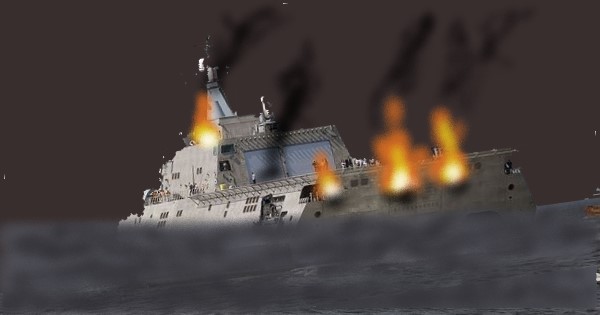
Having been discovered, the destroyer activated its radar and immediately locked on to the LCS which had turned away as soon as it finished launching its missiles and gone to its maximum speed of around 37 kts.  Unfortunately, that speed meant nothing to the four YJ-18 anti-ship cruise missiles the destroyer launched.  The LCS’ 11-cell SeaRAM, the ship’s only defensive weapon, managed to intercept two of the incoming missiles and one missile was decoyed away but the remaining missile hit the stern of the fleeing vessel, entering the mission bay, exploding, and disabling the propulsion system while sending debris and flaming fuel nearly the length of the ship.  With insufficient crew to even attempt damage control, the Captain, miraculously still alive, ordered the crew to abandon ship.


LCS Abandoned and Sinking


Of the eight LCS sent to the Philippines to implement the distributed lethality concept, four were sunk before being able to find a target.  Three others launched attacks resulting in two enemy ships damaged but not sunk and each LCS was, itself, sunk immediately after their attacks.  One LCS survived to return to base, having found no targets.


_________________________________ 


Disclaimer:  This short story was intended to present several of the distributed lethality issues and concepts that we’ve discussed.  As always, such stories are not meant to be fully accurate combat simulations but, rather, are simply a more entertaining way to present the concepts and understand how they are related.


Thursday, November 3, 2022

Submarines and ASW in the China War

The US military recognizes that the geography of the Pacific region dictates that a war with China will be a naval and air war.  What’s more, an astute - or just semi-literate – naval analyst will recognize that the war will be, substantially, a submarine war.  Of course, US Navy admirals do not qualify even for the semi-literate classification so who knows whether they recognize this or not?  Regardless, the rest of us recognize the primacy of the submarine in this conflict.  With that understanding, let’s take a closer look at  submarine warfare and its counter, anti-submarine warfare (ASW), in a war with China.


Numbers


The obvious starting point is numbers and both sides have submarines – something the US Navy seems to forget/ignore so let’s check each side’s respective submarine numbers.


China


China has around 64 submarines of all types with the majority being SSKs.  Excluding the SSBNs, the total is 56.  Obviously, it is very difficult to know exact numbers and there is some uncertainty about the active/inactive status of some vessels.  Acknowledging that, the numbers break down as follows:


Type

Class

Qty.

SSN

Han class (may be inactive/reserve)

3

SSN

Shang I class (Type-093)

2

SSN

Shang II class (Type-093A)

4

SSBN

Jin class (Type-094)

8

SSK

Ming class (Type-035)

4

SSK

Song class (Type-039)

13

SSK

Yuan class (Type-039A/B)

18

SSK

Kilo class (Project 877/Project 636/Project 636M)

12


Total

64


In addition, China maintains many older SSKs in reserve status and these could play a pivotal role in a sustained war after both sides lose many of the front line submarines.


United States


The US currently has 68 active submarines that break down as follows:


SSBN 14

SSGN 4

SSN 50


Of course, unless we enter a nuclear war with China, the 14 SSBN are of no combat use which leaves us with 54 combat submarines compared to China’s 56. 


In addition, the US is still on the long anticipated downward trend which is projected by the Navy’s latest 30 year plan to bottom out at a low of 46 SSN in 2028 and will not reached a sustained 50+ level again until 2034.  This also assumes no additional early retirements – not a bet I’d care to take.


So, at the moment, the US and China have equal numbers of submarines with China being mostly an SSK force and the US being exclusively nuclear. 


SSK


United States naval observers keep clamoring for SSKs because they are so quiet and effective.  Turning it around, that must mean that Chinese SSKs are a major threat to us. 


Given the geography of the East and South China Seas, where combat can be reasonably anticipated to take place, China’s conventional submarines have significant advantages related to acoustics and stealth.  The traditional disadvantages of SSKs – range, endurance, low speed, etc. don’t really apply when operating so close to home ports.  Therefore, China, with a fleet of 47 SSKs enjoys a potentially significant tactical advantage, being able to saturate chokepoints and operating areas with extremely quiet, nearly undetectable submarines that suffer few of the SSK disadvantages.


Should the Chinese submarines attempt to venture out from the first island chain, the advantage would flip to the US with its nuclear subs.


Chinese Yuan Class SSK 


SOSUS


China has established a network of SOSUS-like listening arrays throughout the first island chain.[1, 2]  US submarines will have a difficult time penetrating the first island chain and operating undetected. 


On a related note, China has acknowledged having listening stations monitoring undersea activity around Guam.


The Chinese government has revealed the existence of two underwater sensors situated between the United States island of Guam and the South China Sea. …


The state-run Chinese Academy of Sciences only disclosed the pair of acoustic sensors earlier in January 2018, but had been operating them since 2016, according to a report from the South China Morning Post. One of them is in the Challenger Deep, located at the southern end of the Marianas Trench and the deepest known point on earth, and the other is situated further west near the island of Yap, part of the Federated States of Micronesia. Both reportedly can pick up acoustic signatures more than 620 miles away, putting them within range of Guam and the major strategic U.S. naval base at Apra Harbor.[3]


Similarly, the US and Japan have reportedly established a network of listening arrays throughout the first island chain and extending into the Indian Ocean.[4]  Chinese subs will have a difficult time operating undetected.


Since both sides operate listening arrays, this would seem to favor neither side.  However, the extreme quiet of the SSKs might seem to offer an advantage to China.


ASW


The US has much greater experience and institutional knowledge about ASW although the Navy seems intent on squandering that advantage by refusing to produce combat-effective ASW assets.  For example, the P-3 Orion was not suited to operating in contested areas and replacing it with the nearly identical P-8 Poseidon was foolish.  The LCS-ASW variant has been officially abandoned, leaving the Navy with no dedicated ASW surface vessel.  The Burkes, while ASW-capable, in theory, are woefully deficient in training and are far too expensive to risk playing tag with Chinese SSKs.


To compensate, the US needs to focus its submarine force o on ASW, dropping strike, ISR, special ops, and any other non-ASW mission.  This singular focus is necessary to produce maximum competency and thereby negate China’s SSK advantages.  New submarine designs and construction with this singular focus would have the effect of making subs cheaper (no VLS) and, therefore, more numerous.  It also makes them smaller and quieter.  All else being equal, smaller is harder to detect than larger.  VLS serves no purpose for the submarine’s main mission of ASW or even its secondary mission of anti-surface warfare.  If we want land attack subs then we should build dedicated SSGNs.


The US desperately needs to begin realistic, intensive ASW training using actual SSKs as enemy surrogates.  Some time ago we leased the services of an SSK for such training but we ended that practice and no longer have dedicated training against SSKs, as far as I know. 


Where is our Top Gun for submarines where dedicated enemy sub simulators and surrogates operated by exquisitely trained instructors specializing in enemy tactics teach submariners how the enemy will fight and how to defeat them?  We don’t have such training.  The Navy has made noises about establishing such an organization but has, thus far, failed to provide actual SSKs and dedicated OPFOR crews to man them.  Without that, any minor training efforts are just paper exercises.


Closely related to ASW training is the practice of anti-ASW, meaning the evasion and escape from, and defeat of, enemy ASW forces?  To the best of my knowledge we do not practice that at all.


Confined Waters


Confined, often shallower waters present unique characteristics when compared to the open ocean, deep sea waters that US submarines are used to operating in.  Salinity, density, thermoclines, depth, conductivity, acoustic propagation, etc. are all different inside the East and South China Seas.  This confers a familiarity that gives Chinese submarines a ‘home field’ advantage.  Are we actively and aggressively collecting data on the physical characteristics of the waters inside the first island chain?  I would hope so but I’m not aware of any sustained program along those lines.


The differing physical characteristics dictate different submarine tactics than those used in open ocean scenarios.  Are we practicing confined water (E/S China Sea) submarine tactics?  Again, I would hope so but there are no programs that I’m aware of.  While there may well be physical characteristics data collection that I’m not aware of, it is far less likely that there are tactics programs that I’m unaware of.  I know for a certainty that there is no equivalent to Top Gun.


Summary


Both sides have equal numbers of submarines with China leaning heavily towards SSKs while the US favors nuclear subs.  Both sides have listening arrays which possibly confers a slight advantage to the Chinese SSKs.


One would hope that we are diligently working on locating Chinese SOSUS arrays and have lans to destroy them at the outset of war.  Finding and planning/training for the Chinese SOSUS destruction would be a worthy mission for SEALS instead of being a land combat force in the Middle East.


Neither side possesses useful, tactically relevant ASW forces.  P-8s cannot survive in the anticipated operating area.  US surface forces are nearly inoperable as regards ASW.  When war comes we will not risk Burkes conducting ASW and, indeed, would be foolish to do so.  Burkes are nearly non-functional due to lack of training.  The LCS has been eliminated as an ASW asset. 


On the other hand, China is completely without submarine or ASW experience and likely has little acoustic data on US submarines.


The winner of the submarine/ASW fight will win the war and the winner will be the side that trains the hardest and most realistically.  While I have no knowledge about Chinese submarine warfare training, I can say that the US is not training hard, is not training productively, and is not training realistically.  That doesn’t bode well for us.


We just don’t seem to be serious about war.


__________________________________


[1]Forbes website, “China Builds Surveillance Network In South China Sea”, H. I. Sutton, 5-Aug-2020,

https://www.forbes.com/sites/hisutton/2020/08/05/china-builds-surveillance-network-in-international-waters-of-south-china-sea/?sh=68ef686d74f3


[2]http://www.hisutton.com/Cn_Underwater_Great_Wall.html


[3]Drive website, “China Reveals It Has Two Underwater Listening Devices Within Range of Guam”, Joseph Trevithick, 30-Jun-2019,

https://www.thedrive.com/the-war-zone/17903/china-reveals-it-has-two-underwater-listening-devices-within-range-of-guam


[4]https://defence.pk/pdf/threads/fish-hook-sea-bed-sosus-network.448398/