Continuing on a little bit of an acquisition theme, we have
become conditioned to think of military acquisition ordering, specifically ship
ordering, as occurring in large quantities.
For example, here’s some planned or built orders for some classes:


But, this was not always the case. In fact, this is an anomaly in the history of
the Navy. Historically, most
shipbuilding programs resulted in small orders.
Consider the following sequential list of combat ship types in the WWII
era and note the size of each class, as shown in the table below.


We see that even in the midst of an emergency wartime crash
construction program that would see the Navy ultimately build a fleet of 6000
ships, the individual class sizes were still very small … stunningly small by
today’s norm.
Even the smaller ships, of which the Navy needed many
hundreds, were built in fairly small quantities as shown below.
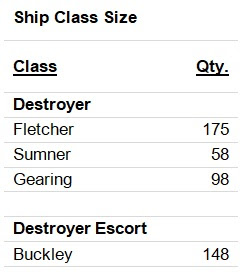
Even these larger destroyer and destroyer escort class numbers
are deceptive in that they were all built in the span of a few years. Thus, although the numbers may have been
larger, the construction period for the classes was very short which is almost
the same as being a very small class as far as how it impacts ordering,
construction, and pricing. Contrast this
with the LCS class, a corvette size ship, which has been under construction for
some twenty years or the 3-ship Zumwalt class which began construction in 2009
and is still continuing, sixteen years later!
Future Proofing
One of the major impacts of class size has to do with the
misguided notion of future proofing, the concept so beloved by so many naval
observers. The idea of future proofing
is that if we build excess capacities (weight margin, electrical power,
internal hull volume, hull length, extra cabling and ducting, etc.) into the
new ship it will be much cheaper to upgrade it in the future as new
technologies emerge. While superficially
appealing, the concept has failed almost completely in practice and has
resulted in more expensive ships that never get ‘futured’, meaning, they never
receive those nebulous, undefined future upgrades.
Future proofing results in compartments that have no
function, cables and ducting that are dead ends, and length, width, and volume
added to the ship for future needs that, history tells us with near 100%
certainty, will never happen. In short,
we increase the cost of ships trying to future proof them despite knowing full
well that we’ll never apply the future upgrades. Instead, when the time comes for adding future
upgrades, the Navy will claim, as they always do, the ships are too old and that
it is no longer cost effective to upgrade the ship and that the ship is too
worn out to be worth upgrading and that we must buy new hulls. How many times have we seen this happen and
yet naval observers keep calling for future proof designs? Remind me, what’s the definition of
insanity? Oh yeah, that’s right …
In WWII, there was zero future proofing built into
ships. Future proofing, meaning the
incorporation of new technology, was handled by building small classes so
frequently that classes with new technologies (or the lessons of actual combat)
were always just around the corner.
Order Size
One might think that industry would love large orders and,
in theory, that would be correct if the Navy ever followed through on the large
order (see, “Follow Through”). In theory, large orders would lend stability
to shipbuilders since they could plan years ahead for their workloads, better
manage workforce levels, and intelligently plan facility improvements. Of course, this is not what happens in
practice. In practice, shipbuilders are
left unsure about future workloads since every program is always on the verge
of being cancelled or reduced, orders surge and wane resulting in frantic
attempts to hire workers followed shortly by layoffs, and facility improvements
and, indeed, basic maintenance, keeps getting pushed into an undefined
‘someday’ that never arrives. What’s the
point of large orders that just get cancelled or reduced?
Contrary to what one might think, small orders actually promote
stability in the shipbuilding industry because industry has a much higher
confidence that the order will be fully carried to completion and that
subsequent small orders are coming.
Large orders have had the effect of reducing new classes and
new projects to near zero. For example,
we’re down to one new combat aircraft order every twenty or thirty years now. This results in one winner in industry
getting all the work for decades (Lockheed Martin and the F-35, for example)
and the other manufacturers being forced to consolidate and/or die due to lack
of work.
It is time to return to the historically more normal
practice of building frequent, small classes of ships with short life spans
(10-20 years). We knew this, once upon a
time, but stupidly abandoned timeless wisdom.
Let’s study our history, recall the lessons, and return to sanity.


