Showing posts with label America Class. Show all posts

Monday, February 28, 2022

Lightning Carrier

The notion of a lightning carrier keeps coming up.  So many people are enamored of this 'lightning carrier' concept without really understanding its capabilities or limitations.  I guess it’s time to examine this concept.


So, what is a lightning carrier?  For this discussion, the concept refers to the use of a big-deck amphibious ship operating an all fixed wing, F-35B, air group.  An example would be an America (LHA) or Wasp (LHD) class amphibious ship with an air wing of around 18-22 F-35B. 


Alternatively, though less common, proponents envision an amphibious ship with a ski ramp and arresting gear allowing the ability to operate F-18 Hornets.  However, this variation on the concept is simply not feasible and we’ll address that a bit further on.


Any discussion of a lightning carrier must start and end with the air wing.  In fact, the term ‘lightning carrier’ really means ‘lightning air wing’ because a carrier, any carrier, is its air wing.  With that in mind, let's review some of the limitations and constraints of a lightning air wing.


Lightning Air Wing


-The F-35B would operate at half the range and payload of an F-35C which is, itself, inadequate for the Pacific theater.  F-35 fanboys won’t accept this but it was clearly stated in an interview with the Ford program manager and documented in an older post.[1]  The range/payload limitation, alone, is reason enough not to pursue lightning carriers!


-A lightning carrier cannot operate a tanker aircraft and the lack of a tanker only emphasizes the aircraft’s lack of range.  Even if a tanker could magically be added to the air wing it would take away a combat aircraft slot from an already meager air wing.  It is possible to take off light on fuel and refuel after take off from some other, unspecified tanker source but there is no way to take off light in weapons and load more in the air!


-Similarly, the lack of an E-2 Hawkeye (AEW) precludes effective air wing control, combat direction, and situational awareness.  It has been proposed that a V-22 could be equipped with a radar as a substitute, however, any AEW V-22 would be a poor man's version of an E-2, at the very best.  It would have a smaller, less powerful radar - whatever type that would be - with resultant shorter effective sensor range which would, necessarily then, place it closer to danger to achieve the required detection and discrimination.  It would lack the room for sufficient consoles, computers, communications gear, and operators for the battle management function which is the true purpose of an E-2.  It would lack the endurance to provide long term coverage.  In short, it would be nearly useless in a high end combat scenario.  It is this same lack that renders the British carrier and air wing nearly pointless for anything other than very low end, low threat work.  Even if a V-22(AEW) were developed, each one added to the air wing would remove a combat aircraft.


-The above also applies to electronic warfare (EW) aircraft although it is, at least, possible to imagine an EW version of the F-35B being developed someday.  Of course, an F-35B(EW) would, again, eliminate a combat aircraft slot.


-We’ve previously demonstrated, in multiple posts, that a carrier needs to retain around two dozen aircraft for self/group defense.  Given that a lightning carrier can only accommodate around twenty aircraft, what does that leave for offensive operations?  Nothing!  At best, the carrier can barely defend itself and without AEW, EW, and tanker aircraft, not even that.  A lightning carrier would exist only to defend its existence which is pointless.


-Now, consider a lightning carrier with a theoretical maximum of 20 F-35B.  Now, add two AEW-modified helo/V-22 and two tankers of some unspecified sort.  That’s four aircraft added to the air wing which means four F-35B combat aircraft have to be subtracted.  That leaves a usable combat component of 16 F-35B.  Is that a useful combat component?  Is it worth operating – and risking – a $4B ship, 1000+ crew, and several escort vessels just to operate 16 F-35B aircraft with limited range and payload?


Lightning Carrier


We’ve examined the air wing.  Now, let’s take a look at some characteristics of the ship, itself.


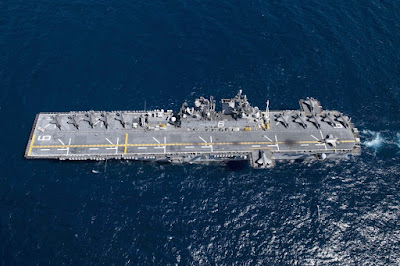
-With no cats or arresting gear, half the deck is dedicated to landing spots.  Below is a photo of the USS America during an Oct 2019 Navy experiment in which the ship was operated as a lightning carrier.  Note the jam-packed deck that contained only 13 F-35Bs and note that half the deck is consumed by the landing spots which are kept clear for normal or emergency landings.
 

USS America Oct 2019

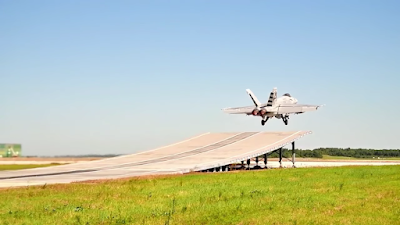
-Some have postulated a ski ramp on an amphibious ship in order to operate F-18s.  Boeing claims that an F-18 can launch from a ski ramp although the conditions of launch (weight, weapons, etc.) are unknown.  Boeing tested the concept from a land based mock up of a ramp as shown in the photo below.[2]  The maximum weapons load that I’ve seen in photos of the tests show two small bombs.  The internal fuel load of the aircraft is unknown.
 

Hornet Ski Ramp Test


Boeing conducted F-18 ski ramp take offs as a preliminary to possible sales of the aircraft to India.


A ski-jump launch may well impose a penalty in terms of the payload the jet can take off with, but Boeing says it has conducted multiple tests with different, undisclosed, kinds of payloads.


According to the company, these tests “show that the Super Hornet would do well with the Indian Navy’s Short Takeoff but Arrested Recovery (STOBAR) system and validate earlier simulation studies.”[3]


Note that Boeing carefully omits any information about payloads which is, undoubtedly, due to the fact that the ski launch requires reduced payloads/fuel.  If it did not, Boeing would be loudly and proudly trumpeting the fact … but they’re not.


A ramp might, at least, enable the use of EA-18G (EW) aircraft but could they take off from a ski ramp with a full load of EW pods?  That’s unknown.  Regardless, every EA-18G means one less combat aircraft from an already very small air wing.


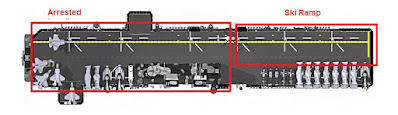
Ski ramps take up huge amounts of deck space and, in the case of operating F-18s, would also require conventional arresting gear which, without an angled deck, prohibitively ratchets up the danger factor of recovery when the inevitable bolter occurs straight down the deck and into the aircraft parked and operating forward.  Danger aside, the combination of ski ramp and arresting gear would consume ¾ of the available deck space which would severely reduce the number of embarked aircraft.


In fact, from visual estimation, I’m fairly sure that a ski ramp and arrested landing area could not fit on an America/Wasp class ship given that they are around 200 ft shorter than a conventional carrier and do not have angled decks.


Below is an overhead schematic of the USS America with my wild estimates of the area needed for a minimal ski ramp and arrested landing area.  In fact, the ski ramp area is probably too narrow for safe take offs.  It should probably be the width of the bow.
 

Lightning Carrier Ski Ramp and Arrested Landing Gear Area


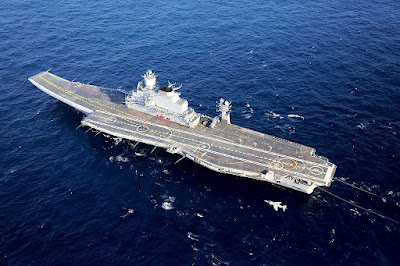
For comparison purposes, here’s a photo of an Indian carrier (932 ft long, overall) with both a ski ramp (the entire bow!) and an angled recovery (almost the entire midships and stern!).  There is simply not much room left for parking the air wing.  Indeed, the air wing is only 26 MiG-29K plus some helos and that’s for a carrier that is nearly the size of a US supercarrier.
 

Indian Carrier - Note Ski Ramp and Angled Deck Arrested Landing Area


-An unmodified amphibious ship could operate a maximum of 18-24 aircraft.  The largest amphibious ship, USS America, intentionally designed for maximum fixed wing capacity, can only operate 22-24 aircraft according to the Navy.  Any other amphibious ship will have even less aircraft capacity.


-An amphibious ship could be modified and rebuilt to operate larger numbers of aircraft but it would require a true rebuild of the ship involving large scale structural changes such as removing bulkheads to create hangar space, reinforcing other areas to compensate for the removed bulkheads, creating new compartments for aircraft maintenance and parts storage, creation of new magazines for added weapons storage, likely construction of additional munitions elevators, creation of additional aircraft control and communication compartments, a greatly enhanced hangar fire suppression system, and so on.  In other words, it would be hideously expensive, with costs likely rivaling or exceeding the original purchase.


Opportunity Cost


So many people are fixated on the idea of comparing our carriers to some other country’s carriers or some multiple number of other country’s carriers and proclaiming that if we have more naval aircraft then we are somehow superior.  Well, unless some country or countries challenge us to a one-on-one carrier match, it’s utterly irrelevant how many carriers or aircraft we have compared to someone else.  What matters is how our overall military force compares to an enemy and, within that context, how our carriers contribute to that overall force and to our overall military strategy (you know … assuming we had one).


The relevant question, then, is does a lightning carrier with its acquisition/conversion cost and operating cost of a crew of a thousands plus a dozen or so escorts justify the meager contributions of twenty or so  significantly limited aircraft and, more importantly, could the cost of this contribution be more effectively spent on any of dozens or hundreds of alternatives?  This is the opportunity cost.  Could the immense operating cost of a lightning carrier group buy us more and better overall military firepower in some other form?  For example, for the operating cost of a lightning carrier group, we could buy untold numbers of cruise missiles, or we could significantly harden multiple forward bases, or we could buy umpteen thousands of tanks, or many dozens of dedicated minesweeper ships, or  … the list of alternatives is nearly endless.


One of the arguments put forth for the conversion of amphibious ships into lightning carriers is that, if we’re getting rid of them anyway because of the Marine’s refocusing on small, hidden, forward bases - and there is no evidence of that, yet - then we could, at least, get some stop-gap use out of them as lightning carriers until they’re retired instead of retiring them early.  Again, this is an opportunity cost issue that goes back to the operating cost for a very meager capability.  Early retirement would free up a lot of operating cost funds that could be applied to any number of other weapon systems, each demonstrably more effective than a handful of limited aircraft.


Supplementing CVNs


Another argument for lightning carriers is that, while they are not equal to a conventional carrier, they could supplement conventional carriers by adding their small numbers of aircraft to the CVNs carrier group and the CVN can, in turn, cover the shortcomings of the lightning carrier. 


Good grief, NO!  A limited, constrained 'carrier' added to a CVN doesn't enhance the CVN, it pulls down the overall capabilities of the CVN group.  This would be analogous to adding a high school basketball player to a professional team.  The high school player doesn't add anything to the pro team, he pulls the overall effectiveness of the pro team down.


By having to split and further spread the CVN's AEW, EW, and tankers to cover the shortcomings of the lightning carrier, the overall effectiveness of the CVN is diluted and decreased.  At best, the handful of limited capability aircraft on the lightning carrier can defend their own carrier.  The lightning carrier would, as we previously noted, exist to defend its existence … the self-licking ice cream cone.


Amphibious Support


While a lightning carrier offers little to the high end air/strike war, it can offer a potentially useful short range strike capability in support of amphibious operations.  Twenty or so F-35Bs operating in support of ground combat could prove somewhat useful although, again, the limited payload and inability to carry some of the larger munitions internally (2000 lb munitions, for example) limit the usefulness.  High end ground combat requires constant ‘artillery’ support and aircraft, any aircraft, can only provide that support sporadically and in very small quantities.  Still, the concept offers some degree of usefulness although at an enormous operating cost.  Think about how many self-propelled artillery vehicles could be purchased for the operating cost of a lightning carrier!


Conclusion


Despite the enthusiastic support of so many naval observers, a rational examination of the lightning carrier concept clearly demonstrates that the combat capabilities of the carrier and its air wing are so minimal that it is not worth the operating cost.  More damning is the opportunity cost associated with the concept which shows that we could acquire far more combat capability, in any number of alternate forms, for the operating cost than can be supplied by the lightning carrier and air wing.


It seems clear that the limited combat capability makes the lightning carrier appropriate for only low end, low threat operations which then takes us right back to the opportunity cost issue.  It’s not even suitable for peacetime patrol type operations because we categorically refuse to use force during routine peacetime operations.  That being the case, there’s no point having a carrier and aircraft around because we won’t use them.


Unfortunately, despite the enthusiasm so many people have for the concept, it just can’t be justified.  It brings too little combat capability for far too great an operating and opportunity cost.


______________________________________


[1]https://navy-matters.blogspot.com/2020/03/ford-design-considerations.html


[2]https://www.aerotime.aero/articles/26767-super-hornet-shows-ski-jump-off-carrier-ramp-india


[3]https://www.thedrive.com/the-war-zone/38324/watch-a-super-hornet-launch-off-of-a-ski-jump-during-testing-aimed-at-the-indian-navy


Thursday, September 9, 2021

Why Are We Building Another LHA?

The Marines have publicly stated that they are out of the amphibious assault business (so why are they buying ACVs?  But, I digress …).  The Commandant has designed his own, personal, slow, defenseless, light amphibious warship (LAW) that will somehow transport troops and supplies deep into enemy waters while remaining undetected.  The new Marine war plan is to use small units to launch missiles at ships and, in some unspecified way, to conduct anti-submarine operations and sink subs.


With that in mind, it would seem that neither the Marines nor the Navy has any use for the multi-billion dollar big deck amphibious assault ships like the America class LHA and the San Antonio LPD and yet the Navy is continuing to build them.  For example,


LHA-8 was laid down Mar-2019 and is currently under construction at Huntington Ingalls Industries (HII) in Pascagoula, Mississippi with delivery expected in 2024.


And,


The FY 2022 budget requests $68.6 million to support a future America class landing helicopter assault amphibious (LHA) ship. (1)


The 2022 National Defense Authorization Act, the military’s main budget, is currently being marked up and Congress appears to be adding funding for the America class LHA, LHA-9, to the shipbuilding budget.  HII received a $107M contract for LHA-9 long lead items in Apr-2021.(2)


America Class - Don't Need 'Em But Still Building 'Em


 The Marines don’t want them.  The Navy can’t use them.  They’re hideously expensive to build and operate. 


So  …  why are we building more LHAs?


This is the kind of head-scratching nonsense that makes me wonder if a lobotomy is a requirement for flag rank.  It certainly appears so.


_________________________________


(1)Highlights of the Department of the Navy FY 2022 Budget, p.2-5

file:///F:/Report%20-%202022%20Budget%20Highlights.pdf


(2)https://defbrief.com/2021/04/20/hii-gets-107m-for-us-navys-fourth-america-class-amphibious-assault-ship/


Monday, October 8, 2018

Aviation Amphibious Assault Ships

The centerpiece of the US amphibious assault force is the aviation capable, big deck LHA/LHD ship such as the America (LHA) and Wasp (LHD) classes.  Even the smaller amphibious ships such as the now standard San Antonio (LPD) class have a significant aviation capability.

The USS America (LHA-6), for example, is a monument to aerial flexibility and power.  The aviation component can vary according to mission needs but a typical mix of aircraft might be 12 MV-22 transports, 6 F-35B strike aircraft, 4 CH-53K heavy transport helicopters, 7 AH-1Z/UH-1Y attack helicopters, and 2 MH-60S helos for search and rescue, according to Wiki (2).  The ship can also be configured to operate as a mini-carrier by dropping the helos and MV-22s and embarking 20 F-35Bs instead.

Even the smaller San Antonio (LPD-17) can operate a mix of several helos and MV-22s.

Collectively, this impressive aviation capability leads me to refer to these imposing vessels as … useless.

Wait, what?

How can that much aviation capability be useless?

For starters, I’ve repeatedly stated that there is no strategic need for amphibious assaults in any war against Russia, NKorea, and China (with the possible but unlikely exception of retaking Taiwan).  There is a slight chance of an amphibious assault against Iran but that would be more along the lines of an unopposed unloading rather than an assault.  With that said, our amphibious fleet offers no useful capability because it simply will never be needed.

For the sake of continued discussion, let’s assume that there is some undefined, non-specific need for amphibious assault.  Let’s take a closer look at the large deck, amphibious fleet of 30+ ships.  What do these aviation amphibious assault ships offer?

The Marines seem to desperately want to become an aviation vertical assault force.  By definition, that means that they can only be a light infantry force since they can’t transport tanks, heavy vehicles, etc. by air.  Worse, such a force can only be a very, very short duration force since it is not possible to sustain an assault by MV-22/helo resupply especially when the likely attrition rates are factored in. 

So, what kind of action does this translate to?  At most, it would be a low intensity, short duration raid or rescue type scenario.  This low level of combat power is simply not useful in peer combat and certainly does not justify the construction and maintenance of a 30+ ship amphibious fleet.  Really, 30+ amphibious ships to service light infantry?  Does that make sense?

Let’s look now at close air support.  Supposedly, the Marines want their “own” carriers so that they can always be assured of air support.  Okay, how much firepower does that air support provide?  A standard Amphibious Ready Group (ARG) consists of three amphibious ships:  an LHA/LHD, an LPD, and an LSD.  The typical attack aircraft totals are 6 F-35Bs and 7 attack helos.  So, what kind of firepower does that represent?

An F-35B can carry a total of 6 air-to-ground weapons (2 internal + 4 external with 2 additional near-wingtip hardpoints for smaller, air to air weapons only).  Therefore, 6 F-35s can deliver a theoretical maximum of 36 weapons per attack “wave”.  Also, note that the F-35B model is limited to 2x 1000 lb bombs internally (the remaining internal mounting points are for smaller, air to air weapons).  So, assuming a maximum 2000 lb bomb on the external hardpoints (I don’t know if this is even a permissible arrangement) plus two 1000 lb bombs internally, the maximum munitions load for a single aircraft would be 10,000 lbs.  Thus, 6 F-35Bs can deliver a theoretical maximum of 60,000 lbs of munitions.

An AH-1Z can carry up to 16 Hellfire missiles or 76 unguided 2.75 inch rockets or 28 guided rockets.  This is a nice “sniper” capability to have in a low end scenario but is almost insignificant in terms of firepower in high end combat.

So, the aviation element can deliver 36 munitions (10,000 lbs) once every few to several hours.  Assuming no aircraft combat losses and minimal maintenance (an invalid assumption since all modern military jets require extensive maintenance for every flight hour), we could, theoretically, generate an aviation attack wave once every, say, six hours, at best.  Doing the math, that’s an average of 6 munitions per hour.  Does that sound like it would have the slightest effect on a Marine assault/battle? 

Of course, the numbers cited are for a Marine Expeditionary Unit and they values would scale up as we move to a MEB/MEF but the relative contributions would remain unchanged.

Now, just for fun, let’s look at a Burke class destroyer providing fire support with its single 5”/54 or 5”/62 gun.  The gun can fire 68 lb shells at a rate of 20 rounds per minute with a magazine of 680 shells (1).  Thus, a single Burke with a single 5” gun can provide 46,240 lbs of munitions and can deliver that amount in 34 minutes, firing at a rate of 20 rpm.  Further, the naval gunfire is always on call, cannot be jammed or decoyed, is impervious to weather conditions, and puts no pilot’s lives at risk.  Of course, this assumes that the Navy is courageous enough to risk a Burke within a few miles of shore and that the targets are within range of the ship’s guns!

At this point, the astute military analyst should be asking, why do we even bother with amphibious aviation ships given the very marginal firepower support they can provide?  Wouldn’t all that aviation money be better spent on naval gun support?

To be fair, we should note that amphibious aircraft can offer weapons delivery further inland than current naval gun support.  Of course, the further inland, the fewer the number of attack waves (sorties) we can generate so that’s a double-edged sword.  Again, the astute military analyst should be asking, wouldn’t all that aviation money be better spent on long range, amphibious, self-propelled artillery that the Marines can bring ashore with them?


Wasp Class LHD


We should also note that much of the amphibious aviation element is geared towards transport rather than weapons delivery.  However, given that current aircraft can’t lift/transport tanks, engineering vehicles, artillery, or any other heavy equipment, the Marines are, by definition, limited to being light infantry when using aviation as the ship-to-shore transport mode.  The astute military analyst should be asking, is it worth the incredible expenditure to build and maintain a 30+ large deck, amphibious fleet just to provide light infantry combat capability?  Couldn’t the Army/Air Force combination provide light infantry anywhere in the world for a lot less money?

So where does that leave us and what can/should we do?

There are several possibilities.

  • In recognition of the Marine’s (now) light infantry capability combined with the unlikelihood of major amphibious assaults in the foreseeable future, eliminate the bulk of the amphibious fleet.  We can retain around 9 ships (3 ARGs) for training and core competency retention or for use in low end scenarios.  Turn the rapid response light infantry role over to the Army/Air Force.

  • Greatly increase our naval gun support capability.  As we have no effective naval gun support, currently, this would entail designing and building a new class of naval gun support ship.

  • Greatly increase the Marine’s organic self-propelled artillery capability.  The challenge with this approach is to get the equipment ashore quickly and early in an assault.

  • Figure out a way to get the current heavy equipment, armor, and firepower from ship to shore in a faster, more survivable way that can put the equipment ashore from outset of an assault.  Since it’s highly unlikely that aircraft could be developed that could provide the necessary lift, this means designing landing craft that are small (sized for individual tanks as the maximum size requirement), fast, and reasonably survivable as part of the initial assault wave.

  • Eliminate aviation-capable amphibious ships and transfer the aviation responsibility to the regular aircraft carriers.  This would greatly streamline aviation maintenance and efficiency.  It would also eliminate the need for the F-35B since the carriers can operate the “C” model.  This would also have the effect of increasing air wing size and employing the wing more effectively until that rare moment, if ever, when we need amphibious air support.  Hand in hand with this would be the relocation of the ground element to smaller, cheaper, pure transport vessels (Attack Transports – APAs, to use the WWII terminology).


Considering that we’re maintaining a fleet of 30+ multi-billion dollar aviation-based amphibious ships for a marginal aviation capability, one has to wonder if the expense is worth it.  Our big deck amphibious ships simply don’t offer high end combat capability sufficient to justify their existence.


_____________________________________

(1)NavWeaps website

(2)Wiki, “USS America (LHA-6)”, retrieved 7-Jun-2018,

Friday, April 8, 2016

America Class and the F-35B

The F-35B is, or will be, inextricably linked to the America class LHA.  The F-35B was built to operate from the America and the America was built, specifically, to operate the F-35B since the ship has no well deck.  My suspicion is that the America was built to be a mini-aircraft carrier rather than an amphibious ship.  America can operate 20 F-35Bs when configured as a mini-carrier.

America was informally commissioned in Jul 2014 and proceeded to sail to San Diego where the ship was formally commissioned in Oct 2014.  In the ensuing 17 months, the ship has spent the majority of the time in dock and has just now returned to duty after spending the previous ten months undergoing upgrades to accommodate the F-35B.  Upgrades included strengthening the flight deck, adding soundproofing, rearranging and restructuring compartments immediately under the flight deck due to noise issues, hangar modifications, and treating the flight deck with a specially designed thermal coating to accommodate the massive heat load of the F-35B.  As a USNI News article puts it,

“The aviation-centric big deck was commissioned in late 2014 but required additional work to take the day-to-day strain of operating the short takeoff and vertical landing (STOVL) strike fighters that will operate from the ship.” (1)

Apparently, no one realized the impact the F-35B would have on the ship that was designed to operate it.  That’s some pretty major design flaws in a ship that was specifically designed to operate the F-35B! 

This also illustrates the on-going impact of the F-35B on the entire military.  The cost of the F-35B program extends well beyond the “mere” cost of the aircraft’s construction.  I have seen no figures beyond an initial $32M contract for normal post-shakedown work but what do you think a 10 month upgrade/rebuild effort on the America cost?  It’s got to be hundreds of millions of dollars.  Further, the next ship in the class, LHA-7, will also require extensive refits after completion which is more money to make the F-35 program work.  The Navy’s website makes it clear that the vast majority of the 10 month upgrade period is due strictly to the F-35.

“America is more than halfway through its post-shakedown availability period (PSA) in which the ship's crew and contractors make improvements to the ship's design. About 20 percent of the work being performed is the normal maintenance associated with PSAs for newly constructed ships. The rest of the maintenance consists of the upgrades designed to support the JSF.” (2)

Beyond the cost, the work required the ship to be idled for 10 months.  Thanks to the F-35B, the America has been in dock for 10 of its 17 months in commission.  The ship’s two year anniversary is coming up and it has yet to deploy.


(1)USNI News, “USS America Back to Sea After Completing 10-Months of Deck Strengthening for F-35s”, Sam LaGrone, March 22, 2016,

(2)navy.mil, “America Modifications Increase Air Capabilities”, USS America (LHA 6) Public Affairs, 8-Dec-2015,