Showing posts with label Naval History. Show all posts

Monday, June 8, 2026

Lessons From Truk

How often have we seen comments stating that our carriers are hopelessly outmatched against China because a carrier has only around forty combat aircraft (160 in a 4-carrier group) and China has thousands of aircraft?  As good naval analysts always do, let’s turn to history to see what lessons we can learn that might be applicable.  A salient example is the US Navy’s WWII attack on Japan’s Truk island bases on 17–18 Feb-1944.
 
Truk was the major Japanese base in the South Pacific and was referred to as the "Japanese Pearl Harbor" and "the Gibraltar of the Pacific”.  It was believed to be heavily defended, fortified, and nearly impregnable with five airfields and a seaplane base and large numbers of warships.
 
It was feared that an attack on Truk would be quite costly and might well not succeed.  Despite this, an attack was ordered (Operation Hailstone) and conducted by three carrier task forces consisting of 5 fleet carriers  (Enterprise, Yorktown, Essex, Intrepid, and Bunker Hill) and 4 light carriers (Belleau Wood, Cabot, Monterey, and Cowpens) along with seven battleships, including Iowa and New Jersey, and many cruisers and destroyers.
 
The US carriers employed their usual run in under cover of night and pre-dawn launches to begin the attacks and achieved total surprise.  The result was a completely lop-sided victory for the US and Truk was never again a significant threat.
 
As it turned out, the Japanese had already begun withdrawing major naval units from Truk prior to the attack but that does not lesson the courage and skill of the attackers.
 
What can we learn from this?
 
Surprise – Surprise has forever been a major contributor to success on the battlefield and there is no better instrument for achieving surprise on the naval battlefield than a carrier group (submariners might argue that!).  In WWII, carriers conducted high speed run ins to their target under cover of night.  Today, darkness offers less cover but the tactic is still valid.  A carrier at sea is generally “invisible” and can show up anywhere at any time.  An enemy’s superiority can be decisively overcome if surprise can be achieved.  The art and task of the military planner is to arrange matters so as to achieve surprise.
 
Localized Superiority – It doesn’t matter how many assets the enemy has in its total inventory.  What matters is how many are instantaneously available at the point and moment of attack – a concept that seems to elude many of today’s naval observers.  The Japanese had superior numbers of aircraft when the initial US fighter sweep arrived but the Japanese aircraft were largely caught on the ground (see, Surprise, above) thus enabling the US to establish and maintain local, effective superiority.  As long as the attacking force doesn’t hang around too long, local superiority can be achieved and maintained for the duration of an operation.  Thus, the oft claimed superiority of numbers of Chinese aircraft in their total inventory is meaningless.  What matters is how many they can put into the air at the moment of attack.  Even having superior numbers locally is meaningless if surprise is achieved and the aircraft are caught on the ground.
 
Firepower – In addition to the hundreds of attacking aircraft, the US utilized large caliber naval guns on its battleships and cruisers to bombard bases and facilities on the islands and sink several fleeing ships, thus effectively supplementing the carrier aircraft.  As devastating as the air attacks were, nothing compares to large caliber naval gunfire for effective, sustained, unstoppable (with air superiority established!) destruction.  This is a lesson the Navy has completely forgotten.  We have no surface firepower and will one day rue the absence.  Large caliber naval guns are a devastating weapon and it is the responsibility of the naval planner to recognize that and work to bring that firepower into play, as appropriate.
 
Another aspect of firepower is numbers of delivery platforms.  The attack on Truk succeeded due to the immense numbers of carrier aircraft involved (500 aircraft).  An aircraft can only deliver a very limited amount of firepower and has no ability to sustain that delivery without returning to its base/carrier to rearm which means aerial firepower can only be applied sporadically.  This limitation was overcome at Truk (and throughout the war) by applying huge numbers of aircraft.  Each individual aircraft carried an almost insignificant amount of firepower but numbers compensated.  Our carrier air wings, today, consist of only around thirty actual combat aircraft (subtracting out combat aircraft relegated to tanker duty because we idiotically gave up our tankers without replacement).  We’ve forgotten that quantity matters when it comes to delivering firepower.
 
Courage – Last but not least, Truk teaches us the importance of courage.  At the time, there was a great deal of trepidation about an attack on Truk but we went ahead anyway.  Today, we have far too many Chicken Littles who see nothing but doom and gloom and are unwilling to take the slightest risk. 
 
Who Dares, Wins
Fortune Favors the Bold
 
These are the mottos and philosophies we should be living by, not
 
What Will the Chinese Think?
We Can’t Risk Escalation
 
Look at all the people, including within the military, who are terrified by the mere thought of engaging Iran, a third rate military, at best, certain that we cannot win.


As with any battle throughout history, there are important lessons to be learned and, as with every battle throughout history, the Navy is deaf, dumb, and blind to the lessons history is screaming at us.

Monday, February 23, 2026

Where Did It All Go Wrong?

Clearly, today’s Navy is badly broken in almost every respect but that wasn’t always the case.  In WWII, the Navy was an efficient, deadly, fighting force that knew how to produce warriors and ships on a routine basis.  What changed between then and now?  Where did it all go wrong?
 
Let’s start with the “what changed”.
 
What changed is the focus. From the early 1900's (pre-WWI) on, the Navy had an intense focus on combat effectiveness (with a few notable exceptions such as the WWII faulty torpedo fiasco).  After the late 1950's and early 1960's, the war veterans (those who understood combat and designed ships to meet that requirement) retired leaving people whose focus shifted from combat to career. The focus became empire building, budget pursuit, and career enhancement rather than combat-effective ship and fleet design and procurement.  Without the crucible and filter of combat to weed out the incompetent, idiots who were politically adroit took over and foolish policies became the norm.
 
Okay, that’s clear enough.  Now, when did it happen?  What event triggered the shift?  Let’s check some noteworthy events in history that lead to our current state of affairs.  Some of the events were even hailed at the time as great achievements.  Here’s a chronology (nowhere near all-inclusive!) of events that clearly traces the rise of incompetence:
 
 
General Board (1951) – The Board was dissolved by CNO Forrest Sherman in a move to consolidate his power.  This began the shift in focus from combat to bureaucracy and career.
 
Spruance (1970) – This was the point at which the Navy abdicated its design responsibility and relinquished it to industry as a result of the Total Package Procurement concept originated by the Whiz Kids of SecDef Robert McNamara.  There has been a steady downhill erosion of technical capability and competence by the Navy ever since.
 
Adm. Zumwalt’s Hi/Lo Policy (1970’s) – instead of building the fleet we needed, he settled for the fleet he could get; he compromised the nation’s security and naval strength and institutionalized mediocrity and acceptance of inferiority.
 
Note that my rejection of hi/lo does not mean that we want a fleet of all battleships and carriers.  We need smaller combatants because there are some functions they can fill better than larger ships.  A mix of large and small combatants is not an example of a hi/lo mix, it is an example of a balanced fleet whose needs are all met.  Hi/lo, on the other hand, is an example of an unbalanced fleet that lacks vital levels of warships and attempts to compensate by substituting larger numbers of smaller ships.
 
Offsets (1980’s) – This introduced the pursuit of technological leaps instead of consistent, steady, evolutionary development.  Unfortunately, it has failed every time.
 
Fall of the Soviet Union (1991) – This eliminated all the remaining intense focus on combat that the Navy had.
 
2-1/2 War Abandonment (1993) – Being able to fight and win 2-1/2 wars was the long time standard requirement by which we sized and composed our military.  When that proved expensive (duh!), instead of making the case for it to Congress, the military began adopting a series of ever-shrinking requirements leading to the current “1 regional conflict (not even a war) plus holding against another.  The threat level did not change and yet the requirement shrank, justified by budget rather than threat.
 
Minimal Manning (1990’s) – This began the physical decline of the fleet as maintenance was deferred and ships were allowed to, literally, rot.  This also instituted and formalized the Navy’s acceptance of cripplingly lowered standards of readiness.
 
Concurrency (2000’s) – This god forsaken practice has cost the Navy dearly and has failed miserably every time it’s been attempted and yet the Navy continues to practice it.
 
Unmanned (2000’s) – This marks the Navy’s public and formal acceptance of insufficient combat power in the pursuit of technological fads.  Instead of doing the hard work of evolutionary development, the Navy institutionalized the pursuit of magic beans and the delusional, lazy, easy way forward.
 
Diversity (2010’s) – This marked the Navy’s formal recognition of priorities other than combat effectiveness.


And here we are, today.  It’s clear that there was no single event that crippled the Navy but, rather, a creeping rot evidenced by a series of misguided (to be polite) actions over the years.
 
Ironically, many of the flawed actions were praised at the time they were implemented but only by people who did not have a combat focus.  Looking back, it is easy to see the actions for the mistakes they were.  Our current failure is our inability to see the failings and course correct.

Wednesday, May 21, 2025

Ship Order Quantities

Continuing on a little bit of an acquisition theme, we have become conditioned to think of military acquisition ordering, specifically ship ordering, as occurring in large quantities.  For example, here’s some planned or built orders for some classes:


But, this was not always the case.  In fact, this is an anomaly in the history of the Navy.  Historically, most shipbuilding programs resulted in small orders.  Consider the following sequential list of combat ship types in the WWII era and note the size of each class, as shown in the table below.


We see that even in the midst of an emergency wartime crash construction program that would see the Navy ultimately build a fleet of 6000 ships, the individual class sizes were still very small … stunningly small by today’s norm.
 
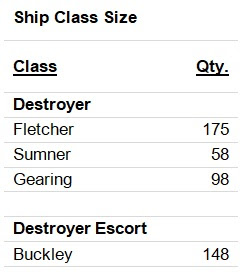
Even the smaller ships, of which the Navy needed many hundreds, were built in fairly small quantities as shown below.


Even these larger destroyer and destroyer escort class numbers are deceptive in that they were all built in the span of a few years.  Thus, although the numbers may have been larger, the construction period for the classes was very short which is almost the same as being a very small class as far as how it impacts ordering, construction, and pricing.  Contrast this with the LCS class, a corvette size ship, which has been under construction for some twenty years or the 3-ship Zumwalt class which began construction in 2009 and is still continuing, sixteen years later!
 
 
Future Proofing
 
One of the major impacts of class size has to do with the misguided notion of future proofing, the concept so beloved by so many naval observers.  The idea of future proofing is that if we build excess capacities (weight margin, electrical power, internal hull volume, hull length, extra cabling and ducting, etc.) into the new ship it will be much cheaper to upgrade it in the future as new technologies emerge.  While superficially appealing, the concept has failed almost completely in practice and has resulted in more expensive ships that never get ‘futured’, meaning, they never receive those nebulous, undefined future upgrades.
 
Future proofing results in compartments that have no function, cables and ducting that are dead ends, and length, width, and volume added to the ship for future needs that, history tells us with near 100% certainty, will never happen.  In short, we increase the cost of ships trying to future proof them despite knowing full well that we’ll never apply the future upgrades.  Instead, when the time comes for adding future upgrades, the Navy will claim, as they always do, the ships are too old and that it is no longer cost effective to upgrade the ship and that the ship is too worn out to be worth upgrading and that we must buy new hulls.  How many times have we seen this happen and yet naval observers keep calling for future proof designs?  Remind me, what’s the definition of insanity?  Oh yeah, that’s right …
 
In WWII, there was zero future proofing built into ships.  Future proofing, meaning the incorporation of new technology, was handled by building small classes so frequently that classes with new technologies (or the lessons of actual combat) were always just around the corner.
 
 
Order Size
 
One might think that industry would love large orders and, in theory, that would be correct if the Navy ever followed through on the large order (see, “Follow Through”).  In theory, large orders would lend stability to shipbuilders since they could plan years ahead for their workloads, better manage workforce levels, and intelligently plan facility improvements.  Of course, this is not what happens in practice.  In practice, shipbuilders are left unsure about future workloads since every program is always on the verge of being cancelled or reduced, orders surge and wane resulting in frantic attempts to hire workers followed shortly by layoffs, and facility improvements and, indeed, basic maintenance, keeps getting pushed into an undefined ‘someday’ that never arrives.  What’s the point of large orders that just get cancelled or reduced?
 
Contrary to what one might think, small orders actually promote stability in the shipbuilding industry because industry has a much higher confidence that the order will be fully carried to completion and that subsequent small orders are coming.
 
Large orders have had the effect of reducing new classes and new projects to near zero.  For example, we’re down to one new combat aircraft order every twenty or thirty years now.  This results in one winner in industry getting all the work for decades (Lockheed Martin and the F-35, for example) and the other manufacturers being forced to consolidate and/or die due to lack of work.
 
It is time to return to the historically more normal practice of building frequent, small classes of ships with short life spans (10-20 years).  We knew this, once upon a time, but stupidly abandoned timeless wisdom.  Let’s study our history, recall the lessons, and return to sanity.

Monday, May 12, 2025

Surface Ship Aviation

It has been some 80+ years since WWII and in that time we have seen some truly remarkable advances in tank design, aircraft design, missile development, sensors, etc.  One would think that ship design would have advanced at least as much and yet this is clearly not the case.  Not only has ship design not advanced, in many respects it has regressed.  Armor, weapon density, survivability, redundancy, endurance, sailing range, etc. have all regressed.  Well, at least we can say that surface ship aviation has advanced with the development of the helicopter … right?  Or has it?  Let’s look.
 
As a reminder, WWII US cruisers typically carried four seaplanes operated from two catapults and recovered with one or two cranes.  The seaplanes they used included, primarily, the OS2U Kingfisher and, at other times in the war, the Curtis SC-1 Seahawk and Curtis SOC Seagull.  Today, Burke class destroyers Flt IIa and beyond carry one SH-60 type helo (theoretically capable of two but never done, as far as I know) and provision for a small Fire Scout type UAV which have rarely been used and are being phased out (see, “Fire Scout Status”).  Flt I/II Burkes, have no hangar and carry no helos.  The Constellation class carries one SH-60 type helo and one Fire Scout type UAV.  The LCS carries one SH-60 type helo and one Fire Scout or smaller UAV.
 
 
Aircraft
 
Just as the value of an aircraft carrier is wholly dependent on the size and abilities of the air wing, so too is the surface ship aviation value dependent on the aircraft they carry.  Following is a comparison of the primary aircraft from WWII surface ships and today’s surface ships.


OS2U Kingfisher


Discussion
 
The main function of ship’s aviation both in WWII and today is scouting/targeting.  In WWII, ship’s planes, with a few hundred miles of search radius and an enemy ship speed of advance of only 30 kts maximum, a ship/scout could ensure the ship’s safety for the better part of a day.  Today, with enemy weapons having a speed of advance of several hundred miles per hour or more, long range searches are more critical than ever and yet today’s shipboard aircraft have around half the range of WWII aircraft.  Does that make sense?  What ship designer thought, “Hey, let’s cut the range of our shipboard aviation in half and go with that.”  and everyone agreed with him instead of laughing him out of a job?
 
The other notable regression is in the number of embarked aircraft.  A WWII cruiser carried four aircraft.  Today’s ships carry one full size helo and a small UAV.  Quite a drop!  Admittedly, a WWII cruiser is a bit bigger than even a Burke but the WWII cruiser also didn’t have the 100 ft flight deck and enormous hangar that a Burke has.  Approximately one third of a Burke’s total length is devoted to aviation.  WWII ships devoted almost no length to aviation.  Catapults were placed wherever there was a small amount of room available, including on top of gun turrets!  

The one area where an argument can be made that aircraft have significantly improved is anti-submarine warfare (ASW).  Helos have proven quite useful and effective at this thanks to sonobuoys, dipping sonar, and air-dropped torpedoes.  Unfortunately, the reduction in number of embarked aircraft have rendered the ASW helo only marginally useful unless several ships can pool their aircraft.  As the saying goes, if you have one helo, you have none.  This is recognition of the very high maintenance demands of helos and their inability to maintain a high readiness rate.
 
So, while ASW helos are theoretically significantly improved, the reality of reduced numbers and readiness rates have rendered any theoretical improvement only marginally useful.
 
As with so many other aspects of ship design, today’s surface ship aviation capabilities have not significantly improved and have, in many ways, regressed.  Today’s ships carry fewer (half or less) aircraft with significantly shorter ranges.  
 
How can we address the shortcomings in surface ship aviation?  We have, potentially two possible alternatives to today’s aviation problems:
 
1. Revert to shipboard seaplanes.  With modern engines, enhanced aerodynamic designs, stealth shaping, etc., we should be able to design a ship’s seaplane with range in excess of a thousand miles and a reasonable degree of stealth for survivability and the ability to scout without being instantly detected.  Four (to use the historical number) such aircraft would go a long ways towards providing ships with effective situational awareness and target detection.
 
2. UAVs.  We’ve discussed the use of small, stealthy UAVs for shipboard surveillance many times.  Operated by the dozens at a time, small UAVs can be quite effective while representing little financial risk if some are lost (see, “UAV’s – Numbers Matter”).

Monday, May 5, 2025

Naval Marines

A reader recently suggested using detachments of Marines on Navy ships to conduct small land actions and, further, to supplement them with sailors who have been give some land combat training.  The reader noted that this was once a common practice.
 
The idea is intriguing and I’d like to run with it a bit. Is it a feasible idea, today?  Would it be effective?
 
Let’s do a brief review of some historical naval Marine actions to remind ourselves how they were used.
 
 
Sandwich – In May 1800, at Puerto Plata, Commodore Talbot, aboard the USS Constitution, sent a raiding party of 90 sailors and Marines under the command of then Lieutenant Isaac Hull to ‘cut out’ the Sandwich, a French privateer that had been plaguing the area and was being refit under the protection of the nearby Spanish fortress.  They quickly surprised and overwhelmed the Sandwich but needed time to prepare the ship for sailing.  Hull ordered the Marines to seize the nearby fort which they did with no casualties, ensuring the safety of the operation.  The Sandwich was successfully sailed out of the harbor.
 
Barbary Pirates – In Feb 1804, at Tripoli, Captain Stephen Decatur led a small unit of Marines in a clandestine night attack on the previously captured frigate Philadelphia, now being used as an enemy gun battery.  They successfully boarded the vessel and burned it, thus denying its use to the enemy.
 
Marquesas Islands – In Dec 1813, a detachment of Marines and sailors from the frigate USS Essex, Captain David Porter commanding, landed on Nukuhiva and secured the island to enable refit and R&R operations.  They established a small fort and mediated a cessation of a local tribal war.
 
Cape Antonio - On December 16, 1821, USS Porpoise, conducting anti-piracy operations under the command of Lieutenant James Ramage, located five pirate vessels and the merchant brig Bolina. Forty sailors were lowered into five boats and Ramage led an attack which burned the vessels and freed the Bolina.
 
Matanzas – In Nov 1822, near Matanzas, Cuba, USS Alligator, commanded by Lieutenant Allen as part of the Navy’s West Indian Anti-Piracy Campaign, launched small boats carrying 40 men to attack a group of three pirate schooners and five prizes.  The pirates were routed although Allen was killed in the action.
 
 
It is interesting to note that shipboard Marine detachments ended in 1998.  Beyond that, the Marines did, at one time, experiment with a Company Landing Team (CoLT) concept.  I don’t know what became of that.
 
 
Analysis
 
Now, let’s analyze the historical examples to understand why they worked and whether those same conditions for success would apply today.
 
In earlier times, the absence of timely long distance communications meant that ship’s captains had to act as an arm of the country’s diplomatic efforts, often creating policy on the spot.  This offered captains a great deal of latitude in the choice of options and force was often a preferred and effective choice.
 
Another major factor that allowed the success of these small naval Marine actions was the localized nature of affairs.  An enemy couldn’t respond quickly to bring reinforcements to bear.  Indeed, it would often be days or weeks before the enemy’s higher command or nearby forces even learned of the action.  Thus, if the naval Marines could overcome the local resistance, they and their host ship were assured of safety for days or weeks.  Today, with instantaneous communication, aircraft, missiles, long range artillery, etc., any local operation can potentially be countered with overwhelming force in a matter of minutes or hours.  A very lightly armed raiding force simply cannot withstand aircraft, armor, missiles, etc. and, further, the ship that they operate from is placed in immediate danger as well.
 
Today’s instantaneous communications means that the entire world will hear about an action almost on a real time basis which means that any action will have global political repercussions, good and bad.  This, among other factors, has made today’s leaders extremely reluctant to engage in the kind of ad hoc naval Marine actions we’re considering.  In earlier times, communication lags meant that it would takes months or years for an action to become known around the world and, by then, it was a past event and limited global consequence.
 
Along this same line, small actions generally mean small consequences.  A small naval Marine action would, almost by definition, have limited physical consequences – the political repercussions being a separate concern, of course.
 
Manpower was another reason why naval Marine actions were feasible.  Sailing warships carried large crews both for manning the labor-intensive cannons and to make up boarding and prize crews.  Thus, ships had an abundance of sailors and Marines available for off board actions.  Today, with minimal manning compounded be extensive at-sea billet gaps, there simply aren’t enough personnel to even consider such actions.
 
Yet another aspect of these actions is the defensive weapons that an enemy could bring to bear.  In earlier times, the attacking naval Marine force would face only weapons similar to their own with the exception of cannons which had limited, if any, mobility.  Thus, the attacking force could not be overmatched in weapons.  Today, with highly lethal, mobile, and often armored tanks and vehicles along with artillery, missiles, rockets, and aircraft, the attacking force, with only light weapons, is quite likely to face far superior defensive weapons.  Thus, even a small, local defense force may well possess superior firepower compared to a naval Marine force.
 
Finally, the most important factor in any potential naval Marine action is the willingness to take decisive, forceful action.  In earlier times, we were willing to use force as a part of war or as an arm of diplomacy.  Contrast that with today’s timid policy of avoidance and appeasement.  Even if we had naval Marine forces, we wouldn’t use them.
 
 
Potential Uses
 
Understanding why earlier actions were successful and the limits imposed on today’s potential actions, where/how could we use naval Marine forces, today, if we did have them?  Here’s a few examples.
 
Anti-Piracy – On any number of occasions, a naval Marine force could have used small UAVs to track today’s pirates back to their bases of operation and then conducted raids to eliminate them.
 
Anti-Small Boat – A raid against any of Iran’s swarm boat facilities would be a potential use for naval Marine forces.
 
Illegal Islands – As China attempted to build their illegal islands in the South China Sea, naval Marine forces could have conducted raids to destroy the island building efforts.
 
Cutting Out – Chinese vessels that violate allied nation’s territorial waters could be ‘cut out’ and seized.  China has repeatedly, and illegally, sent swarms of fishing vessels and “Coast Guard” vessels into Vietnamese, Philippine, and other waters.
 
 
Conclusion
 
Naval Marine forces for off board actions have been an historically useful and fairly common occurrence.  Today, for a variety of reasons, not the least of which is timidity, this is no longer practiced.  There are, however, situations that could benefit from such actions if we had the mindset and wished to allocate the required resources.
 
Timidity aside, the main drawback would seem to be the potential for the attacking force to run into a level of weaponry that it cannot handle.
 
As an alternative, many of the contemplated actions might seem worthy of SEAL involvement although the need to transport SEALs to the action site would largely negate the benefit of having an organic action party always at hand.
 
It seems that there are situations that could benefit from a naval Marine force but the infrequency of such combined with the cost in additional manning and resources would seem to preclude the practice.  A much better alternative would be to make greater use of SEALs on carefully planned, small missions.  Of course, that assumes a level of fortitude we have not exhibited for many years.

Monday, April 21, 2025

USS Massachusetts vs. Jean Bart

One of the lesser known engagements of WWII involved the gun duel between the US battleship USS Massachusetts and the French battleship Jean Bart.  The allies wanted to deny the use of the French battleship to the enemy and executed an attack by a small naval force.  Here’s a brief summary of the engagement.
 
At about 0700, as the Massachusetts, Wichita, and Tuscaloosa were preparing to engage French shore batteries, Tuscaloosa approached the entrance to Casablanca Harbor and reported that her scout plane was being fired upon, two French aircraft were closing, and two submarines were standing out from the harbor.
 
The cruiser subsequently shot down one of the French aircraft. The formidable French shore battery known as El Hank (four 8-inch guns) opened fire and straddled Massachusetts with its first salvo.
 
The unfinished and immobile French battleship Jean Bart opened fire with her operable forward quad 15-inch turret from pierside in Casablanca Harbor and hit a couple hundred yards from Massachusetts. Massachusetts received the “play ball” code at 0704, and she and Tuscaloosa concentrated their fire on Jean Bart. Massachusetts fired nine full 16-inch gun salvos (9 x 9 = 81 rounds) and hit Jean Bart five times within 16 minutes. The first shell hit in an empty magazine.
 
The last shell to hit glanced off the number 1 turret’s armor and bounced into the city, apparently without exploding, as it later became a souvenir at French navy headquarters. The hit, however, jammed the drive train of the turret and put Jean Bart’s main battery out of action for eight hours. Jean Bart’s 15-inch guns had sufficient range to reach the landing area at Fedala, but Massachusetts’s quick action eliminated that threat. El Hank, however, was not easily silenced and would dog U.S. ships all day, despite hundreds of rounds fired its way.[1]
 
The French warship able to fire just seven rounds at the U.S. battlewagon before the turret rotating mechanism jammed. USS Massachusetts‘ heavy 16-inch projectiles caused significant damage to the Jean Bart, although few actually exploded because they had been fitted with fuses manufactured a generation earlier. Had they had exploded; it is likely Jean Bart would have been crippled.[2]

This action again demonstrates multiple lessons such as the value of concentrated firepower, armor, etc.  I won’t belabor those as we’ve covered them many times.  Instead, I’d like to focus on one aspect of this action that jumps out and that is the concept of risk and reward.
 
USS Massachusetts


Jean Bart post WWII - note the unique 4-gun turrets

 
Risk/Reward – There is no avoiding the fact that risk and reward go hand-in-hand in combat.  People and equipment must be exposed to risk in order to accomplish anything worthwhile.  We’ve forgotten this and have come to believe that we can conduct wars without risking anything. 
 
For example, the idea of sending a ship to conduct a one-on-one duel with another ship that is supported by land batteries, is highly risky and not something we’d even consider today.
 
The corollary to risk/reward this is that losses will occur and we have to be willing to accept them and be able to absorb them.  This is the polar opposite of today’s military philosophy.  Today, we’re building staggeringly expensive ships and aircraft that we are loathe to risk because we can’t absorb their loss and can’t replace them in any useful time frame.  This risk aversion means we can’t accomplish anything worthwhile.  We have expensed ourselves into an almost unwinnable position.
 
We need to stop building ‘unriskable’, irreplaceable assets and return to simpler, single function assets that can be produced quickly and in quantity and that we’re willing to send in harm’s way.


_____________________________
 
[1]Rebellion Research website, “Operation Torch : The Naval Battle Of Casablanca, 8–10 November 1942”, Admiral Samuel J. Cox, USN, 17-Oct-2021,
https://www.rebellionresearch.com/operation-torch
 
[2]The National Interest website, “Navy Battleship Massachusetts vs. France’s Battleship Jean Bart: Who Won?”, Peter Suciu, 15-Jan-2024,
https://nationalinterest.org/blog/buzz/navy-battleship-massachusetts-vs-frances-battleship-jean-bart-who-won-208607

Monday, March 3, 2025

USS Stark Lessons

We have often examined battles to glean lessons learned.  Along a slightly different line, let’s take a look, now, at a single incident, as opposed to a full battle.  The incident is the attack on the USS Stark which saw an Iraqi aircraft launch two Exocet missiles, both of which hit the Stark, one exploding and the other may not have exploded but did spew hundreds of gallons of flaming fuel.
 
The information that follows is taken mainly from the excellent book, Missile Inbound [1].
 
Here are some points of interest to keep in mind as you review the timeline presented further down the page:
 
  • The electronic warfare (EW) SLQ-32 unit on the Stark was a passive-only signal detection device.  It could detect signals and identify them by comparing to a signals library.  The ultimate output of the SLQ-32 to the operator was a signal source/type and bearing.[1, p.67]  It did not provide range.
  • The CIWS on the Stark was capable of detecting, tracking, and notifying the operator that it was tracking a target.[1, p.68]  The Stark’s CIWS was in ‘Standby’ mode at the time of the attack.
  • Stark had both the SPS-55 and SPS-49 operating.  The SPS-49 operator was inexperienced and did not have the proper range setting on the radar and failed to see the attacking aircraft.  In fact, the Stark’s radar never detected the aircraft but were aware of the aircraft’s movements via data link from an AWACS.
  • Ship was in Battle Condition III (BC III) which required a third of the crew to be on duty and all weapon stations manned.[1, p.69]
 
As a brief review, here is the timeline of the event.  I’ve used generic descriptions of a person’s position, listed in block parentheses [xxx], instead of names to avoid confusion.
 
2050 hr – One of the two required fire controlmen was allowed to leave CIC, in violation of BC III, for a bathroom break and never returned before the missiles hit.
 
2055 hr – Stark establishes its first radar contact when an officer changes the radar range mode to the correct setting.
 
2102 hr – SLQ-32 operator detects the aircraft’s search radar emissions.
 
2104 hr – Aircraft is 39 nm from Stark.
 
2105 hr – At 32.5 nm, Mirage turns directly towards Stark but no one in CIC notices.
 
2107 hr – At 22.5 nm, F-1 Mirage launches first missile.
 
2108 hr – Stark CIC notices Mirage has changed course directly towards them and decides to issue standard radio warning to aircraft.  At 15.5 nm, Mirage launches second missile.  SLQ-32 detects a momentary radar fire control lock from what the CIC crew believes is the Mirage.  The signal reverts to routine search mode in a couple of seconds.
 
2109 hr – Crew is dispatched to arm the port and starboard chaff launchers and launchers are switched from ‘safe’ to ‘on’.  Lookout spots first missile but verbal warning is not relayed to CIC in time.  SLQ-32 operator reports second radar lock signal.  CIC officer orders the Mk92 STIR (fire control radar) to track the Mirage but is told that the Mirage is in the STIR blind zone.
 
2110 hr – First missile impacts.
 
2111 hr – Second missile impacts.
 
 
Discussion
 
The Stark incident has been reported and analyzed many times so I won’t belabor the more obvious points.  There are, however, a few points that are particularly pertinent.
 
1. Officers later testified that they never detected a ‘terminal homing’ signal from the Mirage.  This indicates a glaring lack of knowledge about the Mirage which had a track-while-scan radar and did not generate anything approximating a ‘terminal homing’ signal.  What the SLQ-32 operator momentarily noticed was likely the first missile’s seeker signal.  Had CIC recognized what the SLQ-32 actually detected, they would have had time to switch the CIWS into automatic mode.
 
This reveals that the crew was poorly trained.  They should have been well versed in both the capabilities of the SLQ-32 and the characteristics of all the aircraft in the region.  This is just elementary logic.  The failure to learn about the aircraft and weapons in the region would suggest that either the captain and crew were negligent in the extreme (fatally so) or were too busy with ancillary work to make time for the study of regional aircraft and weapons.  Indeed, the book points out that the crew's top priority leading up to the moment of attack was an upcoming high speed engineering test (OPPE).  Crews in a war zone should never have a higher priority than combat.  This is a failure of leadership at higher levels than the ship and crew.
 
2. The CIWS was never placed in automatic mode which would have allowed it to fire at the incoming missiles.  The officers testified that they left the CIWS in manual mode because they didn’t want to risk an accidental shoot down of the aircraft, believing it not to be a threat.  How they thought a CIWS with a range of some 1500 yds would shoot down an aircraft 15-20+ nm away was never explained.  Again, this demonstrates the officer's lack of familiarity with their own equipment.
 
The default mindset in a war zone should have been the opposite:  CIWS should always be in automatic mode in a war zone and switched to manual only when a verified friendly aircraft receives permission to approach.  If the price of saving a billion dollar ship is the occasional loss of a friendly pilot and aircraft due to the pilot’s stupidity, so be it.  I think such an approach would see a very rapid increase in pilot awareness and discipline – which is a good thing!
 
3. Allowing crew to leave their stations during BC III reveals the lackadaisical approach of the ship’s leadership and the absence of a combat mentality.  The ship’s captain, Capt. Glenn Brindel, testified that the absence of the fire controlman was a major contributing factor.  Regarding the inability of the STIR to track the Mirage due to the blind zone, Brindel said, 
[The CIC officer] did not know of the blind zone, Brindel said it was because [the fire controlman] had left the CIC for a head call without [the CIC officer’s] knowledge.  That fact, Brindel said, was key to the CIC’s inability to defend the ship.[1, p.80]
Brindel claimed not to know that leaving CIC without qualified replacement was a common practice by his crew.  If true, that speaks poorly about Brindel’s awareness of his crew’s behavior and his own failure to properly train his crew.
 
 
Lessons
 
Mindset.  The preceding points offer an overall lesson for us, today, about combat and combat mindsets.  Ultimately, the Stark tragedy can be traced back to the lack of a combat mindset by both the captain/crew and higher level fleet leadership.  No one in the entire chain of command was mentally prepared for combat.  They were lulled into complacency by the multitude of previous attacks that were directed against Iranian shipping.  In today’s world, where terrorism can strike anywhere and anytime, combat must be the default mindset.
 
Technology versus Knowledge.  Technology is not the answer to combat;  knowledge is.  Highly advanced equipment that is not fully understood (looking at you, Aegis) is worse than useless as it leads to incorrect assumptions (recall the training drone strike on the Tico cruiser), misinterpretations, and failure to grasp the reality of a situation.  Better to have simpler equipment that is completely understood.
 
__________________________
 
History keeps telling us exactly what we should be doing and we keep ignoring it.
 

__________________________
 
(1) Missile Inbound, Jeffrey Levinson and Randy Edwards, Naval Institute Press, 1997, ISBN 1-55750-517-9
 

Thursday, July 4, 2024

USS United States

The most famous and gloried ship of the United States Navy is the sailing ship, USS Constitution, ‘Old Ironsides’.  However, on this 4th of July, Independence Day celebration, what could be more appropriate than to take a look at one of Constitution’s sister ships, the aptly named USS United States.
 
USS United States


The USS United States was conceived in response to the actions of the Barbary pirates and the continued harassment of American ships by the British.  Congress passed the Naval Act of 1794 authorizing the construction of six frigates – four of 44 guns and two of 36 guns.  The Constitution was the most famous of the group but the United States was the first launched on 10-May-1797 and commissioned 11-Jul-1798.  The ship was built in Philadelphia to Joshua Humphreys’ plan.  The ship’s figurehead was the ‘Goddess of Liberty’.
 
She first sailed under Captain John Barry, performing trials and patrols before being laid up in 1801 during which her armament was upgraded along with other changes.
 
The ship reportedly sported two narrow red stripes, one each above and below the gunports, as opposed to the classic black and white scheme of the Constitution.
 
USS United States was activated for the War of 1812, captained by Stephen Decatur.  On 25-Jul-1812, she encountered the British frigate Macedonian and in a two and a half hour battle dismasted the British ship and took her as a prize.  Macedonian was eventually repaired and taken into the US Navy.
 
United States was later chased into  New London, Connecticut by a British squadron and sat out the remainder of the war.
 
Among other noteworthy post-war accomplishments, the USS United States saw the enlistment of Herman Melville (author of Moby-Dick) as an ordinary seaman on 18-Aug-1843.
 
The ship was decommissioned in Feb-1849 and lay in Norfolk until the Civil War when she was seized by Confederate forces and taken into service for harbor defense and training.  She was eventually scuttled when the Confederates abandoned Norfolk.  The Union raised the ship before finally breaking it up in 1864.
 
Though not as famous as her sister ship, Constitution, the United States still led a proud and productive naval service.  It is well that we remember her.

Monday, February 12, 2024

Squandered Opportunities

History is replete with squandered opportunities.  Consider a few examples:
 
Pearl Harbor – We knew, almost to the day, that an attack was coming and squandered the opportunity to prevent it or effectively defend against it.
 
Twin Towers/11-Sep-2001 Terrorist Attack – We had all the information required to anticipate the attack but squandered the opportunity to put the pieces together.
 
Hitler – The Allies had endless opportunities to forcefully confront and halt Hitler in the run up to WWII but squandered the opportunity to prevent or limit the scope of the war.
 
Russia – After the collapse of the Soviet Union and the end of the Cold War, we had a chance to bring Russia into the international community as, if not a friend, at least not an enemy but squandered the opportunity to integrate them into the rest of the world.
 
 
Now, some argue that those opportunities were evident only in hindsight but that’s simply not true.  We had all the information we needed to recognize each instance but we failed to take advantage of the opportunity.
 
This raises the question … what opportunities are we squandering, right now, that some misguided idiot in the future is going to attempt to claim were not evident right now?
 
Sticking with military related topics, here’s a few that are glaringly obvious and yet we’re in the process of squandering the opportunities.
 
 
Weapons Production – The Ukraine situation is bashing us across the head with a 2”x4” warning that our weapon production capacity is woefully insufficient to wage a war with China.  If we can’t supply Ukraine, we certainly can’t supply a war with China.  Now, during whatever years we have left before the war with China, we should be desperately ramping up weapons production and yet we’re squandering the opportunity.
 
Fleet Size – It is painfully evident that war with China is inevitable (or, to pacify you optimists, it’s at least a very real possibility, if not a sure thing) and we should be desperately building up our fleet size.  Instead, we’re squandering the opportunity and actually doing the exact opposite by retiring more ships than we’re building with many of them being early retired.  We’re also squandering the opportunity to build a reserve fleet.
 
Raw Materials – It is a fact that many of our critical raw materials are outside our control.  For example, our supply of rare earths, critical for the manufacture of so many weapons and sensors, comes from China!  We should be desperately building mining, refining, and manufacturing facilities to become self-sufficient in every strategically critical raw material but we’re squandering the opportunity.
 
Nuclear Iran – Iran is not even pretending to hide its nuclear weapons production efforts.  Now is the time to strike and strike hard to prevent this.  Instead, unbelievably, we’re not only squandering the opportunity to stop Iran, we’re actually shipping them money to finance their nuclear ambitions!
 
Africa – China and terrorists (is there a difference?) are taking over Africa.  Now, before either are irrevocably established, is the time to prevent this.  Instead, we’re but we’re squandering the opportunity.
 
Containing China – It’s obvious that China is on a collision course with the US/West.  We’ve had endless opportunities to contain China but continue to squander the opportunities.
 
Internal Terrorism – With the unregulated southern border admitting all manner of terrorists and unfriendly state actors, it’s only a matter of when, not if, we’ll suffer an attack similar to the Hamas attack on Israel.  We’re blatantly squandering the opportunity to seal the border and prevent a future attack.
 
 
And the list goes on. History will not be kind to us, nor should it, when the squandered opportunities are recognized and documented on some tragic day in the future.

Monday, December 4, 2023

What We Had and Have Now Lost

We once had amazing capabilities that were considered routine.  Today, we’ve lost so many of those capabilities.  Far worse, we’ve somehow come to believe that those capabilities are no longer possible.  I constantly hear people argue that we can’t do something when the reality is that we did it, and did it routinely, decades ago.
 
For example, a common claim is that we can’t put armor on ships because it would slow them down or sink them under the weight or severely reduce their range.  The reality is that EVERY warship in WWII had armor, 30+ kt speed, and immense range compared to today’s ships.  We’ve forgotten what we had and now believe it’s no longer possible to achieve those things.
 
Let’s take a look at some of the other capabilities we once had and now believe are no longer achievable.
 
 
Long Range Interceptor – We no longer believe that we can have a long range interceptor or air superiority fighter because it would require too large an aircraft to operate from a carrier.  The reality is that we had a carrier-based, long range interceptor, the F-14.  Despite that we no longer believe that we can operate anything larger than a Hornet.
 
Specialized Aircraft – We no longer believe that we can afford to design, build, and operate separate, specialized strike and fighter aircraft.  The reality is that we operated both the F-14 fighter and the all-weather, A-6 strike aircraft, simultaneously
 
Manning – We no longer believe that it’s possible and affordable to man even a 300-ship fleet.  The reality is that we fully budgeted and manned a 600-ship fleet in the 1980’s.
 
Tanker - Interestingly, the A-3 had the most capacity of any Navy tanker, delivering 29,000 lb of fuel at 460 miles (see, “Navy Aerial Refueling”).  The Navy is currently struggling to develop a tanker with half that capacity (stated goal of 15,000 lb at 500 miles).
 
Armor – We no longer provide any significant armor for our ships.  Many people believe that ships would spontaneously sink under the weight of armor or, best case, be slowed to a crawl and have not enough range to make it out of harbor.  The reality is that every combat ship in WWII was heavily armored and yet managed 30+ knots with greater range than today’s ships.
 
Firepower – We no longer believe that it’s even possible to manufacture large caliber naval guns.  The reality is that we routinely manufactured 16”, 8”, and 5” guns.
 
Air Wings – The Navy no longer believes it is possible to operate air wings of 90+ aircraft.  Recall their triumphant statements when they cobbled together an air wing with one or two extra aircraft and bragged about pushing the boundaries of air wing size?  The reality is that we used to operate air wings of 90+ aircraft from WWII through the early Nimitzes.
 
IRST – The Navy has been working [unsuccessfully, thus far] on developing a IRST for the F-18 as a marvel of new technology.  The reality is that we had it on various aircraft of the F-14 era.
 
Fleet Without Helicopters – We now believe that it is impossible to operate a ship and fleet without every ship having a helicopter.  We’ve forgotten that we operated a 6,000 ship fleet in WWII without any helicopters.  We managed to replenish at sea without helos.  We managed to transfer personnel at sea without helos.  We’ve forgotten how to operate.
 
 
We’ve forgotten all the things that we used to routinely do and now either believe they’re impossible or we look on them with amazement.  We need to remember what we were once capable of and start bringing some of it back into the fleet.

Thursday, September 28, 2023

Old Ironside's Lesson for Today

The US sailing frigate, USS Constitution, nicknamed Old Ironsides, is the most famous ship in US naval history (USS Enterprise, CV-6, is a close second!) and for good reason.  In addition to her notable victories, she established the pattern of building ships that could stand in a fight, absorb hits, and keep fighting.
 
The Constitution was unique in its construction, for the time, using a system of diagonal beams to support the ship’s structure, thus lending far greater strength to the structure and allowing much heavier planking (armor) to be carried.  This heavy planking and strong structure earned the ship its nickname when enemy cannon balls supposedly bounced off the sides of the ship.
 
In addition to the ship’s heavy planking (armor), she carried a heavy weapons fit.  Nominally rated for 44 guns, Constitution typically carried 50 or more.  For example,
 
During the War of 1812, Constitution's battery of guns typically consisted of 30 long 24-pounder (11 kg) cannons, with 15 on each side of the gun deck. Twenty-two more guns were deployed on the spar deck, 11 per side, each a short 32-pounder (15 kg) carronade. Four chase guns were also positioned, two each at the stern and bow.[1]

Constitution’s heavy firepower and strong planking (armor) allowed her to stay in fights and win.
 
USS Constitution - Firepower and Armor


That original US Navy tradition of heavy arms and armor continued through to WWII where ships such as the New Orleans class cruiser, approximately the same size as a modern Burke, carried heavy armament and armor.
 
 
New Orleans Class Armor
 
Belt                              3-5 in
Deck                            1.25-2.25 in
Turrets                          1.5-8 in
Barbettes                      5 in
Conning Tower              5 in
 
 
Inexplicably, the Navy abandoned armor after WWII.  I don’t know what the last ship built with traditional armor was but it would be interesting to know.  Maybe someone has some data?
 
We had conceptual ship design figured out in the 1700’s and, after proving its worth in WWII, we promptly abandoned it.  How’s that for illogical?  How’s that for failed leadership?
 
Go Navy!


__________________________________
 
[1]Wikipedia, “USS Constitution”,
https://en.wikipedia.org/wiki/USS_Constitution

Thursday, February 9, 2023

Battle of Jutland Lessons

ComNavOps enjoys examining historical naval battles for lessons applicable to us, today.  One such battle is Jutland in WWI.  Jutland has been analyzed to death by a multitude of writers and historians and many of the lessons are obvious and repetitive.  Rather than repeat what’s already been thoroughly covered, I’d like to focus on just a couple lessons that may be less obvious.


To ever so briefly review, the WWI Battle of Jutland occurred between the Royal Navy Grand Fleet (Jellicoe) and the German Navy High Seas Fleet (Scheer).  As noted, the battle has been thoroughly described by many sources.  I won’t attempt to describe the battle other than as necessary to support the various points.  You can research the details of the battle for yourself, if you’re interested.


The Germans planned to break Britain’s blockade by enticing a portion of the Grand Fleet out, trapping it, and destroying it.  As it happened, both sides wound up luring sections of each other’s fleet into traps, generally unintentionally.  Thus, both sides wound up trying to execute the same plan!


In the end, the Royal Navy lost  

  • 3 battlecruisers
  • 3 armored cruisers
  • 8 destroyers

 The German’s lost 

  • 1 battlecruiser
  • 1 pre-dreadnought battleship
  • 4 light cruisers


Many other ships on both sides were damaged.


Following is a discussion of a few lessons that deserve special attention.


Submarines – The Germans attempted to lure the Royal Navy forces across a picket line of submarines.  However, poor timing, bad weather, and poor communications prevented the submarines from achieving much success.  In addition, British ASW efforts forced some subs out of their intended operating areas.


The obvious lesson is that submarines are very difficult (impossible) to communicate with and control in close combat and their limited sensor ranges make ad hoc independent operations by the submarines very difficult.  While some modern observers believe that submarines will instantly spot, identify, and target anything that moves, the reality is that submarines are still not able to be part of a ‘team’ combat effort.  Communication difficulties make friendly fire incidents highly likely or, best case, they paralyze the submarine due to uncertainty.


So many naval observers want to include submarines in naval battles but, in order to be effective, submarines must be deployed to areas with no friendly activity, leaving them free to maneuver and to assume that any contact is an enemy and that they can act accordingly.  Combat coordination between subs and surface ships is simply not feasible.


Confusion – This requires special attention because it is a constant of combat that the US seems to be ignoring.  Examples of confusion include,


  • Both sides had a plan (very similar plans, as it happened) and both side’s plans fell apart immediately. 
  • Beatty’s battlecruisers passed by the unprepared German submarine picket/trap line and showed up near the German ships long before the Germans expected them
  • The German submarines were not ready when the operation began.  German submarines reported British ship courses incorrectly (they reported a leg of a zig-zag rather than the base course).
  • The British 5th Battle Squadron battlecruisers failed to receive course change instructions and, having not operated with Beatty’s ships before, did not know to maintain formation on the flagship and the overall formation was seriously disrupted.
  • Groups from both sides appeared seemingly out of nowhere.
  • The German commander, Scheer, had no idea the British Grand Fleet was even at sea until they appeared in front of him.
  • The German fleet was sighted several times by Jellicoe’s screen while disengaging and escaping but the sighting reports were not received by the British.


The only clear winner was Murphy.  Confusion rules the battlefield.  All our vaunted and hyped networking won’t change that reality one iota when combat and Murphy come calling.


The terrain of the naval battlefield is confusion.  It’s what you hide in and it’s how you conceal yourself.


As has been said so many times, no plan survives contact with the enemy which emphasizes the importance of sound doctrine


Survivability – Survivability is paramount in battle.  So many British ships blew up so quickly.  If you can’t survive, you can’t contribute; you’re a waste of resources.  The US Navy has intentionally adopted unarmored, non-survivable warships – some of them designed to be abandoned after the first hit!


Related note:  You must exercise under realistic conditions (overheated steering gear jammed because no one stressed the gear during exercises).


HMS Queen Mary Exploding

Communications – German radio signals alerted the British that a major operation was happening and the British sailed before the Germans were ready.  It is a timeless lesson that communications are never as secure as believed.  Even today, our low probability of intercept, line of sight, encrypted, whatever communications are not nearly as secure as we’d like to believe.  The enemy doesn’t need to break our codes to discern our intentions.  Signals analysis (frequency of transmissions, locations of transmission sources, increase in comm traffic from HQ’s, departure from normal communications, etc.) will clearly tell at least the general concept of what’s about to happen and alert the enemy.  I’ve talked to current comms people and, while they won’t divulge any details, they assure me that communications are nowhere near as secure as believed.
 

An important aspect to note is our current habit of constant micromanaging which requires every level to continuously communicate with the levels one step above and below.  This verbal diarrhea cannot be concealed.  The sheer quantity assures that the enemy will detect it.  We must break ourselves of this habit and start practicing total communications silence.


The failure to train realistically and establish standardized doctrine resulted in communications issues even between ships of the same side.  For example, from Wikipedia,


… the battleships of the 5th Battle Squadron – which were too far behind to read his [Beatty’s] flags – found themselves passing the battlecruisers on an opposing course and heading directly toward the approaching main body of the High Seas Fleet.[1]


And, another example, a British ship-launched seaplane spotted German forces but was unable to relay the information to back to the ship.


Distances - Too many people today seem to think that ships will sail a hundred feet apart in combat.  On this blog, we’ve discussed the reality that a carrier group, for example, will be spread over a circular area 25-50 miles in radius.  Ships in combat will be miles apart, not a hundred feet.  At Jutland,


Beatty's ships were divided into three columns, with the two battlecruiser squadrons leading in parallel lines 3 mi (2.6 nmi; 4.8 km) apart. The 5th Battle Squadron was stationed 5 mi (4.3 nmi; 8.0 km) to the north-west … [1]


And this was before the advent of missiles with their much longer ranges.


Summary


As I said, this post touched on just a few lessons that bear added attention.  History is screaming lessons at us but our arrogance – and incompetence – prevents us from hearing them.


We have got to start preparing for high end naval combat – not the fantasy type of combat where everything we do works and nothing the enemy does works but real, confused, chaotic, up close, combat.  We’ve got to train for the kinds of things we think will never happen:  night combat, gun range combat, total chaos, loss of command and control, unanticipated enemy forces, and so on.


We need to start training without concern for stressing or damaging equipment.  We need to let our pilots apply maximum g’s and if the airframe can’t stand it then we need new, stronger airframes.  We need to maneuver our ships to the edge of their envelopes and if equipment fails we need better equipment.  While we can’t ignore safety, it can’t limit our training, either.  Accidents and deaths will happen and we have to accept that.  Our priority is not keeping everyone alive and healthy;  it’s preparing for high end combat where anything less than 100% preparedness is a guarantee of defeat and mass deaths.


We have got to either test our completely unfounded notion of secure communications and data transfer under realistic conditions and prove that it works or give it up as unworkable and learn to fight without constant communications.


We must start intentionally incorporating total confusion into our exercises.  Let’s, unannounced, ‘kill’ commanding officers and see what happens.  Let’s give intentionally incorrect orders and see who can adapt and overcome.  Let’s start providing intentionally false contact reports and see what happens.  And so on.  We must embrace confusion and chaos and learn to fight with them as our constant companions.  We must get familiar with them so that they no longer frighten or upset us.


We need the Van Riper’s of the world to humiliate us in realistic exercises and then thank them for doing so while we correct the identified problems.


___________________________________


[1]https://en.wikipedia.org/wiki/Battle_of_Jutland