Showing posts with label UCLASS. Show all posts

Tuesday, February 2, 2016

The Navy Punts on UCLASS and Carriers

Well, the Navy has decided the role of the aircraft carrier for the next couple of decades.  Is it a deep strike platform using long legged strike aircraft whether manned or unmanned?  Is it an air superiority platform to carve out large swaths of airspace from enemy control in order to support Air Force deep strike bombers?  Is it an escort platform to protect Burke Tomahawk shooters as they sail to their launch positions?  All of these are potentially viable roles depending on the overall strategy being undertaken.  So, what’s the Navy’s choice?

Ahhhh …….   They punted.  They opted for none of the above.

As reported by Breaking Defense website, the Navy has decided that the UCLASS is dead.  In its place the Navy will pursue a non-stealthy, unmanned tanker, more Super Hornet E/F’s, and more F-35Cs (1).  ComNavOps has no problem with dropping the UCLASS.  I’ve doubted its feasibility and applaud the decision.  The problem lies with the other actions that the Navy is now committing to.  Let’s look a bit closer at what this means.

On the plus side, the Navy desperately needs a dedicated tanker.  Using Super Hornets, the front line strike fighter, as a tanker was an example of stupidity of monumental proportions.  At least now the 4-6 Hornets being used as tankers on each carrier will be able to return to being combat aircraft.

The decision to purchase more F/A-18E/Fs is a place holder decision.  It accomplishes nothing.  It doesn’t move the combat needle forward.  It’s just more of what we have.  The Hornets are a solid, capable aircraft at the moment but will become increasingly outclassed as China and Russia continue to produce new, top end aircraft.  Worse, the Hornet is short ranged and buying more just solidifies the air wing’s inadequacies, especially in the Pacific.

Buying more F-35C’s is doubling down on an already bad bet.  We’ve beaten this poor horse to death but the F-35 has neither the range to operate effectively in a thousand mile A2/AD zone, the weapon carrying capacity to fight other stealth aircraft, nor the maneuverability and combat characteristics to be an air superiority fighter.  To paraphrase, it’s a jack(ass) of all trades – bad at everything and good at nothing.  It’s a misfit for the roles that the carrier should be performing.

We’ll now have a carrier with an air wing that is short ranged, not very stealthy, can’t establish air superiority, and has no long range strike capability.  So what can the carrier do?  Well, that’s the $14B purchase price question for the Ford and subsequent carriers, isn’t it?

These capabilities describe a carrier and air wing that is limited to low intensity, third world operations.  In a high end fight against a peer, our carriers will be marginal contributors with this air wing.  This leads inexorably to the question, “Are carriers worth the cost, anymore?”  I can no longer say yes.

Well, that takes care of the problems but it’s easy to criticize.  What’s the solution?  What should the Navy have done?

The answer begins with the deep strike mission.  After all, strike is how you win wars.  The UCLASS two thousand mile, deep penetration, autonomous, super stealthy unmanned miracle aircraft is just a fantasy that is technologically unachievable, as yet, and would just have become the next F-35 – decades overdue, technologically failing, and utterly unaffordable.  So, where does that leave us?

There are only two sources of long range strike:  Air Force bombers and cruise/ballistic missiles.  We’re talking about the Navy’s role so that means cruise/ballistic missiles which, at the moment, means Burke and submarine Tomahawks with their barely adequate thousand mile range.  Thus, there is no high end combat strike role for the carrier.  That means the carrier exists to escort and protect the Burke shooters and to establish air superiority in support of the Air Force.  To do that requires a top end, long range, air superiority fighter.  Unfortunately, that is not the Hornet or the F-35.  Buying more Hornets and F-35s simply extends the lack of capability further into the future.

What should the Navy do?  The Navy should drop the F-35 and procure the Advanced Super Hornet (ASH).  That would at least move the combat needle forward a bit and provide a bridge to a new design air superiority fighter.  The ASH offers increased range, conformal tanks, improved stealth, better avionics and sensors, etc.  The bits of the F-35 and other aircraft that have been proved out, like radars, sensors, and weapons, can be incorporated into the ASH.  It doesn’t get us to an F-22-like performance but it improves on the Super Hornet and, unlike the F-35, is already available and nowhere near as expensive.  It buys time to develop a new design fighter while improving air wing capability.


Advanced Super Hornet

 A new design air superiority fighter should be akin to the F-22 but the main design emphasis has to be achievability.  Every function and capability must already exist.  Trying to develop a ship or aircraft that depends on non-existent technology is how we got the LCS, Ford, and F-35 fiascos.  Beyond that, the aircraft must have great range and a large weapon payload.  Payload is paramount given that we’ve already identified that shooting down stealth aircraft will require many missiles per kill.  Limited payload is one of the major weaknesses of the F-35.  As we’ve stated, stealth versus stealth air combat may well devolve into classic eyeball dogfights so maneuverability is mandatory.  In short, a new design air superiority fighter needs to be all the things that the F-35 isn’t. 

If we can stick to existing technology and maintain a sharp focus on the mission and nothing more, we should be able to field production aircraft in 5 years.  The reason the F-35 is taking so long is that its technology is non-existent.  The F-35 program isn’t trying to simply verify existing technology, it’s attempting to develop brand new technology while testing.  Of course that takes forever!

The unmanned tanker is fine if it can be procured cheaply.  That would offer valuable incremental experience in operating unmanned, presumably autonomous, aircraft on and around the carrier.

At the same time, the Navy needs to develop a supersonic, stealthy, longer ranged Tomahawk replacement and an intermediate range (2000-3000 miles) ballistic missile.

Finally, if the Navy thinks long range, unmanned strike aircraft are the way to go (and I have severe doubts about that), then they can work on it as a strictly research project.

A carrier that is only able to operate in low end combat is not worth the $14B price tag.  If the Navy won’t upgrade the air wing then we need to get out of the supercarrier business and revert to small carriers for handling the low end, “peacetime” tasks like plinking terrorist pickup trucks.

If the Navy wants to remain a credible high end combat force then it needs to understand the role of the carrier and being redesigning the air wing to support that role.


(1)Breaking Defense, “Good-Bye, UCLASS; Hello, Unmanned Tanker, More F-35Cs In 2017 Budget”, Sydney J. Freedberg Jr., Feb 01, 2016,


Saturday, August 1, 2015

UAV Price Point

Insitu Inc., has received a $78M contract for the procurement of six low-rate initial production Lot IV RQ-21A Blackjack unmanned aircraft systems.  That equates to $13M per aircraft.

To refresh, the Blackjack is a small UAV of a bit over 100 lbs and a payload of around 40 lbs.  This is a really tiny aircraft!

What’s the relevance, here?  Well, there is a school of thought that claims that UAVs, be they UCLASS/UCAV or whatever, will be significantly cheaper than corresponding manned aircraft.  That’s absurd, of course.  If they’re corresponding then the cost would correspond, also.

In any event, here’s a data point.  A 100+ lb UAV costs $13M each.  If that cost scales up to, say, a Predator size UAV which is 20x the weight, the cost would be $260M each.

The point is that UAVs are not going to be cheaper than manned aircraft for comparable capabilities.  Logic dictates that they can’t be and here’s an actual price point that supports that conclusion.

Face it, people.  UAVs are just as expensive as manned aircraft. 

OK, that’s sobering but not exactly earth-shaking.  Is there more to this story? 

 
RQ-21 Blackjack

Yes, one of the concepts for UAV utilization seems to be a willingness to throw UAVs at high value, high risk targets.  Well, from a pilot safety perspective that’s certainly valid.  However, we see that the type of UAV that can cover a thousand miles and return, carry a significant payload, and have a significant degree of stealth so that it has a chance to survive to reach its target will be very expensive.  Will we really “throw” $200M UAVs at targets where we expect high attrition rates?


Monday, January 12, 2015

UCLASS Controller

Our past discussions have touched on the use of the F-35 as a local controller for an Unmanned Carrier Launched Airborne Surveillance and Strike (UCLASS) strike aircraft.  The concept is that we are not at the stage of autonomous programming behavior that would allow the UCLASS to truly function on its own in a contested and complex environment so the F-35 would act as a man-in-the-loop local controller for the UCLASS.  Let’s look a bit closer at this concept.

We have to start by stipulating that this is almost entirely uninformed conjecture.  There is no official doctrine related to this that I’m aware of.  Further, the UCLASS not only hasn’t been built, yet, but hasn’t even been spec’ed.  In fact, we don’t even have agreement on the conceptual scope of the UCLASS design.  There are two camps, one pushing for an ISR UCLASS and the other for a full, deep penetration strike aircraft. 

Further, we have no concrete description of what “control” entails.  Is it remote control flying all the way to the target?  Is it analyzing sensor data and then designating targets and allocating ordnance?  Is it simply being available as a human fail safe but otherwise remaining inactive during the course of the UCLASS mission?  Something else?

Thus, it’s premature, at best, and irresponsible, for sure, to begin analyzing the F-35/UCLASS control methodology so that’s exactly what we’ll attempt to do!

The success of the concept depends, in large measure, on the degree of physical separation (the range) between the UCLASS and the F-35.  If, because of ECM, jamming, and communications difficulties, the F-35 has to fly wingtip to wingtip (on a relative basis, not literally) all the way to the release point then there’s no need for the UCLASS – the F-35 would already be there and could simply release the ordnance itself.

Control distance is also an issue as it relates to the F-35’s survival and involvement in combat.  If the F-35 has to be close enough to the strike area that enemy fighters and SAMs can find it and engage, the F-35 will probably be too busy to fighting for its life to control another aircraft.

Thus, the control range is a critical factor but it’s the realistic control range that can be achieved in an electromagnetically contested environment with active enemy ECM and jamming.  Currently, we believe that we can control UAVs half-way around the world but we’re going to find that in a war against a peer our communications and control capability is going to be seriously degraded.  ECM, jamming, degraded GPS, loss of satellite comm relays, and cyber attacks will conspire to render our peacetime expectations completely invalid.  Similarly, our optimistic assessment of the control distance between an F-35 and a UCLASS is, undoubtedly, going to prove invalid.  I would guess that the control distance will be a degraded line of sight, meaning around half line of sight.

I also wonder about the control signal reception and transmission.  Will the F-35 control aircraft have to maintain a specific attitude relative to the UCLASS in order to maintain a directional link and antenna geometery?  Will a maneuvering F-35 disrupt its own control signal by masking and unmasking its antenna?  I have absolutely no idea.  I merely pose the question.

Let’s move on to the actual control.  Are we going to ask a single pilot to fly his F-35, monitor threats to his own aircraft, fight for survival, and simultaneously control some number of UCLASS?  This sounds like way too much of a workload for a single pilot.  That leaves us with the need for a two-seat F-35.

Aside from the fact that there is no two-seat combat F-35, can a backseat operator effectively control another aircraft while his own plane is engaged in combat and pulling high-g’s or will the combat maneuvering render any hope of control null?  It would take a very calm, cool, and collected backseater to methodically work his control charges while the aircraft is fighting for its life!  This gets back to the previous question of standoff distance between the F-35 and UCLASS.  Without knowing the control distance, we can’t really address this aspect intelligently.  Still, it seems quite likely that a two seat F-35 will be needed since by definition these missions will be in the heart of enemy defenses and the F-35 pilot will probably be fully occupied monitoring and maneuvering to avoid those defenses.

Now, let’s consider the opportunity cost associated with this concept.  If the UCLASS requires an F-35 controller, that means we need to send two aircraft (or whatever the control ratio is) to execute a single ordnance release.  Not very efficient.  Further, tying up F-35s as controllers means that they can’t be executing another mission – the opportunity cost.  Worse, the controller would be the Navy’s absolute top of the line aircraft – almost a double opportunity cost hit.  It would be one thing if the controller were a helo that didn’t have any other high priority mission to do anyway but the F-35 will, presumably, be in ultimate demand and tying them down as controllers is a big hit on the air wing’s overall capability.  Of course, to be fair, if the target is sufficiently valuable then the opportunity cost is worth it.  However, the implication of that is that only a very small handful of missions would justify the use of the UCLASS/F-35 combo.  In that case, one has to question the usefulness of the UCLASS to begin with.

Another variation to the control scheme that has been proposed is a string of relay aircraft sending control and/or data streams back to the carrier.  This simply takes the preceding concept and multiplies it in regards to the opportunity cost.  If we have to dedicate several F-35s to each UCLASS we’re killing our combat efficiency.

Frankly, I don’t see the value of the strike UCLASS and the need for an F-35 controller (if, indeed, it does!) diminishes the value even further.

Sunday, July 13, 2014

The Congressional UCLASS

It’s not often that ComNavOps praises or defends Navy leadership but this is one of those moments.  I’ve posted that the Navy’s UAV/UCLASS/UCAV program is an example of a well run program (see, "The Navy's Best Run Program").  It is proceeding in reasonable steps which are providing progress and cost restraint simultaneously.  The program has not given in to PowerPoint hype and run-amok technology insertion.  The Navy has recently initiated the process of requesting proposals from industry for the next step in UCLASS development which will focus on surveillance (ISR) capabilities.  Unfortunately, this reasonable step has met with resistance from a Congress that appears to want a do-everything, stealthy, deep penetration strike UCLASS (Unmanned Carrier Launched Airborne Surveillance and Strike).

Rather than continue to develop the UCLASS in measured steps while exercising fiscal restraint and responsibility, Congress wants the Navy to once again try to leap a generation of technology.  You’ll recall that previous attempts to leap generations have given us the LCS, JSF, and Ford among other notable failures.

DoD Buzz website posted an article on the subject and summed the controversy up,

“The thrust of the debate centers around [whether] the platform can adapt over time or whether features like stealth and electronic attack need to be engineered into the original design at from the start. Forbes (ed.: Rep. Randy Forbes, chairman of the Seapower and Projection Forces subcommittee of the HASC) wants those capabilities from the beginning even though it will increase the drone’s initial price tag.”

Forbes recognizes the impact on cost of trying to leap ahead and yet wants to do it anyway.  History tells us with absolute certainty that such an effort will derail the steady progress of the program and result in a bloated, failed platform mired in cost overruns and schedule delays.

The subcommittee does raise one noteworthy point.  Language from the budget markup of the Seapower and Projection Forces subcommittee, chaired by Rep. Randy Forbes states,

“The disproportionate emphasis in the requirements on unrefueled endurance to enable continuous intelligence, surveillance, and reconnaissance support to the carrier strike group, a capability need presumably satisfied by the planned acquisition of 68 MQ-4C Tritons ..."

There is a bit of an apparent duplication at work.  The two unmanned systems would seem to be filling the same niche.  Not having seen an operational concept for either of the systems I can’t evaluate the apparent duplication.  Perhaps they’re going to perform similar but different roles.  On the other hand, the Navy’s history of questionable decision making doesn’t exactly rule out a complete and unnecessary duplication!  A third alternative is that the Navy views the requested UCLASS as simply a developmental step intended to prove out integration in an air wing while still getting a degree of usefulness out of the aircraft.  If so, that would be a perfectly reasonable approach.  I haven’t seen any indication of the quantity of UCLASS aircraft the Navy wants.  If they only want a few, that would suggest they view it as a developmental step.  If they want dozens, that would suggest they view it as a finished product and would legitimize the duplication question.

The article goes on to state,

“While not willing to comment publicly on plans for stealth or low-observability for UCLASS, Navy program officials have consistently maintained that the program’s requirements do call for a weaponized strike platform as well as an ISR vehicle.  However, the weapons capability is something that is described as incremental, meaning it will be engineered into the platform over time, Navy officials explained.”

Again, this type of incremental approach is perfectly reasonable and ComNavOps just recently stated that the JSF should have been developed this way (see, "F/A-18 Hornet - An Evolultionary JSF?").

As I’ve stated before, the UCLASS program is a rare example of a well run program.  I would hate to see it become the flying LCS with lots of unattainable technology crammed in for no good reason.  Let’s be realistic.  UAVs are crashing constantly.  They’re not exactly a finished product, yet.  We don’t know what the real world difficulties of trying to operate UAVs over extremely long distances in an electromagnetically challenged environment are.  We don’t know what the real world difficulties of trying to operate an unmanned aircraft in and around a carrier are.  It would be foolish and fiscally unwise to attempt to leap ahead as Congress wants.  We need to walk for a while before we attempt an all-out sprint.  The Navy should bring a few UCLASS aircraft into an airwing and gain some operational experience and understand the technological difficulties before committing to the B-2 bomber version of UCLASS. 

Let’s not repeat the LCS fiasco.  Hold your ground, Navy.  ComNavOps stands with you on this one.


(1) http://www.dodbuzz.com/2014/07/10/pentagon-reviews-uclass-strike-capabilities/, DoD Buzz, Kris Osborn, "Pentagon Reviews UCLASS Strike Capabilities", 10-July-2014

Tuesday, December 10, 2013

UXXX

“When unmanned systems are able to operate from U.S. carriers, the capabilities of the Navy will grow proportionally.”

This quote from Lt.Col. Freeman (1) sums up the attitude of many.  UAVs will be the next great weapon and the Navy will gain immense capabilities with their advent.  Is this true?  Are UAVs that powerful and capable?

The Navy is heavily invested in unmanned aerial vehicles operating from carriers as a routine part of the air wing.  Whether it’s UCAS, UCLASS, or whatever flavor of UAV, the Navy views UXXX as the future of naval aviation.  I’d like to examine this movement a bit closer.  Does it make sense?  Can UXXXs replace manned aircraft?  Are they economical?  Can they operate in combat?  And so on …

The Navy has indicated several possible roles for carrier based UXXXs:

  • Deep penetration and strike
  • Fighter combat
  • Land and surface strike
  • Intelligence, Surveillance, and Reconnaissance (ISR)
  • Broad Area Maritime Surveillance (BAMS)
  • Communications, network, and positional relay nodes

There are a few notable omissions from the list.  As far as I’m aware, the Navy hasn’t seriously suggested UXXXs for:

  • ASW
  • Tanker
  • ECM

The Navy has also suggested several characteristics that supposedly make UXXXs better suited for naval aviation then manned aircraft:

Stealth – The Navy has suggested that UXXXs are stealthy, however, current and projected models aren’t particularly stealthy.  The small size of some of the common UAVs in operation today may have lead to a claim of stealthiness but the larger UXXXs have only moderate stealth characteristics, at best.

Endurance – Taking the pilot out of the equation means that the UXXX endurance is limited only by fuel and mechanical reliability.  Endurance is potentially a strong point, without doubt.

Performance – Maneuverability of manned aircraft is limited by pilot G-force tolerance.  Again, taking the pilot out the equation means that maneuverability is limited only by the physical strength of the aircraft’s structure and electronics.  Maneuverability can, theoretically, be increased significantly.

Risk Tolerance – Clearly, without the threat of lost aircrew, risk tolerance increases.  Missions may be attempted that otherwise would be rejected.

On the other hand, the Navy has glossed over some drawbacks to unmanned aircraft.  They include:

Payload – UXXX payloads are not generally greater than conventional aircraft.  While greater payloads could be accommodated, they would have to come at the expense of fuel (hence endurance) or stealth (meaning external carriage).  For the foreseeable future, payloads will likely be the same or even a bit less than manned aircraft.

Communications – The Achilles Heel of unmanned vehicles is communications.  The “pilot” must be in continuous and very near real time communication with the aircraft.  This will be problematic in an ECM environment and over the vast distances envisioned in many of the operating scenarios.  Communication lags of seconds or even fractional seconds hugely increase the likelihood of crashes when operating at low altitudes and/or high speeds.

Situational Awareness – Anyone who has “flown” a simulator knows that the situational awareness is far, far less than that enjoyed by an actual pilot.  While this may not be an issue for guiding an aircraft from one point to another, it presents a near impossible problem to overcome in combat where situational awareness is everything.

Cost – UXXX will be the same size and complexity as a corresponding manned aircraft and, hence, will cost the same.  Having a pilot in the cockpit doesn’t really add any significant additional cost to the airframe.  In fact, on an overall basis, given the cost of the equipment for the remote “pilot”, the cost may be greater for unmanned aircraft.

In addition to the missions and characteristics we just discussed, there are also a couple of issues that need careful consideration.

Risk versus Cost Effectiveness – Yes, we may be willing to take on more dangerous missions, however, greater risk also means greater attrition.  Given that the UXXX will be as expensive, if not more so, than a corresponding manned aircraft, risky missions that become one-way missions will become very expensive missions.  Are we prepared to “throw away” $100M+ unmanned aircraft?  Perhaps, if the reward justifies the risk.  The point is that reduced risk does not mean disregard for loss.  Many people seem to have the idea that we can throw UAVs at high risk missions with absolutely no thought.  While we may not be risking pilots we will be risking huge amounts of money and valuable assets.  We will not be able to replace $100M+ unmanned aircraft any easier and quicker than we could F-35s.  Ironically, the cost of highly capable UXXX aircraft is going to negate the UXXX’s risk reduction, the main beneficial characteristic, to a significant degree.

Higher Loss Rate – Whatever mission the UXXX flies, the loss rate will be higher than for manned aircraft.  UXXX will be subject to the same attrition due to enemy forces as manned aircraft.  Additionally, the UXXX will suffer losses from “glitches” in communication and control.  Indeed, we see this now with UAVs wandering off and crashing with some degree of regularity if not frequency. 

What is the takeaway from all this?  Well, UXXX aircraft definitely have some usefulness but are not the magic answer to all aviation needs.  It’s disturbing that the UXXX discussion seems to have leapfrogged over the question of usefulness and straight into what type of UXXX.  The Navy is champing at the bit to get UXXX onto carriers without having fully explored the missions, tactics, costs, and rationale.  This is eerily similar to the LCS development where the “need” for littoral combat was repeated so often that the discussion eventually just shifted to what type of vessel without the underlying rationale having been answered and we see how that worked out.  I believe there is a valid rationale for UXXX but it’s not the magic answer that Lt.Col. Freeman and so many others seem to believe.


(1) USNI Proceedings, “Assured Access, Anytime, Anywhere”, LtCol Freeman, Nov 2013, p.39

Tuesday, August 13, 2013

UCLASS Range

Based on a comment and link offered by ShockwaveLover in the UCLASS Update  post, the 8000+ nm range spec may be very much less than that.  A commenter from another site, claiming to have intimate knowledge of the procedures and terminology, says that the requirement to fly 600 nm and then conduct two orbits (or 1200 nm and one orbit) doesn’t mean what the graphic that accompanied the stated requirement implied it meant.  Instead of an orbit being a circle around the carrier’s location, it means an orbit (actually oval racetrack) around the end point of the UAVs travel.  In other words, the UAV would fly 600 nm out and then conduct two comparatively miniscule orbits around that end point. 

Taking the longest case of 1200 nm out and back plus a single, very small orbit, the range requirement looks to be more on the order of 3000 nm.

This is a completely plausible explanation despite the graphic that strongly implied an orbit around the carrier and I’m inclined to believe it.  In addition, it accords much better with my estimation of the range that a UAV would have in that role.  We’ll have to wait for confirmation one way or the other.

Saturday, August 10, 2013

UCLASS Update

The Navy’s Unmanned Carrier Launched Surveillance and Strike (UCLASS) aircraft development program has issued an initial RFP for continued prototype work to four companies.  Unfortunately, actual specifications have been hard to come by.  The United States Naval Institute (USNI News) has released a few details (1).

Persistence/Range – UCLASS should be able to perform two orbits around its launch point at a range of 600 nm or one orbit at a range of 1200 nm.  It should be able to conduct a strike mission at 2000 nm.  A quick calculation shows that to be a total range of 8,000 nm or so - awfully impressive (skeptically so?) for a craft that size.  I'm not sure I believe that's possible.

Carrier Compatibility – UCLASS should be able to take off and land in Sea States up to 7 (29 ft waves).

Weapons/Payload – Payload is 3000 lbs and should include EO/IR capability.  A third (1000 lbs) of the payload must be existing carrier weapons.  A self defense payload is required although the details were not specified.

Communications – UCLASS should be compatible with existing communications systems including beyond line of sight and should be capable of being handed off between operators and systems.

Stealth – Major stealth is not a requirement although it should have enough to allow it to operate in “lightly contested areas”.

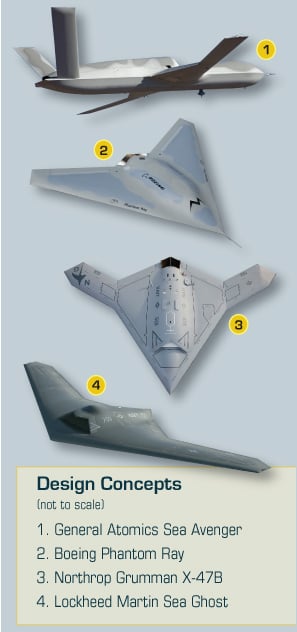
The competing companies and their expected entries are:

Northrop (X-47B)
Boeing (Phantom Ray)
Lockheed Martin (Sea Ghost)
General Atomics (Sea Avenger)

The issuance of the current RFP to the four companies is intended to initiate a Preliminary Design Review phase of development after which a down-select will occur (bearing in mind that the down-select of the LCS never happened!) in late 2014.

The current RFP seems to suggest a very low level of capability compared to original concept capabilities.  The UCLASS seems to be geared towards surveillance and intelligence gathering with only a minimal, light strike capability.  This is quite a departure from the original concepts but seems eminently reasonable – gather actual operating data from simple missions and functions rather than trying to leap into capabilities that are beyond reach, as happened with the LCS.  I find this approach sensible and refreshing.


Wednesday, July 17, 2013

X-47B Carrier Landings

The Navy recently loudly and proudly announced the first landing of an unmanned X-47B on a carrier.  For those of you keeping score at home, the X-47B has now attempted four landings and two have succeeded.  You may have missed the failed landing attempts as the Navy didn't announce them with quite the same degree of enthusiam and fervor!

No, this is not a criticism of the X-47B program.  The landings are part of a development program and failure is part of development.  The only conclusion I take away from this is that the program clearly isn't ready for prime time, yet, and that's just fine.  The Navy seems content to take the time needed to get this right, unlike the LCS.

This is just an informational post - nothing more!


Friday, May 24, 2013

FY 14 Budget Markup

The House Subcommittee on Seapower and Projection Forces has released its markup on the FY14 National Defense Authorization Bill – H.R. 1960.  In essence, Congress has inserted its specific comments into the Navy’s budget.  Here are some highlights.

CVN-78.  Congress agrees to increase the previously mandated spending cap on the Ford, CVN-78, from $11.755B to $12.9B which is the Navy’s new estimate of the final completed construction cost.  The previous cap had been adjusted and set in 2010.  That’s more than a billion dollar overrun since that point !!!!  And, you know more is coming as the various new technologies like EMALS, AAG, radar, etc. are integrated into the ship.  The Ford is going to cost well over $13B when done.  We simply can’t afford that when the entire yearly shipbuilding budget is $15B.  Carriers are either pricing themselves out of existence or pricing the rest of the fleet out.

Amphibious Combat Vehicle.  Congress has directed the Comptroller General of the United States to conduct an annual review of the Amphibious Combat Vehicle program including costs and analysis of alternatives.  That’s Congress’ way of telling the Marines and the Navy that they don’t trust either of them to tell the truth and make fiscally sound decisions.  When Congress tells you that you’re not trustworthy, that’s gotta hurt!

UCLASS.  Congress has directed the Navy to demonstrate the air-to-air refueling capability of the X-47B no later than 1-Oct-14.  This statement is astounding but I’m not entirely sure why.  That Congress is now specifying test procedures is unheard of.  Does Congress not trust the Navy to carry out a demonstration of such an important capability if left on their own?  That’s entirely possible given that the Navy refused to carry out shock testing on the LCS and Ford class carriers in a relevant and useful time frame.  The Navy is clearly being called to task over something but I’m unsure exactly what.  This bears further watching.

Congress goes further with the UCLASS program by specifying that a Milestone A technology development contract may not be awarded

“… until a period of 30 days has elapsed following the date on which the Under Secretary certifies to the congressional defense committees that the software and system engineering designs for the control system and connectivity and aircraft carrier segments of such program can achieve, with low level of integration risk, successful  compatibility and interoperability with the air vehicle segment selected for contract award with respect to such program.”

Again, Congress is letting DoD and the Navy know that they don’t trust them.  There’s a background issue at work here that I’m unclear on.

Flt III AMDR.  Congress has directed the Navy to submit a report on the proposed use of the AMDR radar on the Burke Flt III that will address capabilities of the system, limitations of the Burke with regard to hosting the AMDR, and an analysis of alternatives.  Again, Congress is making it clear that they don’t believe the Navy’s own assessment and want to force the Navy to directly address some of the issues that the Navy has, thus far, skirted around.

There’s one resounding theme amongst Congress’ actions and that is a mistrust of the Navy.  Congress seems not to believe that the Navy will provide timely, relevant, and accurate information upon which Congress can base their decisions.  As a result, Congress is starting to get into the nitty-gritty details of weapons development and procurement.  On the one hand, that’s great.  Congress has, for far too long, abdicated their oversight role of the military and procurement spending by simply going along with pretty much whatever the military has requested.  It’s about time Congress started asking questions and demanding answers.  On the other hand, it’s a sad state of affairs when the Navy no longer retains the trust of Congress.  As regular readers well know, the Navy has squandered their reservoir of trust on a seemingly endless string of poor decisions, abrupt changes in direction, misinformation, and incomplete or poorly performed analyses and assessments of weapons systems.  The Navy’s chickens are coming home to roost and they have no one to blame but themselves.

Thursday, February 14, 2013

The Navy's Best Run Program

Regular readers of this blog know that ComNavOps is often highly critical of Navy leadership and with good reason.  The litany of failed and failing programs and policies is a long one.  That said, I’d now like to take the opportunity to examine what appears to be a well run program, the X-47B unmanned carrier aircraft.  It’s as if someone in Navy leadership looked at all the mistakes of the LCS/LPD/JSF and decided not to repeat them!

To summarize briefly, the X-47B is the first step in development of an unmanned and largely autonomous carrier aircraft capable of surveillance, strike, and perhaps someday aerial combat.  It's been referred to as the UCAV or UCLASS for those more familiar with those abbreviations.


X-47B - Doing It The Right Way

Unlike the LCS which the Navy committed to replacing a third of its battle fleet with before the first one was even completed, the X-47B is being developed slowly and deliberately with no commitment beyond a few prototypes.  Consider the developmental timeline.  The Navy awarded a six year contract to Northrop Grumman in 2007 to produce two prototypes.  Six years!  Only two prototypes!  That’s a careful, methodical program being executed responsibly.  Again, unlike the LCS which committed to production before any of the requisite technologies had been proven (and they all failed miserably), the X-47B is methodically going about proving its technologies at the prototype stage.  Autonomous aerial refueling, carrier launches and recovery, control software, carrier integration, and so forth are being tested and proven now, before any commitment to production runs.  If and when production occurs the aircraft will be a well known commodity with clearly recognized capabilities and limitations. 

We’ve all commented that the prudent course of LCS development would have been to develop the modules first, using surrogate platforms.  If and when the modules were deemed ready for production the LCS itself could have been built in short order.  In fact, this is exactly what is being done with the X-47B.  For example, the control software needed to perform unmanned carrier landings is being tested using a surrogate Beech King Air aircraft. 

Refreshingly, the X-47B program is not being overhyped and oversold.  Its goals are not magical, fantasy wish lists that can never happen but, instead, are short term, achievable goals that will eventually lead to the desired end product.  Even in the worst case, if it turns out that the ultimate X-47B functionality can’t be achieved, the Navy will not have mortgaged a third of its aerial combat power.  Nothing will have been lost or wasted except for a relatively small amount of research funding.

I tell you, it feels good to be able to praise a Navy program.  Sadly, I have no idea who’s responsible for this mature and common sense approach but they deserve some recognition.  Honestly, this is the best run program in the Navy by a wide margin.


Thursday, July 26, 2012

Unmanned Carrier Aircraft (UCLASS)

The Navy is working to develop a carrier based, unmanned strike aircraft.  This Unmanned Carrier Launched Airborne Surveillance and Strike (UCLASS) aircraft would provide long range, stealthy strike capability for use in the Anti-Access/Area Denial (A2/AD) scenario.

Before I go any further, let me say this up front - I'm not against UCLASS, at all.  Potentially, they could be very useful.  However, the basic concept as applied to the Chinese A2/AD scenario has some serious challenges to overcome that deserve to be discussed in the face of the Navy’s typical rush to acquisition.  Just as with “littoral” and “AirSea Battle”, I fear that the Navy is latching onto “UCLASS” as another acquisition justification buzzword without adequately exploring the underlying concept. 


UCLASS - The Right Concept?

Let’s take a closer look at the underlying concept.  The Chinese A2/AD zone is visualized as being about 1000 nm out from the mainland.  So, assuming a launch from outside the zone against targets on or deep inside the mainland, an aircraft would need to be able to fly 1000-1500 nm.  Of course, the range of the weapon carried by the aircraft could extend the effective striking range of the UCLASS.  During the course of penetration, the UCLASS would have to pass through many radar zones, hundreds of patrolling aircraft, and hundreds of ground AAA and SAM installations. 


So, we can see that a UCLASS needs extraordinary range, something on the order of a combat radius of 1000-1500 nm.  It will also need highly effective stealth and/or great speed to avoid or outrun threats.  Finally, it would be nice if the payload were greater than one or two weapons.  Having flown many hundreds of miles and evaded hundreds of threats it would be silly to only be able to strike one or two targets.  The risk/reward balance just isn’t there without a much greater payload.  And, lest we’ve forgotten, the UCLASS has to be small enough to fit on a carrier.

The Navy’s current prototype UCLASS is the X-47B Pegasus.  Here’s some of the relevant specifications.

Range (one way) – 2100 nm
Combat Radius (estimated) – 500 nm
Weapons Load – 4500 lb
Speed – subsonic
Cruise – 0.45 mach
Wingspan – 62 ft (31 ft folded)

Comparing the X-47B specs to our desired performance, we can see that the prototype’s combat radius is half to one third of that needed.  Remember, that the A2/AD zone is, essentially, all water.  The targets of interest, aside from the occasional ship, are all on the mainland.  Penetrating half way accomplishes nothing.  Of course, this is a prototype so the range can be increased, right?  Well, yes, but longer range means bigger fuel storage which means a bigger, heavier aircraft and the bigger it is, the harder it’s going to be to operate and fit on a carrier.  The prototype is already larger than an F/A-18E/F Super Hornet (wingspan = 44 ft).  The largest aircraft currently on carriers is the E-2 Hawkeye with a wingspan of 80 ft. 

You may be observing that the range is 2100 nm and thinking that’s a 1050 nm round trip.  That should be plenty of range, right?  You’d be correct except that range is non-combat loaded and assumes a straight line course at the most economical speed and altitude profile.  Adding roundabout waypoints to avoid high threat areas, adding a combat weapons load, and performing evasive or high speed avoidance maneuvers seriously cuts into the range, hence, the estimate of a 500 nm combat radius.  If you don’t believe this, go check out the Hornet’s (or any plane’s) range versus combat radius figures.

Speed is the next obvious deficiency.  A subsonic aircraft (only about 350 kts cruising speed) is going to have a hard time penetrating a thousand mile A2/AD zone and escaping threats along the way.  Let’s be blunt – it can’t.  Unfortunately, there’s a Catch-22 at work, here.  The only way to make the aircraft faster is to increase fuel consumption which decreases the combat radius which leads us right back to having to make a significantly bigger aircraft to carry much more fuel.

Finally, weapons load is extremely light.  The current F/A-18E/F has a weapons capacity of 17,500 lbs which is way bigger than the X-47B’s 4500 lbs.  Again, the only way to increase the payload is to make the aircraft bigger. 

Do you see the trend, here?  The only way to meet the notional requirements for a useful UCLASS is to make it much bigger.  I guess there’s a reason why the B-1 and B-2 deep penetration bombers are so big.

Of course, bigger creates its own set of problems.  The bigger the aircraft, the easier it is to detect.  The bigger the aircraft, the fewer can fit on a carrier.  The bigger the aircraft, the more expensive it is.

Have we left any issues out?  Yes, we have!  How about remote control communications?  Our ability to control UAVs at any distance is currently suspect and at the 1000 + nm ranges that a UCLASS would have to operate, maintaining reliable control communications becomes highly problematic.  In a war, communications satellites and relay nodes will likely be destroyed and heavy jamming will be the norm.  A successful UCLASS will have to overcome those communication challenges.

Closely related to communications is the issue of location awareness.  How will the UCLASS know where it is if GPS satellites go down at the start of conflict as everyone assumes they will?  To be fair, this problem is not unique to the UCLASS but affects every weapon and platform in the US military.  Still, there’s no point penetrating an A2/AD zone if you don’t know precisely where you are. 

I could go on but this serves to illustrate that the basic concept of a long range UCLASS is suspect under the current operating concept and technological capabilities.  A viable UCLASS would need closer to 2000 nm combat radius, much greater stealth or much greater speed to avoid detection/destruction, larger weapons carrying capacity, and reliable control communications over thousands of miles.

Can the Navy get from the initial data point of the X-47B to the desired aircraft?  Possibly, though the challenges are great.  The purpose of this discussion is to point out the magnitude of the challenges and suggest that the Navy not leap into this without addressing the problems and thinking them through.  Failure to do so is what led to the LCS and no one wants to see the flying version of the LCS!