Showing posts with label CVN-78. Show all posts

Wednesday, September 21, 2016

Navy To Accept and Commission Damaged Ship

The Navy continues to fail to learn the most fundamental lessons concerning ship buying.  The latest example is the Ford which has suffered major main turbine generator (MTG) failures (a June explosion of the No. 2 MTG and a similar, more recent event with the No 1 MTG) which have crippled half the the ship’s main generators.  This post is not about the generator problems but, rather, about the Navy’s stunningly idiotic decision to accept delivery of the ship in a damaged state.

“Several repair options were developed, including whether or not to completely repair the MTGs before sea trials and delivery – causing further delays -- or wait until a post-commissioning shipyard period to finish the work.

On Sept. 14, the Pentagon source confirmed, Navy officials decided on a partial fix now and a permanent fix later.  The No. 2 MTG rotors will be removed while repairs are made to No. 1, and full repairs to No. 2 will wait for the post-shakedown availability (PSA) overhaul sometime after the ship is commissioned.” (1)

What is the point of sea trials and inspections if you’re going to accept the ship no matter what condition it’s in?  They may as well just cancel trials and inspections and save some money. 

Would any of us buy a damaged car?  Of course not!  The Navy, though, sees no problem with accepting a damaged ship.  I don’t know the details of the purchase contract but once the Navy accepts delivery, the ability to get the manufacturer to fix problems at their own expense becomes severely limited.  Remember, as we’ve noted before, unbelievably, the Navy has no warranty on the ship!!!!

Not only will the Navy accept delivery of a badly damaged ship but it will also commission a badly damaged ship.  A commissioned ship is supposed to be combat ready.

This is just stupidity beyond belief.  There is no valid justification for accepting a damaged ship.


_________________________________

(1)Defense News website, “Carrier Ford Has Serious Power Problem”, Christopher Cavas, 18-Sep-2016,


Friday, September 2, 2016

Are You Freaking Kidding Me?

Are you freaking kidding me????

As reported by USNI News, the Navy is going to conduct an in-depth review of the Ford because of all the problems it’s encountered (1).  The review is being triggered by a memo request from Frank Kendall, the Pentagon’s chief buyer, to SecNav Ray Mabus.

“The review – outlined in the memo to Secretary of the Navy Ray Mabus from Under Secretary of Defense for Acquisition, Technology and Logistics Frank Kendall – calls for the Office of the Secretary of Defense to take a closer look at key subsystems of the carrier that Kendall said could hamper the “schedule and performance” of Ford … “

This makes, what, about 900 reviews the Navy has conducted in the last year to investigate badly flawed programs.  If they truly need all these reviews then they have no idea what they're doing.  What has been the result of all these reviews?  In almost every case, no matter how flawed the subject, the recommendation and result is to stay the course.  What’s the point of reviews that don’t change anything?

Don’t we have an Admiral in charge of carriers?  Yes, we do!  Program Executive Officer (PEO) Aircraft Carriers for the Navy is RAdm. Thomas Moore.  He’s the guy with complete responsibility and authority for seeing to it that the Ford is progressing smoothly.  If things have gotten so bad that the Pentagon’s chief buyer has to mandate a review, shouldn’t we start by firing the PEO?  Where’s the accountability.  What’s that phrase?  “Not on my watch.”  Well, this has happened on his watch and he needs to be held accountable.

“What we have to determine now is whether it is best to ‘stay the course’ or adjust our plans, particularly for future ships of the class,” Kendall wrote, “The first step in that process has to be a completely objective and technically deep review of the current situation.”

The first step has to be a completely objective and technically deep review of the current situation??!  Are you freaking kidding me?  Shouldn’t a completely objective and technically deep review of the current situation be performed every day, if not every hour, in PEO’s office?  If we don’t have a completely objective and technically deep review of the current situation sitting on PEO’s desk, right this moment, and updated every hour, then PEO needs to be fired.

“The memo identified five areas the 60-day review will cover: propulsion and electrical system components, Electromagnetic Aircraft Launch System (EMALS), Advanced Arresting Gear, Dual Band Radar and Advanced Weapon Elevators.”

Are you freaking kidding me??!  We need 60 days to figure out what’s going on?  I’ll repeat, if PEO Moore hasn’t got an up-to-the-minute completely objective and technically deep review of the current situation sitting on his desk then he needs to be fired.  We don’t need 60 days – 60 minutes should suffice and should be about 59 minutes more than we need.  If we truly need 60 days, those 60 days should be dedicated to a Court Martial of PEO for dereliction of duty.

“With the benefit of hindsight, it was clearly premature to include so many unproven technologies in the Gerald R, Ford.” 

Are you freaking kidding me??!  Benefit of hindsight??!  Every blogger and commenter with a double digit IQ, and most of the ones with a single digit IQ, knew and stated that trying to incorporate so many non-existent technologies into a production ship would cause problems.  Aside from the incredibly obvious common sense that would preclude such a course of action, the history of the LCS and the F-35 should have made it clear that concurrency and the incorporation of non-existent technology is idiotic and leads inexorably to cost overruns and schedule delays.

RAdm. Moore - PEO Carriers - Fire Him!


Don’t try to ease the blame by claiming the problems only became visible with the benefit of hindsight.  Anyone and almost everyone saw this train wreck coming many years ago.  Only the idiots running the Navy failed to see it.  The rest of us saw this with absolute certainty and said so long ago.

So, what does the Navy think about the state of the Ford?

“Those new technologies, “compounded the inherent challenges of a first in class design,” Navy spokeswoman Capt. Thurraya Kent said in a Tuesday statement to USNI News.  “Consequently, a comprehensive test program, the most integrated and complex shipbuilding test program to date, was developed to address the integration of these technologies. This test program has proven to be highly effective at resolving many first-of-class ship issues through the testing of developmental systems onboard CVN-78 and proving the performance of these systems.””

The Navy is quite pleased, it appears.  The test program has proven to be “highly effective” at resolving issues, the Navy claims – so effective that the ship is only billions of dollars over cost and looking to be around two years overdue for commissioning.  Even better, the Navy has hinted that many of the new technologies will be non-functional when the ship is commissioned.  Isn’t a commissioned ship supposed to be ready to fight?

This is the Navy’s idea of “highly effective”?  This is the Navy’s idea of how to run an acquisition program?  This is the Navy’s idea of sound project management?  This is the Navy’s idea of cost control? 

Are you freaking kidding me?

The Navy is in absolute denial.  People at the top need to be fired for this.

The Detroit Lions, long time joke of the National Football League for their perennial losing ways, once had a coach named Darryl Rogers in the mid-1980's.  After a few dismal losing seasons, he was frustrated, depressed, and wanted out.  He disgustedly remarked to a reporter, "What does a coach have to do around here to get fired?"

What does an Admiral in the Navy have to do to get fired?


______________________________

(1)USNI News website, “Pentagon Conducting New Review of Gerald R. Ford Carrier Program”, Sam LaGrone, 30-Aug-2016,


Friday, October 30, 2015

Recent Carrier Costs

Occasionally it’s useful and fun to review some relatively recent history.  Let’s look at carrier construction costs as we’ve transitioned from the last of the Nimitz class to the first of the Ford class.  The primary reference for this trip down memory lane is the CRS report of 2007 (1).

Let’s set the stage by briefly reflecting on the improvements offered by the Ford over the Nimitz.  Claimed improvements include,

  • Increased sortie rate – This claim has been debunked and is not true.
  • Improved EMALS catapult – This may offer a maintenance improvement or ease of use but claims of reduced wear and tear on aircraft are not backed up by any data and logic indicates that the claim is quite likely false.
  • Improved arresting gear – This claim is also not backed by any data.
  • Decreased manning – It remains to be seen whether this reduction is actually workable;  the LCS reduced manning proved false.
  • Dual band radar – While potentially a better radar than what the Nimitz class had, the tactical utility of such an advanced radar for a ship that has only short range, self-defense weapons is lacking and subsequent Fords reportedly will have a greatly reduced capability radar.


We see, then, that claims of improvements over the Nimitz class are marginal, at best.  The question then becomes what price are we willing to pay for marginal improvements?  Well, let’s look at the costs.

The Ford is going to wind up costing around $13B.

According to the CRS report, the last Nimitz cost $6.05B (2006) which translates to $7.14B (2015) when adjusted for inflation.

When we compare the Ford at $13B to the Nimitz at $7.14B, we see an 82% increase (nearly double!) in cost even after adjusting for inflation.  Yikes!  That’s probably worth another – Yikes!

Now for the amusing part.  We’ve seen that the Navy’s acquisition cost estimates are consistently, absurdly low.  Do you remember what the Navy estimated the Ford would cost?  From the CRS report,

“The Navy estimates CVN-78’s [Ford] total acquisition (i.e., research and development plus procurement) cost at about $13.7 billion. This figure includes about $3.2 billion in research and development costs and about $10.5 billion in procurement costs.”

There you have it.  The Navy’s estimate was $10.5B for procurement.  Instead, procurement has ballooned to $13B.  That’s a $2.5 billion dollar overrun.  Bear in mind that Ford is nowhere near done, yet.  The final overrun will be $3B plus.  In fact, the Navy is now engaged in deferring work until after delivery in order to meet the Congressional cost cap.

Oh, for the days when we thought we could build a carrier for only $10.5B …


(1)Congressional Research Service, “Navy CVN-21 Aircraft Carrier Program:

Background and Issues for Congress”, Ronald O’Rourke, Jan 2007

Tuesday, May 20, 2014

Ford - Combat Ready or Business Ready?

An article in the current issue of Proceedings (1) points out, as a notable benefit, that the Ford’s dual-band radar allows considerable reduction in topside equipment,

“Further reductions in topside equipment were envisioned by leveraging the dual-band radar from the … DD-1000 destroyer program, a move that could replace six radars – SPS-48, SPS-49, SPS-67, SPN-43, SPQ-9B, TAS Mk23 – and four NATO Sea Sparrow Target Illuminators.”

What the authors fail to point out is that the consolidation puts 10 separate functions into a single point of failure.  If the dual-band radar is rendered inoperative due to battle damage (or simple electrical/mechanical failure) the ship loses ten functions.  The older system of separate radars may have caused topside clutter (I’m not sure why that’s inherently bad) but they also offered a degree of redundancy in that they represented multiple points of failure – a much more battle worthy system. 

The Ford’s radar may represent a more desirable system from a peacetime acquisition and ease of construction (hence, cost) point of view but does it represent a better combat arrangement?  Only a very detailed analysis from someone with intimate knowledge of the various systems could answer that.  The point is that the Navy almost surely made the decision based on accounting concerns rather than combat needs.  We’ve discussed this before – the Navy has to recognize that combat is generally not compatible with accounting and business practices.  Many combat issues will not make good accounting and business sense (until, of course, they save a ship in combat!) especially when considered from a peacetime perspective.  The Navy must drive its designs from a combat imperative.  If that means higher costs, and it will, that’s simply the price of being combat ready.  There are plenty of areas for productive cost cutting (have I ever mentioned reducing the glut of Admirals and their staffs?) but combat readiness is not one.

On a related note, the authors point out that the Ford will have fewer aircraft elevators.  Again, a construction cost saver, undoubtedly, but is it a combat and battle damage advantage?  Undoubtedly not.  When the ship takes damage and begins losing capability more elevators will be desirable, not less – that’s called redundancy.

So, is the Ford’s radar system more combat ready than the older arrangement?  I don’t know but this type of decision must be driven by combat concerns not business.


(1) US Naval Institute Proceedings, “Christened by Champagne, Challenged by Cost”, Capt. J. Talbot Manvel Jr. (USN, ret.) and David Perin, May 2014, p. 42

Monday, January 13, 2014

Ford Problems

Stars and Stripes reports (1) that the Boston Globe has obtained a Navy report that describes potentially severe problems being encountered during continued fitting and testing of the new carrier, the Ford.  Here’s some excerpts from the article.


“The U.S. Navy's newest aircraft carrier, a multibillion-dollar behemoth that is the first in a next generation of carriers, is beset with performance problems, even failing tests of its ability to launch and recover combat jets, according to an internal assessment by the Pentagon obtained by the Boston Globe.”

“The Globe reported Friday that early tests are raising worries that the USS Gerald R. Ford, christened in November, may not meet the Navy's goal of significantly increasing the number of warplanes it can quickly launch — and could even be less effective than older vessels.”

“At least four crucial components being installed are at risk because of their poor or unknown reliability, states the 30-page testing assessment, which was delivered last month to Secretary of Defense Chuck Hagel and other top Pentagon leaders.”
 
“In addition to the launching and landing systems for jet fighters, officials are also concerned about its advanced radar system. It also remains unclear if a key weapons elevator will work as promised.”

“A number of other systems, such as communications gear, meanwhile, are performing at less than acceptable standards, according to the assessment by J. Michael Gilmore, the Pentagon's director of operational test and evaluation. Gilmore concluded that the Navy has little choice but to redesign key components of the ship.”

I don’t find the existence of problems to be terribly troubling.  A new ship class is expected to have teething problems.  The disappointing aspect of this is that the major problems have been predicted for several years, now.  Components such as EMALS, the AAG, radar, etc. were installed before completing development and testing.  It’s a lot easier to find and fix problems on land, in a test facility, then to do so on an installed system.  Large amounts of money have already been spent retrofitting the Ford to accommodate modifications and fixes to these systems and, apparently, much more will be spent in the coming years.

Was there really a need to rush these systems into service?  None are game changers from a combat perspective.  In theory, they’ll provide some nice advantages eventually but we have a bunch of Nimitz carriers that are functioning just fine without them.  Couldn’t we have waited five more years and installed the new systems on the next carrier after a thorough development and testing period?  We’d have saved many hundreds of millions of dollars and wound up with mature designs.  Did we learn nothing from the LCS fiasco?  Instead, the Navy continued its recklessly irresponsible pattern of concurrent design and production and concurrent R&D and production as we’ve discussed repeatedly in previous posts.

The Navy’s response was predictable.

“Rear Adm. Thomas J. Moore, the program executive officer for aircraft carriers, defended the progress of the ship in an interview and expressed confidence that, in the two years before delivery, the Navy and its contractors will overcome what he acknowledged are multiple hurdles.”

When everyone tells you that you’re wrong about something you can either choose to believe that there might be something to what they say or you can stubbornly believe that they’re all wrong and you, and you alone, are right.  Which response is most likely to be the correct one?  If your name is Einstein, you may be justified in believing that you, and you alone, are correct.  If, however, your name is anyone else, you might want to pause and reconsider when everyone tells you that you’re wrong.  On top of that, if you’ve been through this exercise a dozen times and you’ve been wrong every single time, it’s just the definition of insanity to continue to believe that you’re right and everyone else is wrong.

The Navy continues to ignore GAO, Congressional Research Service, DOT&E, and ComNavOps, among others, preferring to believe that they know better.  Sadly, history does not support their belief and this is just the latest example.

That the Ford has problems is not a concern.  That the Navy continues to exhibit a pattern of stupidity is a concern.


Sunday, June 30, 2013

Small Carriers Or No Carriers?

The new Ford class carrier construction cost is up around $12B-$13B already and will probably finish at $14B or so and I believe that’s without including government supplied equipment as we’ve discussed in a previous post.  New carrier construction schedules have already been lengthened out to a seven year cycle.  The simple math of acquisition tells us that the carrier fleet will continue to decline to around 8-9 active carriers in the moderately near future.  The sad fact is that carriers are pricing themselves out of existence in the face of the new budget reality. 

In addition to the cost factor, there has been a vocal faction arguing for small carriers since the carrier was first introduced.  As a reminder, the USS Wasp, sunk early in WWII, was an attempt to develop a small carrier.  The Navy has done numerous studies on this issue and the conclusion has always been that larger carriers were the most efficient and cost effective form.  This conclusion has not, and will not change. 

So, why is ComNavOps looking at this issue?  Because, while the conclusion that larger  carriers are more effective has not changed, the affordability has.  As I stated, carriers are pricing themselves out of existence.  It doesn’t matter how powerful, flexible, and effective the large carrier is, if you can’t afford it, you can’t build it.  What do we do then – continue to build supercarriers at a slower and slower rate until we eventually only have a single superhugemassivecarrier?  It may be time to re-examine the small carrier question just because of cost.  The small carrier may not be the best way to conduct carrier operations but it may be the only way we can afford to build and operate carriers, period.  The cost efficiency of the small carrier may be poorer than a supercarrier but the total cost is less.  We’re fast approaching the point at which total cost is the driving factor rather than cost efficiency.

The Navy may already be recognizing this problem.  The new America class LHA-6 appears to be an attempt to produce a small carrier having the ability to operate an air wing of around 20 F-35B’s though such operation would invalidate the use of the ship for amphibious operations which is it’s stated purpose.  The other obvious disadvantage of this concept is that it’s limited to operating F-35B’s which are far from being an ideal naval air superiority and strike platform.  Still, the Navy may be anticipating further reductions in supercarriers and planning for at least a partial compensation via the LHA-6.  The advantage to such an approach is that the construction cost is only around $4B versus the Ford’s probable $14B.  To be fair, this is speculation on my part.  The Navy has not explicitly stated this, as far as I know.

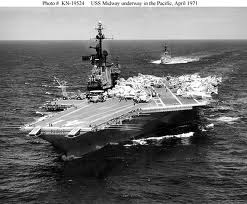
Midway - Small Carrier Option?

 
So, the LHA-6 class could provide a small carrier with some very limited capability.  Is there any other option?  Yes, the old Midway class in its modernized form offers a possible alternative.

The Midway was around 900 ft long versus the 1050 ft of a Nimitz and around 67,000 tons loaded versus the 95,000 tons of a Nimitz.  We see, then, that the Midway is around two thirds the displacement of a Nimitz.

What about the air wings?  Weren’t the Midways limited compared to the Nimitz?  No, not compared to today’s Nimitz.  The Midway operated an air wing of around 65 aircraft consisting of three squadrons of Hornets and two squadrons of Intruders along with Hawkeyes, Prowlers, and helos.  Today’s Nimitz air wings consist of around 65 aircraft consisting of four squadrons of Hornets plus Hawkeyes, Prowlers/Growlers, and helos.  Virtually identical except that the Midway air wing actually had more combat aircraft!

So, a smaller carrier of 2/3 the displacement of a Nimitz (even less compared to a Ford) has been proven to be able to operate the same air wing as current carriers. 

Any light bulbs going off yet?

What would a Midway size carrier cost today?  Who knows, but we know the Fords will cost around $12B each.  The America class LHA is around 850 ft long and 45,000 tons displacement and costs around $4B.  A reasonable extrapolation, then, would be for a cost of $6B for a Midway size carrier.  In other words, we could build two Midways for each Ford and still operate the same size air wings.  In this time of constrained budgets, that’s got to at least be worth some serious consideration. 

Now, before some of you start pounding out your replies and telling me about sortie rates and whatever else, note that I’m not claiming that a Midway size carrier would be better than (or even equal to) a Ford.  I’m saying that we’re fast approaching the point where our choice is not going to be between big carriers and smaller carriers but between smaller carriers and no carriers.  I guess I’d rather have smaller carriers than no carriers.  Sadly, the Navy is riding the big carrier option right down to zero carriers.

Sunday, January 20, 2013

DOTE Report - Ford

Next up on the DOT&E hit parade (see previous post for link to DOT&E report) is the Ford class aircraft carrier, CVN-78.  Other reports have previously documented that the Ford is a billion dollars or more over budget and the delivery schedule has slipped drastically with additional budget and schedule overruns sure to come.  Still, there have been no fatal technology flaws or rash of problems discovered, at least not as compared to the LCS, LPD-17, or JSF.  Here, though, are a few items to keep an eye on.

“In 2007, the Program Office identified discrepancies with the integration of the JSF’s F135 engine onto aircraft carriers. The weight of the F135 power module, approximately 10,000 pounds, exceeds the limit of current underway replenishment (UNREP) systems.  Although CVN-78 will include a heavy UNREP system that will allow transfer of 12,000 pounds, supply ships must include the new system for power module transfer to occur. The Navy’s plan to install heavy UNREP systems on resupply ships has slipped eight years.”
 
This is saying that the Navy can’t get replacement JSF engines at sea from supply ships for the next decade.  Yikes!  Of course, given the glacial progress of the JSF, that may not turn out to be a problem as the JSF may well not reach squadron service for several more years.  Ouch!  JSF – the gift that keeps on giving.

Ford’s combat system has known, major issues.  To be fair, these issues are present across several classes of ships (basically, all the carriers and amphibious ships) and are related to legacy sensor capabilities, sensor placement, legacy weapon’s performance limitations, etc.  As the report states,

“Previous testing of Navy combat systems similar to CVN-78’s revealed numerous integration problems that degrade the performance of the combat system.”
 
The Ford is intended to operate the JSF as its main aircraft.  Unfortunately, the Ford has numerous JSF compatibility issues.

“JSF battle damage assessment and non-traditional Intelligence, Surveillance, and Reconnaissance information captured on the Portable Memory Device or cockpit video recorder cannot be shared real-time with the Distributed Common Ground System-Navy (DCGS-N). This prevents assessment by shipboard intelligence analysts for inclusion in mission reports.”
 
“Ships are unable to receive and display Link 16 imagery; this problem is not unique to JSF. … Limited shipboard capabilities exist with expeditionary Link 16. The Navy is considering a program of record to distribute imagery to analysts and maritime operations command and control nodes (e.g., carriers and amphibious ships). This would be a temporary workaround for the DCGS-N post-flight data gap.”
 
“The JSF Prognostic Health Maintenance (PHM) downlink design for ships is not mature. The uncertainty in the technical characteristics of the final design means that there are potential challenges to integrating PHM into current shipboard communications suites and networks.“
 
“The JSF wheel supplier’s recent rim inspection requirement may force a significant increase in shipboard tire and wheel storage requirements.”
 
While none of the JSF compatibility issues pose a significant technical challenge, they will negatively impact the Ford’s cost and schedule and may initially negate some of the benefits and features of the JSF.

In a recurring theme, the Navy is trying to postpone actual performance tests on ships in favor of simulations.  The Navy wants to postpone shock testing on the Ford for several years and wait to perform it on the next ship, CVN-79.  DOT&E’s comment was,

“While the Navy has made substantial effort in component and surrogate testing, this work does not obviate the need to conduct the FSST [ed.: Full Ship Shock Trials] to gain the critical empirical data that past testing has repeatedly demonstrated are required to rigorously evaluate the ship’s ability to withstand shock and survive in combat. Shock Trials conducted on both the Nimitz class aircraft carrier and the San Antonio class Amphibious Transport Dock demonstrated the need for and substantial value of conducting the FSST. Postponing the FSST until CVN-79 would cause a five- to seven-year delay in obtaining the data critical to evaluating the survivability of the CVN-78 and would preclude timely modification of subsequent ships of this class to assure their survivability. … The delay is not a sufficient reason to postpone the shock trial, since the shock trial could reveal valuable lessons, including previously unknown vulnerabilities.”
 

As the report points out, delay will prevent the lessons learned from shock trials from being incorporated into the next carrier and will result in weaknesses being built into the class and additional expenses incurred to remedy them in already constructed vessels. 

The Navy has fully embraced the philosophy of concurrent design and construction despite overwhelming evidence that the practice causes runaway costs, perpetuated design flaws, schedule slippages, and fielding of sub-par platforms.  This approach is stupidity on a scale that’s almost unimaginable.

As the report points out, there are still several technologies (EMALS, AAG, DBR, etc.) associated with the Ford that cannot or will not be fully tested until actually installed.  Of a certainty, additional problems will be uncovered which will impact mission performance and require lengthy and costly fixes.