Showing posts with label Reconnaissance. Show all posts

Friday, March 29, 2024

Stealth UAVs

ComNavOps has long stated that conventional UAVs are useless in high end combat against a peer enemy because they’re not stealthy which means they’re not survivable.  Worse, being non-stealthy, their operation will lead directly back to the controlling unit’s location.
 
The lack of stealth means that they can’t be used for naval recon and targeting because they’ll be spotted and destroyed long before they can find the enemy.  Some have claimed that, being UAVs, they can fly at wave top height to avoid detection.  This is true but it also means they can’t see anything.  If you want a useful field of view (range), you have to operate at some significant altitude.  If a non-stealthy UAV is at a significant altitude, it will be spotted and destroyed before it can accomplish anything.
 
All of this changes, however, if the UAV is stealthy.  Stealth, in this context, refers not just to reduced radar signature but also to reduced infrared and visible signatures. 
 
Let’s briefly consider the known stealthy UAVs in the US inventory.  I’m only aware of two: 
 
  • RQ-170 Sentinel
  • RQ-180 ?White Bat?
 
Let’s look at a few of their specifications in the following table.


a The RQ-180 specs are speculative with estimates putting the size in the RQ-4 Global Hawk category so specifications have been adapted from that.  Photos have fairly accurately determined the wingspan and length.
 
RQ-170 Sentinel


Both the RQ-170 and RQ-180 have the now common stealthy ‘bat’ shape of the B-2 bomber.
 
The key specification is the size.  The RQ-180 is huge!  Even the RQ-170, while smaller, is far too big to operate off surface ships.
 
The existence of the stealth UAVs likely explains the Air Force’s loss of interest in the more conventional UAVs such as Predator, Global Hawk, etc. as the Air Force has publicly stated that such UAVs are not survivable over the battlefield.
 
Let’s turn our attention to naval UAVs.  The Navy seems to be counting on the P-8 Poseidon and MQ-4 Triton for maritime surveillance, distributed lethality (is that still a thing?) targeting, and anti-surface targeting which seems unwise in the extreme.  As the Air Force has noted, large, non-stealthy aircraft, whether manned or unmanned, are not survivable.
 
ComNavOps has called for large numbers of small UAVs for the surface group surveillance and targeting mission.  The caveat is that these UAVs must be stealthy in order to survive long enough to accomplish their mission.  Losing them is not a concern but they must survive long enough to find targets and transmit their findings back to the host ship.
 
The naval UAV mission calls for a stealthy UAV with the following characteristics:
 
Cheap – The mission is high risk and calls for the use of many UAVs to establish and maintain situational awareness and target detection.  Affordability is a mandatory requirement.
 
Small – These UAVs will operate off various surface ships so they must be small enough to be operational in limited deck space and be stored in large numbers.  The size goal is something on the order of RQ-21 Blackjack (8 ft long x 16 ft wingspan)  or Scan Eagle (5 ft long x 10 ft wingspan) which can be launched with mini-catapults.
 
Range – A useful scouting range is a minimum of 200 miles on out to 500 miles.
 
Conceptual UAV Size for Surface Group Surveillance


Discussion
 
As we’ve discussed in the past, the vast majority of the sensing capability would be passive (EO, IR, SigInt) in keeping with the stealth and survivability requirements.
 
A small, stealthy UAV would give surface ships the ability to establish situational awareness and conduct surveillance without automatically giving away their own presence.
 
Consider what small, stealthy UAVS can do.
 
  • They can extend the situational awareness out to 200+ miles.
  • They can act as early warning detectors of attacking aircraft and missiles.
  • They can act as fire control spotters for naval guns and missiles.
  • They can provide targeting for anti-ship missiles.
 
And, they can do this survivably with a reasonable chance of not being detected.  Isn’t that exactly what we want in a naval surveillance asset?
 
The concept of operations (CONOPS) would be to continually operate a dozen or more (work out the effective number in exercises) UAVs in all directions while concentrating on the expected threat axis.  As needed, a UAV could be sent on a one-way mission which would double its range.
 
The major challenge in this concept is communications and I simply don’t know enough to offer a solution.  Satellite communications are an option if we have sufficient surviving satellites.  High altitude communications relay aircraft using line-of-sight is another option.  As I said, I just don’t know.  Communications experts would have to work that out.
 
Larger UAVs, on the order of the RQ-170, can be operated from dedicated UAV carriers and thought should be given to routinely integrating a UAV carrier with every surface group.

Saturday, January 8, 2022

New Recon Vehicle Summary

The comments to the previous post, “Marines Want New Recon Vehicle”, summed up everything wrong with today’s US military.  The orgy of bloat caused by the suggestions to add all manner of extra functions and equipment is exactly why almost every acquisition program over the last few decades has been an abject failure.  Turning a simple recon vehicle – a vehicle whose main purpose is simply to give the trooper a ride – into a land battleship is symptomatic of the mindset our military and military observers have acquired.  Frankly, I’m disappointed.  I know that the so-called professional warriors at the flag level are incompetent and ignorant but I had hoped for better from commenters.  We should be a cut above because we’ve been examining these issues for several years now.


We’ve seen what happens when we cram every conceivable function into every platform … we fail … badly.  F-35, LCS, Zumwalt, Ford, etc.  Failure.  Can we not learn a lesson that keeps getting repeated?


Add to the bloat the total confusion about what recon even is (the lack of CONOPS) and it’s no wonder our military is floundering and our acquisition programs, when they produce anything, produce nearly useless equipment.


Clearly, I’ve got to keep hammering home the concepts of simplicity, single function, and CONOPS.


Murphy roams the battlefield and the only ‘shield’ we have against him is K.I.S.S. (Keep It Simple, Stupid).  We ignore K.I.S.S. at our own peril.


Very disappointing.


Thursday, January 6, 2022

Marines Want New Recon Vehicle

The Marines want a new Armored Reconnaissance Vehicle (ARV) to replace the venerable Light Armored Reconnaissance Vehicle (LAV-25).  They want 533 units from a 5-year production run.[1]  Okay … that’s fine.  Seems simple enough.  A vehicle to transport a few scouts, see what’s around, and report back.  Cheap … simple … basic.  Quick and easy to procure.  What could go wrong?


Of course, the Marines – like the Navy and the military, in general - can’t just leave well enough alone, can they?  They can’t just do basic.  No, they want to turn a simple recon vehicle into a land version of a battleship;  a do-everything vehicle capable of fighting a war single-handed.  Take a look at the variants they want from what ought to be a simple recon vehicle:


ARV Variants [1]:


Command, Control, Communications, and Computers-Unmanned Aerial System (C4-UAS)

Organic Precision Fire-Mounted (OPF-M)

Counter Unmanned Aerial System (CUAS)

30 mm Autocannon and Anti-tank Guided Missile (ATGM)

Logistics (LOG)

Recovery (R)


Well, there goes simple, heading for the bus stop out of town!


Now, take a look at some of the features they want:


Features [1]:


Munitions upgrades including loitering munitions

Electronic warfare

Air defense

Cannon with programmable air burst munitions

Javelin missiles

Spike II missiles

Aerial drone threat sensors


And cheap just hopped the train out of town!


So, instead of a simple, basic, cheap, small recon vehicle, the Marines are looking to turn the vehicle into a land battleship with strike, anti-air, electronic warfare, anti-tank, drone control, etc. along with six different variants.  That should only take about twenty years to field and cost several times what a main battle tank costs.


Hmmm …


What alternative is there?


You know … it occurs to me that we had a small, simple, cheap, basic recon vehicle in WWII.  It was the M8 Greyhound and it performed quite well.  Let’s compare specs for the M8 Greyhound and the Marine’s ARV.  Of course, we have no specs on the ARV but it won’t likely be any smaller or lighter than the existing LAV-25 and will probably be larger so let’s look at the LAV-25 and the M8 Greyhound.


LAV-25

M8 Greyhound

Length, ft

21’ 0”

16’ 5”

Width, ft

8’ 2”

8’ 4”

Height, ft

8’ 10”

7’ 4”

Suspension

8x8 wheeled

6x6 wheeled

Weight, tons

14

8.5

Power, hp/ton

19.5

13

Range, miles

410

350

Max Speed, mph

62

55

Armament

25 mm chain gun

2x 7.62 mm machine gun

37 mm

1x 0.50 cal machine gun

Transport

3 crew + 4-6 scouts

4 crew

Armor

4.7 – 9.7 mm, small arms

9.5 – 25.4 mm


M8 Greyhound


The obvious question is, which of those specs actually matter in a combat recon role?  Well, the specs that matter most are:


  • Range – more is better
  • Size – less is better
  • Armor – more is better
  • Weapons – more is better


Considering those specs that matter most, we see that the M8 Greyhound has 15% less range (that’s bad), 39% less weight (that’s good), 17% lower silhouette (that’s good), 22% shorter length (that’s good), 102%-162% more armor (that’s good), and heavier weapons (that’s good).  Thus, the M8 Greyhound is smaller, lighter, better armored, better armed, and has only slightly less range.  That’s a pretty strong endorsement for the simple M8 Greyhound.


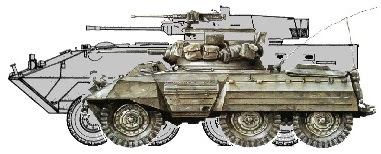
Here’s a scaled silhouette comparison of the M8 Greyhound and LAV-25.


M8 vs. LAV-25 Silhouette Comparison


If you’re trying to do clandestine recon, you want as small a vehicle as possible, right?  Well, that’s the M8 Greyhound, without a doubt!


Another factor that seems important is the crew size.  The LAV-25 (and recon Strykers) carries around 5 scouts per vehicle plus the vehicle crew.  That’s around 8 people per recon vehicle.  Does that seem necessary?  The M8 Greyhound used a total of 4 people.  That seems a lot more reasonable for a recon mission.  Fewer people means a smaller vehicle (that’s good) and less risk to less people (that’s good).  Seriously, what do 8 people productively do on a simple recon mission?


Summary


Well, there you have it.  We have the example of the M8 Greyhound recon vehicle, a vehicle designed for a specific task and with nothing extra.  It is a stellar example of a small, cheap, simple, basic, well armed, well armored recon vehicle and it is eminently suited to its function.  On the other hand, we have the Marine’s desired ARV which is bloated, overloaded with tasks, risks too many crew, and is ill-suited to its function.


The Marines, like the rest of the military, are instantly leaping from a simple task – recon – to a multi-multi-multi-function do-everything behemoth of a gold-plated beast that will be decades in development and prohibitively expensive. 


Conceptually, we need to take the M8 Greyhound and update its technology and call it a day.  It will accomplish the task with half the risk to people and we’ll be able to buy it in quantity and without waiting decades to complete development.


__________________________________


[1]Task and Purpose website, “This Is The Marine Corps’ Wish List For Its Next High-Tech Recon Vehicle”, Max Hauptman, 17-Dec-2021,

https://taskandpurpose.com/military-tech/marine-corps-lav-replacement-advanced-reconnaissance-vehicle/