Showing posts with label Bomber. Show all posts

Wednesday, April 12, 2023

What Have Our Carriers Done For Us?

A reader recently posed a ‘what if’ type of scenario in which aviation had never attained ascendency in the Navy.  Inspired by that, I’d like to pose the question, what have our carriers done for us in modern times?
 
Here’s the reader’s comment and alternate history scenario: 
 
(Jjabatie April 8, 2023 at 7:56 AM) 
The second no-or minimal-carrier scenario would sprout from the historical Navy/Air Force fight surrounding the USS United States. In the alternate, not only is the new supercarrier torpedoed, but future ones are as well, when the Air Force achieves a much larger victory in their push for primacy with their bombers. Long range bombing is somehow pushed through and overwhelmingly accepted as the nations primary system of conventional and nuclear attack. The Navy is punished/penalized for the fight and loses a massive percentage of their funding. Most of the Essexs dont get upgrades, angled decks, etc. New jet aircraft development lags behind for the Navy, as they have neither the funding to stay current, nor the platforms capable of carrying them. It becomes circular, as later cries for supercarriers are countered by the lack of capable aircraft needing such a platform, and requests for new aircraft and ships are dismissed. The missile age solidifies the Air Forces budgetary grip, as they hold all the nuclear forces. They conspire with the Army to massively expand airlift capabilities, yet another way to deprive the Navy of a mission and funding, by claiming theyve replaced sealift. SSBNs do arrive, but  nearly a decade later than in actual history, again due to budgetary constraints and opposition to the need for a triad from the Air Force dominated Pentagon. SSGNs become the naval strike arm, and become the USNs most numerous platform. As the Vietnam era comes and goes, the Essexs start to age out. The handful of angled deck conversions have become CAS platforms, the unaltered ones, helicopter platforms to support Marine Corps operations- precursors to the LH platforms that eventually appear as the Navys newest, largest warships in the 70s...
 
Suppose we had gone down the path the reader postulates?  Suppose we had no significant carrier aviation component?  Or, posing the question in a different manner, what have we gained by having a fleet of modern carriers instead of a massively larger Air Force bomber/fighter inventory and capability? 
 
Well, let’s consider the historical events that involved modern carriers and see how they would have differed if we didn’t have carriers.  For this discussion, modern carriers are defined as those from the USS Forrestal (CV-59) on.
 
Vietnam War – While our carriers sat offshore and conducted daily bombing attacks, those attacks were ineffective in the overall conduct of the war.  I know this will offend many but the truth is that carrier aviation didn’t alter the course of the war or produce a definable achievement.  Alternatively, a much larger Air Force presence and capability could have accomplished the same thing.
 
Desert Storm – Carrier aircraft flew many sorties but did not materially affect the course of the war and could have easily been replaced by Air Force aircraft.
 
Kosovo War (1998-99) – NATO forces generated something on the order of 40,000 sorties and the carrier Roosevelt generated 3000 sorties – a minor role.
 
Afghanistan/Iraq – Carrier aviation was reduced to truck plinking and contributed little of value that an increased Air Force presence couldn’t have easily handled.


One notable contribution of carrier aviation was Operation El Dorado Canyon (1986).  Ironically, the Navy was not, originally planned to play a major role.  The strike was assigned to F-117 stealth aircraft but they were removed from the mission at the last moment due to security concerns.  Instead, Air Force F-111 and Navy A-6 Intruders flew the strike.  Even then, the Navy A-6 attack aircraft were unable to meet the mission requirements.  From Wiki,
 
Although the F-111s would be required to fly from distant bases, they were essential to mission success, because the eighteen A-6 available aboard USS Coral Sea (CV-43) and USS America (CV-66) could not carry enough bombs to simultaneously inflict the desired damage on the five targets selected.
 
It seems clear that there have been few tangible benefits from having a fleet of modern carriers.  Of course, the real question is not what have the carriers done but what could they do?  Many of the weapons and capabilities in our military have never or rarely been used and yet we find value in them for what they could do, if needed.  For example, our nuclear arsenal has not actually accomplished anything, never having been used in modern times, but we find it to be very valuable because of what it could do. 
 
Thus, the question becomes, what can our carriers do in the future that makes them worth the cost, as opposed to the carrier budget being routed to the Air Force, instead?
 
I see great value in carriers but only if they’re used correctly and, unfortunately, I see zero evidence that the Navy has any strategy for effectively utilizing carriers in combat.
 
It is fascinating to ponder what the Air Force could have done with all the Navy’s carrier and aircraft budget.  How many more bombers would we have?  How many more bases?  How many more types of aircraft?  How much more globally dispersed would the Air Force be?  And so on.
 
Note that I am not advocating eliminating carriers.  This is just a fantasy, speculative post although it offers the opportunity to assess how we’ve used (or misused) carrier aviation and what our proper position should be in the future.  It’s an open-ended post in the sense that I’m not offering any conclusion.  I leave it to you to draw your own conclusion and maybe share your thoughts in a comment.

Monday, February 6, 2023

Russian Bombers

It’s always a good idea to know your enemy’s capabilities.  Let’s take a look, today, at Russia’s bomber force.


As you know, during the Cold War the Soviet Union’s main counter to US carrier groups was long range bombers armed with long range cruise missiles.  The US and the Soviet Union played a continual cat and mouse game with the Soviet Union attempting to find US carriers and simulate attacks while the US carriers tried to hide and detect the Soviet bombers and intercept them far enough away to demonstrate that they could prevent an attack.


Today, much of the Russian bomber force has fallen into disrepair and most of what’s left is obsolete.  However, what exists is still a potential threat especially given our greatly reduced air wings and shorter ranged aircraft.


Wiki lists the current active bomber force as: (1)


Aircraft

Yrs Built

Built

Active

Range

Tu-160 Blackjack

‘80s-‘90s

27

16

4000 nm

Tu-22M Backfire

‘70s-‘90s

497

69

1500 nm

Tu-95 Bear

‘50s-‘90s

500+

60

9400 nm


As seen, the numbers of active aircraft are very small and likely overstated even at those reduced levels due to poor maintenance.  In a war, the aircraft would be a nuisance but not a serious, on-going threat.


Here’s some specs and features of the aircraft:


Tu-160 Blackjack


-       Speed = Mach 2

-       Combat radius 4000 nm

-       Produced 1984-1992

-       Built 27

-       Currently active qty=16

-       2x internal weapon bays;  2x rotary launchers each holding 6x AS-15 Kent subsonic cruise missiles with 1350 nm range

-       Payload = 88,000 lbs

-       Swing wing

-       Russian version of US B-1

-       Currently undergoing modest modernizations although industrial, financial, and quality issues are significantly impacting the effort.


Tu-160 Blackjack


Tu-22M Backfire


-       Speed = Mach 1.9

-       Combat radius = 1500 nm

-       Produced ‘70s-‘90s

-       Built 497

-       Currently active qty = 69

-       Internal weapons bay, fuselage and wing pylons

-       Payload = 53000 lbs

-       Major update to the Tu-22 Blinder

-       Swing wing


Tu-22M Backfire


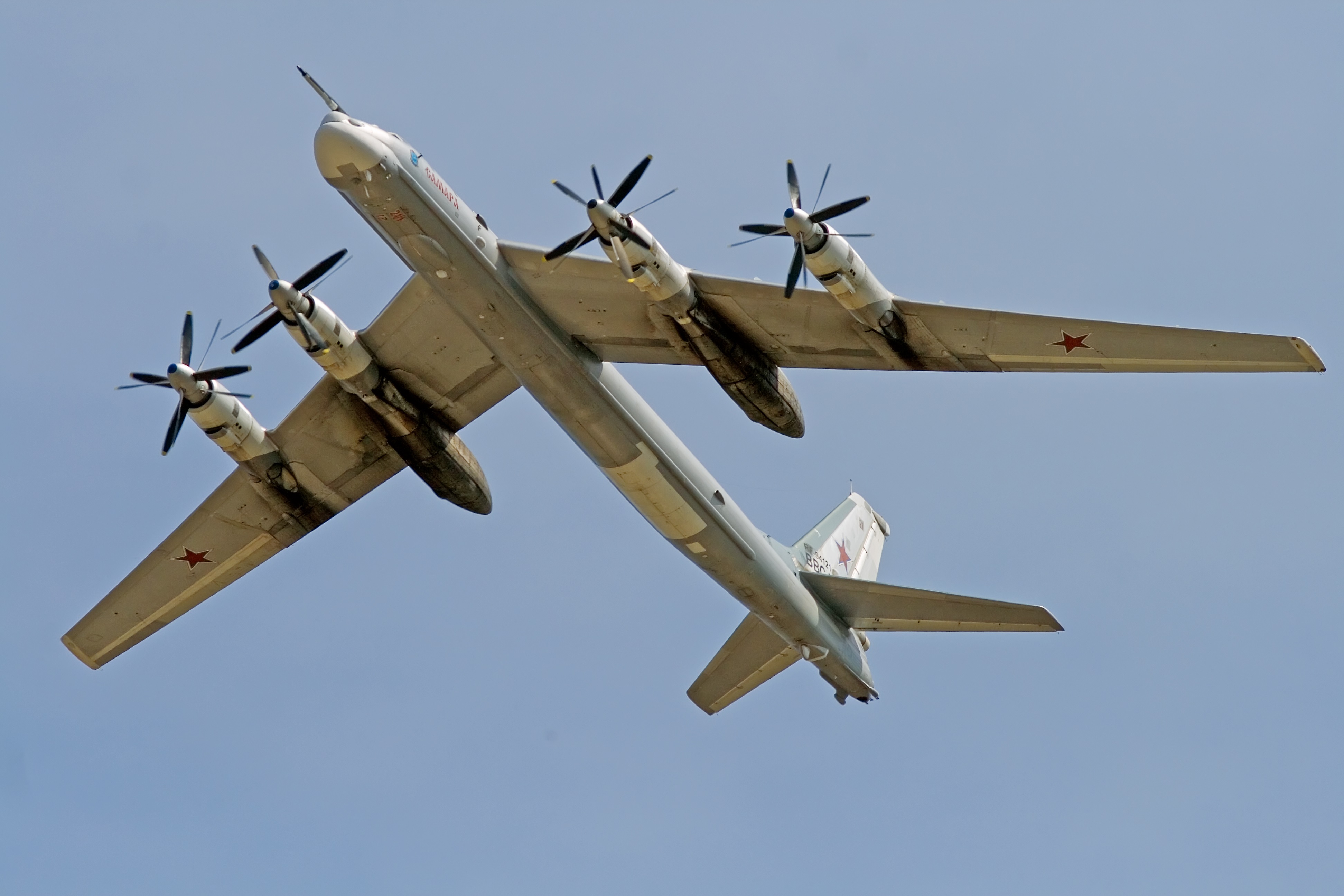
Tu-95 Bear


-       Speed = 510 kts

-       Combat radius = 4000 nm

-       Produced 1952-1994

-       Built 500+

-       Currently active qty= 60

-       Wing pylons

-       Payload 33,000 lb    

-       4x propeller engines with dual contra-rotating props


Tu-95 Bear


Technology.  The bombers are all basically 1970’s era technology.  While some of the aircraft have undergone modernizations, the effectiveness of that effort is questionable.  For example, no amount of modernization can turn a large, non-stealthy aircraft into a stealthy, penetrating bomber (consider our own B-52!).  In addition, Russian quality control is notoriously poor and the Ukraine war has demonstrated that Russian systems have performed well below expectations.  There is no reason to believe that their aircraft upgrades have fared any better.


Weapons.  While the numbers of active aircraft are quite small, the weapons they carry are reasonably formidable and constitute a serious threat.


Kh-15 (AS-16 Kickback)  Mach 5, 160 nm, may be retired from service

Kh-22 (AS-4 Kitchen)  1960’s tech,  Mach 4.6, 320 nm

Kh-32  updated Kh-22, updated, anti-ship, long range

Kh-47M2 Kinzhal  hypersonic, long range, ?accuracy issues?


It should be noted, however, that most Russian cruise missiles are older generation and far less of a threat than current, state of the art missiles.  In addition, reports from Ukraine suggest that the Kinzhal may suffer from accuracy/guidance issues although any reports about the Ukraine conflict are suspect.


Analysis


Threat to Carrier Groups – Carrier groups have a multi-layered defense and the furthest layer is long ranged aircraft which serve two purposes:  one, they shoot down bombers before they can launch their missiles and, two, they shoot down the targeting aircraft (Bear recon aircraft) to prevent the acquisition of targeting data.  The attacking aircraft+missile range is irrelevant without targeting data.  This outer layer aerial defense was the exact mission of the F-14 Tomcat.  It is a staggering dereliction of duty on the part of Navy leadership to have allowed the Tomcat to pass without replacement.


Beyond targeting, Russian bombers are large and non-stealthy (by today’s standards, at any rate) and cannot be considered penetrating aircraft.  Their ability to penetrate a carrier groups layered defense is nearly non-existent.


All things considered the threat to US carrier groups has to be considered very low.


Fleet Status – Due to age, maintenance, quality, and personnel issues, the Russian bomber fleet is likely barely able to assemble a handful of flightworthy aircraft at any given moment.  Thus, severely limited numbers, alone, make the bomber fleet a nuisance but not a serious threat.


Summary


The Russian bomber fleet is old, obsolete, poorly maintained, suffers from quality issues, and is operated and maintained by poorly trained and ill-equipped personnel.  The vast majority of the fleet is not flightworthy, notwithstanding the occasional publicity stunt of a few aircraft flying a photo op mission.  The days of Russian bomber regiments are over.


With the usual caveats, the Ukraine conflict seems to be clearly demonstrating all the worst qualities and characteristics of the Russian system, meaning, poor equipment, poorly maintained equipment, poorly trained personnel, unmotivated personnel, inadequate logistics, and so on.  The ultimate proof that this is true is the fact that Ukraine, a fraction of the size, population, and military of Russia is not only still fighting but may be winning.  That doesn’t happen to Russian forces unless the statements about their problems are true.  You don’t have major ships sunk, apparently without even defending themselves, unless the statements about their systemic problems are true.


While the Russian bomber fleet poses little threat to US carrier groups, we still desperately need a very long range air superiority fighter to effectively execute the carrier’s role of escort for the cruise missile shooters.  In short, we need a conceptual, longer ranged, naval F-22.


_______________________________


(1)Wiki, “List of active Russian military aircraft”, retrieved 26-Mar-2018,

https://en.wikipedia.org/wiki/List_of_active_Russian_military_aircraft


Saturday, May 19, 2018

Chinese H-6K and AKD-20 ALCM

China Defense Blog has published a report with pictures of a Chinese bomber and Su-35 escort fighter conducting patrols out and around Taiwan (1).  The interesting aspect of this is the photo of the bomber carrying an AKD20 Air Launched Cruise Missile (ALCM). 

The AKD20 ALCM is derived from the CJ-10 land based cruise missile and the new air launched variant is reported to have a range of 930 – 1550 miles (1500 – 2500 km), depending on its payload. (4)

The bomber was the H-6K which is an updated version of the H-6 which is, itself, a license built version of the Soviet Tu-16 Badger.  Upgrades include new engines, new radome, improved ECM and defensive measures, EO/IR sensors, datalinks, composite materials of construction and improved avionics and a glass cockpit, search and attack radar, navigation, and fire control.  The bomb bay was eliminated to provide additional fuel capacity for longer range. (2)(3)  The bomber carries air launched cruise missiles on 6 wing hardpoints and is reported to have a combat radius of 2170 miles (3500 km). (3)


H-6K Bomber with AKD20 ALCM and Su-35 Fighter Escort (1)


Given that the bomber has a combat radius of 2170 miles and can carry the AKD20 ALCM with a range of up to 1550 miles, that gives the aircraft a strike range of 3720 miles.  Guam is 1952 miles (3148 km) from Fujian Province on the east coast of China, just across from Taiwan.  That puts Guam within easy unrefueled, ALCM strike range.

If the US hopes to use Guam as a significant forward base in the war with China, we need to greatly increase our defenses.  It is obvious that Guam will be a major Day-1 target.  The question is what will be left of Guam on Day-2?  

We need to start preparing for major Day-1 defensive combat.  We have not had to fight to defend an airbase since the very early days of WWII and we have not only forgotten how but we have forgotten even the necessity.

We need to quickly learn how to defend against modern cruise and ballistic missile threats. We not only need to defend but we need to learn how to mitigate damage.  No defense will be perfect and we need to learn how to take hits and come out of an attack with a still functioning base.  We need to figure out how to protect the aircraft and facilities that are hit so that something functional is left.  We also need to give some intense thought to how to construct easily repaired bases as opposed to the exquisitely constructed bases we currently have.  We need to disburse fuel, spare parts, power sources, computer facilities, etc.  We need to construct hardened shelters for aircraft and facilities.  No amount of hardening can totally prevent damage but sufficient hardening can mitigate damage and make the enemy's task much more difficult.

It's time to wake up and begin serious defensive preparations.


_______________________________________

(1)China Defense Blog, “Routine patrol with AKD20 ALCM”, 13-May-2018,

(2)Military Today website,

(3)The National Interest website, “China's H-6 Bomber: Everything You Want to Know about Beijing's 'B-52' Circling Taiwan”, Sebastien Roblin, 18-Dec-2016,

(4)Defence Bog, “China H-6M carrying two AKD20 missiles”, Dylan Malyasov, 10-Feb-2015,

Friday, April 27, 2018

New Chinese Bomber

China has been building up an impressive defensive force that extends out to the first island chain.  China considers the first island chain and all land and water within to be sovereign Chinese territory – a claim that the US has done little to dispute.  Having all but formally announced the annexation, China is now engaged in solidifying their gains via the construction of island bases. 

The next logical step is to transition from a defensive force aimed at holding the South and East China Seas to an offensive force intended to forcefully expand China’s holdings to the second island chain and beyond.  To this end, China is developing a far ranging submarine force, major ocean-going surface ships, and, most alarming, a modern strategic bomber force.

China is actively developing a long range, supersonic, penetrating, stealthy, strategic bomber, according to a recent report (1) and is on the verge of unveiling it.  The new bomber will replace the existing H-6 (derived from the Soviet Tu-16).

“China Daily reported on July 2015 that, according to Chinese military officials, a new strategic bomber should be capable of striking targets beyond the second island chain without aerial refueling, while carrying a payload of at least 10 metric tons.” (1) [emphasis added]

The phrase, “beyond the second island chain”, is clearly a reference to Guam and Pearl Harbor.

Additional features are suggested:

“Subsequent reports assess the new bomber to be a stealthy design in order to evade modern air defense systems and penetrate deep into the enemy’s territory. Its range has to be dramatically longer than the current H-6K’s (range of more than 10,000 km, and combat radius of over 5,000 km and in-flight refueling-capable) while able to carry a heavy weapons load (smaller load than the B-2A’s 23 tons, but larger than H-6K) for both nuclear and conventional ordnance. The few images published so far suggest a single center weapons-bay—albeit there are artworks depicting two bays—capable of carrying at least six KD-20 ALCMs or any other precision strike munition on a rotary launcher.

Consequently, the new bomber is expected to feature a modern avionics system built around an Active Electronically Scanned Array (AESA) radar with conformal antennas again similar to the U.S. AN/APQ-181 LPI radar. Additionally, it is said to feature a modern electronic warfare-capability and to be also capable [of] acting as a C4ISR node to interact with other sensor platforms like UAVs, AEW- and strategic reconnaissance aircraft to share information and target data (data fusion).” (1)

The article suggests that the bomber will be a flying wing similar to the US B-2 bomber.  However, more recent articles suggest a more conventional delta wing shape with angled tails. (2)  Moreover, references to Chinese bomber development have labeled the bomber variously as H-X, H-20, and JH-XX.  Whether these are all the same development programs or whether there are multiple bombers under development remains to be seen.

Artist's Concept of Chinese Bomber


Regardless, this bomber is obviously intended to threaten the US military’s ability to operate anywhere in the Pacific.  Given the extreme paucity of military bases in the Pacific, it doesn’t require much strategic imagination to see that if China can incapacitate Guam and Pearl Harbor, the US would be hard pressed to deny China control of the entire Pacific Ocean right up to the west coast of the United States.

Development of a bomber with this type of range should also suggest to the United States what direction to take with its fighter/air superiority force and it isn’t the F-35.  We need a very long range fighter with good speed and capable of carrying a large weapons load and operating a powerful sensor suite.  This suggests a much larger aircraft than has traditionally been considered a “fighter”.

Such a bomber is clearly offensive in nature and is intended to be used.  Chinese apologists can’t even pretend to call such an aircraft “defensive”.  China has their sights solidly set on the Pacific and removing the United States from it.  The first island chain annexation - masterfully accomplished, it must be acknowledged - is merely a first step towards global domination.  The United States needs to recognize and admit China’s goals and begin taking action to counter their ongoing global conquest.


____________________________________

(1)Jamestown Foundation website, “The PLA Air Force’s “Silver-Bullet” Bomber Force”, Publication: China Brief Volume: 17 Issue: 10, Andreas Rupprecht, July 21, 2017,

(2)Popular Mechanics website, “Is This China’s Stealth Bomber?”,  Kyle Mizokami, Apr 9, 2018,