Showing posts with label AGS. Show all posts

Wednesday, April 25, 2018

Zumwalt Fiasco Looking Worse!

The Navy is attempting to explain away the Zumwalt fiasco but is only looking more culpable while doing so.

As you know by now, the Zumwalt’s Advanced Gun System (AGS) was designed in such a way that it could only use one, unique munition – the Long Range Land Attack Projectile (LRLAP).  The idiocy of that decision has become manifestly clear now that the cost of the LRLAP has risen to nearly a million dollars per projectile and the munition development project has been cancelled.  The Zumwalt is now left without a munition for its main weapon, the AGS.

“Even at the high cost, we still weren’t really getting what we had asked for,” he said. “So what we’ve elected to do is to separate the gun effort from the ship effort because we really got to the point where now we’re holding up the ship.”

“Holding up the ship”????  The ship IS the AGS.  The entire ship was designed around the AGS.  The ship’s reason for existence is to carry the AGS.  The ship IS the AGS.

You’re not holding up the ship – without the AGS, there is no ship.  The ship has no purpose or use.

You never, never, never, never design and build a ship around non-existent technology.  It’s failed every time it’s been tried and the Zumwalt was no exception.

Whoever approved the design concept for the Zumwalt program needs to be court-martialed for dereliction of duty and utter stupidity.  If stupefying stupidity is not a violation of the Uniform Code of Military Justice, it should be!

Did you also catch the part about not getting what was asked for?

“…the system was also failing to achieve the range it wanted …”

So, not only was the cost on an exploding, runaway trajectory (unlike the munition itself!) but the performance was inadequate.  The system couldn't achieve the claimed range.  What have I said, repeatedly?  - No system ever achieves its claimed performance.  Despite the 100% certainty of the truth of this statement, people will still wholeheartedly believe the claims for the next great weapon or system.

Take any performance/cost claim and double the cost and halve the performance and you’ll be somewhere in the ballpark of reality.

There’s no explaining this one away, Navy.  You screwed the pooch in a big way.


____________________________________

(1)Defense News website, “US Navy takes ownership of its second stealth destroyer”, David B. Larter, 24-Apr-2018,


Thursday, December 15, 2016

Excalibur - LRLAP Replacement

The Navy recently cancelled the Long Range Land Attack Projectile (LRLAP) that was the sole ammunition for the Zumwalt’s 155 mm Advanced Gun System (AGS).  We’ve previously discussed the utter stupidity of designing an entire gun system that is totally incompatible with any other military munition and is dependent on a single, unique, expensive rocket assisted shell.  That lack of commonality turned around and bit the Navy in the ass when they cancelled the LRLAP program due to runaway costs.  Now they have a gun with no munition. 

There are only two options:

  1. Rip out the AGS and install a conventional gun or missile system.  Interestingly, the Zumwalt, with its cruiser size dimensions, might be able to accommodate the 8” Mk 71 and still fulfill its land attack mission albeit with reduced ranges (around 18 miles with standard rounds – an extended range guided round was proposed but not developed).  Alternatively, the AGS could be replaced with standard VLS cells and Tomahawk missiles, however, this makes the “round” just as expensive as the cancelled LRLAP.

  1. Adapt some other munition to the AGS.


The Navy has selected option 2. and the chosen munition appears to be the Army’s 155 mm Excalibur round.  Excalibur is a GPS guided, gliding projectile.

LRLAP - Too Expensive To Use

On the positive side, this brings the Zumwalt/AGS into line with the rest of the military’s 155 mm weapons and may allow the Zumwalt/AGS to use the Army inventory of 155 mm shells.

On the minus side, a host of problems must be overcome.

  • The AGS will have to be adapted to fire the Excalibur round.  This will likely cost hundreds of millions of dollars and probably take several years to accomplish.
“One defense official told USNI News it might take up to $250 million in engineering costs to modify the three ship class for Excalibur.” (1)

You know those kind of off-the-cuff cost estimates are always ridiculously low.

Additionally, it’s not just the gun barrel that has to be modified but the entire gun and munition handling system.  The Zumwalt was, literally, built around the AGS and its munition handling system which was precisely sized for the LRLAP.  Manual handling is not even an option without extensive modifications because the system was designed from scratch to be fully automated.

  • The AGS’ selling point was the extended range of the rocket munition.  The Excalibur, lacking a rocket assist and dependent only on gliding fins for its range, doesn’t even come close to the LRLAP.

“The GPS-guided round – developed by Raytheon and BAE-Systems Bofors – has about half the range of the 60-mile LRLAP ...” (1)

DOT&E cites a range for the Excalibur 1a-2 of 25 miles (40 km) (2).  Of course, this almost invalidates the Zumwalt’s reason for being!

  • While less expensive than the LRLAP it will replace, the Excalibur is not cheap.
“… The GPS-guided round … costs about a quarter of LRLAP’s estimated $1 million per round price tag.” (1)

Defense Industry Daily website cites contract costs of around $70,000 per round (3).  A Department of Defense Selected Acquisition Report shows Average Procurement Unit Costs (APUC) of around $100,000 per round (4).

  • Excalibur is GPS guided.  If GPS is jammed, the round is rendered ineffective.  To be fair, that’s true of many military weapons.  Further, GPS requires fixed targets so the AGS/Excalibur will have limited utility – the enemy is not going to sit in one spot waiting for us to shoot.  Again, to be fair, this was also true of the LRLAP.  GPS guidance for a deep inland munition was always a bit of a head scratcher.
  
Excalibur - LRLAP Replacement


So, after spending around $30B for the Zumwalt/AGS program, we’re going to wind up with three ships (maybe only two – the last is being looked at as a rail gun test bed) that can fire a 6” round a few miles further than a WWII era battleship’s 16” shells?  For $30B we could have reactivated and operated the battleships for many years.

The AGS/LRLAP is yet another in the seemingly unending list of programs that the Navy committed to before they were technically proven and determined to be cost effective.  The lesson keeps getting hammered home and the Navy keeps refusing to learn.


____________________________________

(1)USNI News website, “Raytheon Excalibur Round Set to Replace LRLAP on Zumwalts”, Sam LaGrone, 13-Dec-2016,


Monday, November 7, 2016

A Ship With No Ammunition

Regular readers know that ComNavOps is highly critical of Navy leadership and their decision making.  I’d like to give them credit from time to time but, good grief, it’s very difficult to do so.  Every time I think they’ve hit rock bottom, they surprise me with yet another stunningly incompetent effort.  Honestly, if I was writing a fictional book and included all the things that Navy leadership has done wrong before they did them, no one would believe me and the book would be ridiculed as utterly unrealistic.  In other words, you can’t make this stuff up!

  • Would anyone have believed that a professional, competent Navy would build a class of small warship before the vessel’s modular equipment, its main armament, was ready – resulting in a third or more of the ships sailing with no functional capability?

  • Would anyone have believed that a Navy would build a bigger aircraft carrier while the air wing it would carry was shrinking to half the design size?

  • Would anyone have believed that a Navy would commission an aircraft carrier with damaged main turbines and non-functional arresting gear?

  • Would anyone have believed that a Navy would literally sink an entire class of the best ASW destroyer ever made?

  • Would anyone have believed that a Navy would early retire the most powerful AAW ship class ever built?

The list is endless and I won’t bother continuing to list examples.  Suffice it to say that if you made this stuff up before it happened, no one would believe it.

Well, here’s the latest.  Would you believe that a professional, competent Navy would build a class (albeit a small, 3-ship class) of ship that was totally conceptualized and designed around the ship’s gun system, commission the ship, and then announce that they had no ammunition for the gun and were canceling acquisition of the ammunition?  That’s exactly what the Navy has just done! 

The Zumwalt’s AGS (Advanced Gun System) exclusively uses the LRLAP (Long Range Land Attack Projectile).  This is the only ammunition that can be fired from the gun.  The Navy has just announced that it is canceling procurement of the LRLAP due to escalating costs (1).

“Barely two weeks after the US Navy commissioned its newest and most futuristic warship, armed with two huge guns that can hit targets 80 miles away, the service is moving to cancel the projectiles for the guns, citing excessive costs that run up to $800,000 per round or more. “

“Even at $800,000 a copy, the LRLAP’s price could go higher. “That’s probably low,” the Navy official said. “That’s what the acquisition community wanted to get it down to.” The official added that there was no sense the contractor was “overcharging or anything.” 

The decision to accept the LRLAP cancellation is part of the Program Objective Memorandum 2018 (POM18) effort, the Pentagon’s annual budget process. “

So, we’re looking at a round that would likely cost around $1M each if the program were continued.

Because the acquisition program is going to be cancelled, we’ve got a commissioned ship, supposedly ready for war, that has no ammunition it can shoot.

The Navy is now scrambling to find some other munition to use.  The problem is that there is no other existing munition that can fit the gun, as is.  Whatever option is chosen, a new developmental effort will have to be initiated to fit the round to a system that was not designed to handle it.

One also has to wonder what this will do to the range of the system.  Recall that the LRLAP is not actually a traditional shell.  It is a rocket propelled warhead.  Where are we going to find another rocket propelled warhead that can fit in the AGS?  We’re not – not without a massive development effort – and what’s that going to do to the cost of whatever we opt for?

We can always take a smaller shell and fire it with a sabot but the range will be nothing more than a standard gun, presumably, in which case, what is the benefit of the Zumwalt?

“…the Navy is evaluating industry projectile solutions (including conventional and hyper-velocity projectiles) that can also meet the DDG 1000 deployment schedule and could potentially be used as an alternative to LRLAP for DDG 1000.” 

“We are looking at multiple different rounds for that gun,” the Navy official said, adding that “three or four different rounds” have been looked at, including the Army’s Excalibur munition from Raytheon, and the Hyper Velocity Projectile (HVP), a project under development by the Office of Naval Research and BAE Systems.


“There are multiple companies that have looked at alternatives to get the cost down and use that delivery system,” the Navy official said.
”

You’ll note that the mentioned alternatives are, themselves, developmental efforts and are not ready for their own use let alone having to undergo further development to be used in the AGS.

There is one more aspect to this story that is interesting.  ComNavOps is on record as stating that the entire Zumwalt gun support concept is flawed and that the gun cannot provide effective gunfire support.  The LRLAP is a guided round and without active guidance is useless.  The likelihood of being able to provide active guidance deep inland is poor.  Unfortunately, the fallback position of blind area bombardment defeats the stated intent of precision fire and is prohibitively costly at $1M per round.  Add to that the small caliber of the round, the limited explosive power, the limitation of only two guns per ship (compared to 9 guns per ship on a WWII cruiser or battleship) and the entire concept is questionable, at best.

With all that in mind, the article offers this tantalizing tidbit.

“While the Navy is stressing that high costs are directly behind the decision to eliminate LRLAP, it is not clear if there are deeper issues at play. The AGS/LRLAP combination was originally developed to provide Marines with a “persistent, precision fire support” capability, able to strike targets far inland with a high degree of accuracy. 

But as the Zumwalt moved from shipyard to sea and to the fleet, the Navy has notably downplayed that attribute, and while the technical achievement of the cutting-edge DDG 1000 has been widely trumpeted this year, its ability to directly support Marines ashore has not.
”

What does that mean?  The article offers nothing to substantiate their suspicion but it is exactly in line with ComNavOps thoughts.  Could the Navy be realizing that the entire concept was flawed?

Finally, the article notes the other inherent bit of stupidity about the AGS – it can’t shoot at another ship.  That’s right, the Navy built a ship with a gun that can’t shoot enemy ships!  The LRLAP is a guided round and there is no guidance mechanism for designating enemy ships and linking that guidance to the munition.  The firing software could be modified, as stated, to allow ballistic firing at a ship but that’s a return to WWII salvo accuracy and we can’t afford to be salvo firing $1M projectiles and hoping for a hit.

As I said, if I were to have written this yesterday as fiction, you’d have scoffed at me and, yet, here it is today, as reality.  Navy leadership has added yet another massive screw up to their collective resume.


___________________________

(1)Defense News website, “New Warship’s Big Guns Have No Bullets”, Christopher P. Cavas, 6-Nov-2016,


Saturday, December 20, 2014

The Answer Is 35

ComNavOps will now amaze and astound you by answering a question before it is asked (apologies to Carnac the Magnificent).  The question has been kept in a guarded and hermetically sealed envelope and is completely unknown to ComNavOps.  Only ComNavOps’ all-seeing and all-knowing military knowledge and expertise could possibly allow him to divine the answer prior to knowing the question. 

The answer is,

35

There you have it.  The answer is 35.  But what does it mean?  Let’s open the envelope and see what the question is.

The question is,

How many rounds must be test fired to certify the maturity and performance of the Zumwalt Advanced Gun System (AGS)?

Boo!  Hiss.  That’s wrong.  No way.  Boo!

Alright, calm down.  I admit the answer seems way too small.  A mere 35 rounds isn’t nearly enough to demonstrate the maturity and performance of a brand new, major gun system.  Could ComNavOps have answered incorrectly?  I mean, not knowing the question at the time of the answer would ensure that any mere mortal would only have a 1 in a gazillion chance of answering correctly.  Still, ComNavOps is far superior to normal men.  Let’s see if ComNavOps is wrong.

A search for announcements about AGS test firings reveals the following events over the past several years.

June 2005 – 1 round, 59 miles

Aug 2011 – 2 rounds, 45 miles

Aug 2012 – 4 rounds

June 2013 – 4 rounds, 45 miles

Sep 2013 – 9 rounds, 45 miles, demonstrated multiple round simultaneous impact (MRSI)

Wow!  That’s really not many test rounds fired.  Maybe I missed some announcements or maybe there were a ton of test firings that just weren’t publicized. 

Well, note this comment, reported after the Jun 2013 test (1),

“ 'These tests bring us closer to completing the 35 tests required by the U.S. Navy to demonstrate the maturity and performance of the system,' said Richard Benton, LRLAP program manager at Lockheed Martin Missiles and Fire Control."

Well, that seems to pin it down.  There are only 35 test rounds (each round is considered a “test”) required to demonstrate the performance and maturity of the AGS.  So, ComNavOps’ answer was right!  That’s an amazing demonstration of clairvoyant and prescient knowledge.  All right, back to the AGS.

Seriously, does anyone consider 35 rounds, broken up in very small groups over a several year period, to be a demonstration of the performance or maturity of the system?

Note that with one documented exception, all the test firings were at a range of 45 miles.  The AGS, you’ll recall, is claimed to be able to hit targets at 70+ miles with pinpoint accuracy.  Well, how do we know it will really do that since we haven’t tried it yet?  What’s the sustained firing performance like?  How will accuracy be affected as a function of sustained firing?  We have no idea since we haven’t tried it.

System maturity?  With only 35 rounds?  How does 35 rounds fired over the course of a few years tell us anything about the maturity of the system?  That doesn’t tell us anything about the required maintenance, systemic problems, mean time between failures, material fatigue, barrel and system longevity, or anything else that might describe the maturity of the system.

Why is the threshold for acceptance so low?  I don’t know.  I do note, however, that the rounds are reported to cost $35,000 - $50,000 each depending on the source.  I suspect that with that kind of cost, the Navy is simply cutting the testing woefully short to save money. 

If 35 rounds is the limit for testing of the system, you have to wonder how many rounds, if any, an operational ship will be allowed to fire during the course of a year for normal training.  I suspect we’re going to have operators who will come and go from the ship without ever firing a round.

Do we really want to wait for actual combat to tell us what’s wrong with the AGS rather than spend a little bit of money and find out now?  For the cost of one stinking LCS we could fire 14,000 rounds.  Isn’t a thorough evaluation of the Zumwalt’s main armament worth building one less useless LCS?  If you don’t want to sacrifice an LCS, we could fire 5700 rounds for the loss of one F-35C.

We’re pouring money into the black hole, money pits of useless programs but we won’t even thoroughly test the AGS?

On a related note, is it possible that one of the lessons to be learned from this is that when your weapons become too expensive to routinely test and train with you may be hurting yourself more than helping?

Are we really going to send sailors into combat with a gun that’s only been fired 35 times?


Saturday, April 6, 2013

Who’s Watching Zumwalt?

For some time now, I’ve been astounded by the lack of monitoring of the Zumwalt (DDG-1000) program by the general media.  At the equivalent stage of development the LCS had been thoroughly dissected and every hiccup in the program was analyzed in detail.  Not so for the Zumwalt which has progressed with little notice on a relative basis, despite being every bit as revolutionary as the LCS and many times more expensive on a per unit basis.  Of course, part of the reason for the lack of attention may be that the Navy hasn’t committed to buying 55 Zumwalts before the first one was built, as they did with the LCS!  Alright, so let’s focus a little attention on the Zumwalt and see what’s of interest.  In no particular order, here’s some items that deserve examination.

Wood Composite Superstructure – The upper three fourths or so of the superstructure is a wood composite material.  While I applaud the Navy for not using aluminum, I’m not sure wood composites are the answer.  It remains to be seen how it will hold up to the day to day stresses imposed by the natural and continuous motion of a ship at sea.  Will repairs be easy and can repairs be made at sea?  How will the wood composite behave in a fire?

AGS – The gun system is a giant black hole for internal ship’s volume and power.  The gun is limited to shore fire support and cannot function in an anti-ship role.  That’s a very limited use for a gun that expensive and with that kind of impact on the ship’s design.  In essence, the ship was designed around the gun, similar to how the A-10 Warthog was designed around its gun.


Zumwalt - Under the Radar?

Hull Form – The extreme tumblehome design on a ship of that size represents an unknown.  I’ve read reports that suggest the ship may have stability problems in all but very calm seas.  I’d like to believe that the Navy thoroughly investigated the hull stability before committing to the design but my faith in the Navy’s common sense is not great.  We’ll have to wait and see.

Survivability – Because of the tumblehome hull form, the waterline cross-sectional area decreases as the ship sinks.  This means that as the ship takes on water from flooding damage, the ship will have decreasing buoyancy.  This is the reverse of a conventional ship where the cross-sectional area increases.  Crew size also enters into survivability.  As we’ve pointed out repeatedly, the main factor in successful damage control is crew size and the Zumwalt has a very small crew (smallest in the Navy relative to its size).  Finally, as mentioned above, the wood composite superstructure remains an unknown in a damage/fire scenario.  Overall, I’m suspicious of the survivability of the Zumwalt.

Peripheral VLS – The Mk 57 peripheral VLS cells (PVLS) are significantly bigger than the Mk 41 cells.  However, there are no weapons either extant or in development that require the larger cells, as far as I know.  If, at some point down the road, larger cells are needed, the installation of the PVLS will be proven to be a wise measure.  On the other hand, if they aren’t needed in the lifetime of the ship they will prove to be a waste of space and money.  Only time will tell.

Narrow Mission – This ship has only one mission and that is shore bombardment.  It has no significant area anti-air capability, can’t engage surface ships with its guns, and is too large and expensive to be risked in an ASW role.  This is a very big and very expensive ship to have only one function.  The cost efficiency of this platform is poor.

Those are the issues I’ll be keeping an eye on.  At the moment, because of the lack of information I don’t really have an opinion on the Zumwalt.  It may turn out to be an amazing platform heralding a revolution in naval technology or it may turn out to be a dead end side street on the naval evolutionary road.  As I said, the truly amazing aspect of the Zumwalt thus far is the near total lack of attention it’s receiving.  Bet the LCS wishes its name started with a Z!

Thursday, March 28, 2013

The Business of the Navy

An anonymous reader made a great comment and posed a question in the Naval Guns post that warrants a post of its own to answer.  The relevant portion of the comment was,

“Given that there will be very limited quantities of 155mm LRLAP ammunition actually procured, you have to wonder what advantage the full size AGS has over AGS Lite, other than a higher ROF [ed.: rate of fire].”
 
The comment correctly points out that the AGS has only a single, very limited use ammunition (for shore fire) and that the AGS Lite (AGS-L) is just a marketing proposal, at this point.  Nevertheless, the question as to what the advantage is of the AGS over the AGS-L has an illuminating answer.  It has nothing to do with ROF or tactical employment.  The answer is that the AGS has the overwhelming advantage, from the Navy’s perspective, of being fully automated from the strike down of ammo to operation of the mount.  The AGS-L would require a good deal more manning.

Reduced manning is the new Holy Grail of the Navy.  Why?  Because the Navy is no longer in the business of warfighting.  The Navy is now in the business of being a business that builds ships as its product and reason for existence.  The obsessive desire to build ships even to the detriment of warfighting capability, as we've previously discussed, means that construction budgets must be constantly increased and Navy leadership has identified manning, specifically reductions in manning, as one of the more obvious and easy sources of freeing up additional funds for construction.

AGS - Good Weapon or Good Business?


Over the last few decades we’ve seen a host of business-based initiatives and programs spew forth from the minds of Navy leadership.  These programs have been about efficiency, synergy, re-organization, cost effectiveness, six-sigma, diversity, etc.  You all know the litany.  The Navy bought into the flawed idea that a warfighting organization can be run like a commercial business.

I’m not going to further delve into the pitfalls of running a combat organization like a business because, frankly, I think the problems are obvious to everyone except Navy leadership.

The key point to take away from this post is that the Navy’s procurement, weapons programs, and planning is being driven by business concepts instead of warfighting considerations.  Which is better: the AGS or the AGS-L?  I don’t know but I do know that the decision should not be based on accounting.  Select one or the other because of combat effectiveness.

Before we turn this into strictly an AGS discussion, remember that this type of flawed business-based decision making is being applied to all aspects of the Navy.  The Navy exists to fight not to make a profit.  Warfighting decisions will often be incompatible with business practices.  So be it.  We’ve got close to 400 Admirals.  You’d think a few of them would realize this.

Sunday, January 13, 2013

Naval Gunfire

Naval gunfire capability has been absent since the last WWII era cruisers and battleships were retired.  The fleet has had only 5" guns to support land operations despite the Marine Corp demands for effective support.  No one, not even the Navy, claims that 5" gunfire is an effective support weapon.  Sure, there may be small targets that a 5" gun can effectively service but naval gunfire lacks any serious punch and has for quite some time.

Supposedly, one of the reasons the Marines allowed the battleships to be retired without raising too much stink is that the Navy promised to develop new guns that were larger than the 5".  However, budgetary pressures and, frankly, ill-considered decisions led to the cancellation of all gun programs before any could reach production.

Only now, with the advent of the Zumwalt's 155 mm AGS has the Navy returned even a bit of gun support to the fleet.  Even so, the 155 mm (6") gun is not really adequate for larger or hardened targets.  In addition, we've discussed the extremely high cost of development and production of the AGS and the fact that it requires a ship to be designed around it much like the Air Force's A-10 Warthog was designed around its gun.  The AGS consumes enormous amounts of internal volume and ships services such as electricity.  The AGS cannot be mounted on other ships in the fleet.  Barring a new class of ship designed for the AGS, the gun will be limited to the three ships of the Zumwalt class which does not exactly constitute a readily available gunfire support capability.

We previously discussed the AGS in detail and concluded with the thought that perhaps the Navy should have looked at the Mk71 8” gun instead.  Let’s look closer at the Mk71.


Mk71 8" Gun - What AGS Should Have Been


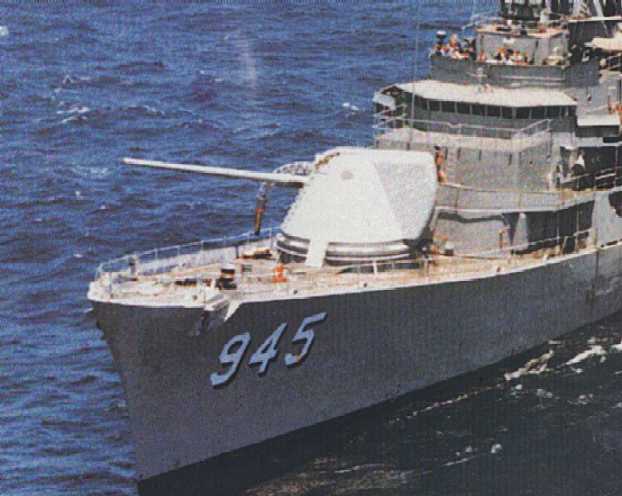
 The Mk71 was the result of the Navy’s attempt to mount a major caliber gun on a small (destroyer size) hull.  The gun was developed in the early 1970’s and a full scale prototype was produced, mounted on the Forest Sherman class destroyer USS Hull (DD-945), and test fired at sea in June of 1976.  Both laser guided and unguided projectiles were test fired at ship and shore targets.  The range of the gun was given as around 18 miles.  Before anyone leaps for their keyboard to tell me that the Mk71 caused the Hull's hull to crack from the stresses, read this NavWeaps link carefully.

The gun eventually fell victim to budget cuts and misguided Navy priorities in the late 1970’s.

Interestingly, the Spruance class was designed to accommodate the Mk71 as was the USS Long Beach had she be upgraded as an Aegis cruiser.  Further, studies were conducted that showed that Burke class destroyers could accommodate the Mk71 with some modifications.

The attractiveness of the Mk71 as compared to the AGS is due to

  • Cost – when the Navy committed to the AGS the Mk71 development costs were already long since paid for.  The gun was essentially free and a prototype had already been successfully tested.  Advanced rounds, if desired, would have entailed additional costs just as for the AGS.
  • Explosive Power – the 8” round is so much more effective than a 6”.
  • Shipboard Impact – the AGS, as we’ve discussed has a major impact on ship design and ship utilities.  The Mk71 is a simple gun and easily accommodated.
  • Flexibility – the Mk71 is a general purpose gun capable of engaging both ship and shore targets unlike the AGS which has no anti-ship mode.

For reasons understood only by the Navy, gun support has been a virtually ignored capability for many decades.  This is all the more puzzling given the ready availability of a fully developed and proven technology that would meet the vast majority of gunfire support requirements.  Even now, the Mk71 seems a better choice for future applications than the AGS due to the enormous impact the AGS has on its ship.

Saturday, December 22, 2012

AGS - DDG-1000 Gun System

The Advanced Gun System (AGS) developed for the DDG-1000 Zumwalt class destroyer is a 155 mm gun in a stealth mount.  The gun (and the ship, in a sense, since it was built around the gun) was developed in response to the retirement of the battleships and the resulting gap in naval gunfire support for troops ashore.


LRLAP 155 mm Round

While 155 mm is a NATO and US Army standard size, inexplicably, the Navy’s AGS will not be able to fire any of the existing rounds thus denying the Navy access to a huge inventory of ammunition.  Bear in mind that the AGS ammunition is the Long Range Land Attack Projectile (LRLAP) which is a rocket assisted projectile with extended glide capability for greater range.  Thus, the AGS is, essentially, a missile launching weapon rather than a standard naval gun.  The LRLAP has a reported range of around 70 miles and uses GPS guidance with canards for flight control.  Efforts are being made to achieve commonality with NATO/Army 155 rounds to the extent possible.  Hmm…  Seems like that should have been the first criteria?  Seeker heads are being investigated for future inclusion.

Other reports state that the AGS cannot be used in an anti-ship role though it is unclear why this is so (the GPS guided nature of the LRLAP, presumably?).  A naval vessel with guns that can’t be used against other ships seems short-sighted.

The AGS is a fully automated system from ammunition strike down and handling to loading and operation of the gun, itself.  While this reduces the crew requirements it also requires an inordinate amount of internal volume especially that devoted to ammunition storage and movement.  The AGS Intra-Ship Rearmament System (AIRS), which is the automated system for moving pallets from the flight deck to the magazine, consumes huge internal volumes.  Both the gun and ammunition handling are all-electric as opposed to previous hydraulic systems.  Power requirements are reported to be 800 kW per mount which precludes fitting the system to other classes of ship.

AGS


The rate of fire is 10 rds/min.  Magazine size has been reported as being 304 rounds per gun.  Rounds are stored on pallets of eight to facilitate the automated handling.

Defense Industry Daily reports that approximately $1.4B has been spent so far on the development of the AGS, AIRS, and LRLAP and work is nowhere near complete yet.  That is a lot of money to develop a gun system. 

In summary, what the Navy has is a dedicated land attack weapon with fair range compared to conventional naval guns.  This may well prove to be a very effective naval gunfire support weapon but the value relative to the cost seems suspect and, when the non-surface firing capability is factored in, the system seems overly restricted.  One can’t help but wonder if the already developed Mk71 8” gun wouldn’t have been a better starting point!