Showing posts with label Sea Hunter. Show all posts

Thursday, October 22, 2020

Just Claim It - No Need To Prove It

As we’ve seen, the US military, and the Navy in particular, are all-in on unmanned assets taking over major portions of combat despite the utter lack of any proof of concept.  The latest example comes to us courtesy of the Hudson Institute in a report titled, “Sustaining the Undersea Advantage: Disrupting Anti-Submarine Warfare Using Autonomous Systems” and discussed in a USNI News article.(1) 


The report itself is not available so we just have the USNI article to work from.  As with all such reports, it appears to be brimming with beautiful, full color diagrams and graphics.  The report apparently describes how unmanned assets will track and defeat enemy submarines.


… the team argues, unmanned systems can – for less money and in greater numbers – track enemy submarines from their home waters towards a chokepoint, and then either maintain a trail on them through and beyond the chokepoint or engage them with a small weapon. (1) 


That sounds great, doesn’t it?  Small, low powered, cheap, unmanned systems will track enemy subs and engage them at our leisure.  I find it hard to believe that potential enemies are even wasting time and resources building submarines given that they will have absolutely no chance to accomplish anything before we destroy them.  The outcome is a foregone conclusion if one believes the report.


Of course, all of this ignores the reality that we have a very hard time finding submarines even in scripted exercises.  Our very best manned systems with high powered sonars, computers, the most sophisticated acoustic analysis software in the world, and trained experts can’t readily find submarines but small, low powered, unmanned assets will flawlessly find and track enemy submarines across the oceans.


Does this sound familiar?  When the Marines first came out with their ridiculous hidden bases and anti-ship missile concepts, I kept pointing out that no one was explaining how these bases would be established, operated, and resupplied without being detected.  To this day, no one has explained that.  Instead, we’ve leapt right over those pesky reality questions and straight into the fantasy portion.


Similarly, all these unmanned ASW concepts fail to explain how our very best manned assets, backed by unlimited power, advanced computers, sophisticated software, and highly trained specialists can’t find submarines but small, simple, low powered, unmanned assets will easily find and ride herd on submarines we can’t even find in scripted exercises.  How is this possible?  If it’s true, then we need to immediately get rid of our Burkes because they can be replaced with a torpedo sized unmanned ASW vehicle for a tiny fraction of the cost.  Those new frigates we’re going to build?  There’s no point to building them since their main mission of ASW can be flawlessly executed by a small unmanned asset.


Either reality is wrong or our grandiose, fantasy, unmanned visions are wrong.  Which is it?  Is reality wrong or are our fantasies wrong?


The Navy clearly believes that reality is wrong and is betting on fantasy.


Where’s the proof that the fantasy is correct?  Before we totally commit to changing over to an unmanned navy shouldn’t we test the concept?  Shouldn’t we turn an actual submarine and an actual unmanned vessel loose and see whether the sub can be effortlessly tracked?  Shouldn’t we prove it?  Instead, we seem quite happy to merely make the claim and skip over the proof of concept.


This Ship and Helo Can't Find a Sub …


… but this Won't Have Any Problem


It would cost next to nothing to set the DARPA Sea Hunter unmanned vessel out at sea somewhere and see if it can find a Los Angeles or Virginia submarine and track it.  In fact, I’d go a step further and allow the sub to live fire against the Sea Hunter, if it can.  That would provide a pretty compelling demonstration, wouldn’t it?


Detection issues aside, there’s another small drawback to small assets.


If the unmanned system were told to engage with a small weapon, the submarine wouldn’t be sunk; but it would be at the very least warned that it’s being prosecuted, potentially forcing it to abandon its mission, or ideally it would be damaged enough that it couldn’t remain silent, forcing it back to port or making it easy to continue tracking. (1)


Small assets can’t actually sink a submarine!   … but they can warn it.  That’s what we want to do in war – warn our enemy rather than destroy them.  We are seriously losing track of reality.  This is what passes for a serious concept and report to the Navy nowadays.


Here’s some more unreality about war,


If naval commanders chose to just track them [submarines] instead of engage, the unmanned systems would track them to the chokepoint, where seafloor sensors, ocean surface gliders and sonobuoys would support unmanned vehicles in monitoring the enemy sub tracks, and another set of unmanned platforms would meet the subs on the other side and continue tracking them.


In war, what naval commander is going to choose to track rather than destroy a sub?  That’s insane!  Again, note the presumption that we can effortlessly track modern submarines with small unmanned assets despite all evidence to the contrary and absolutely no evidence that unmanned assets can actually track a sub.  Why don’t we try it before we commit to it?  Where’s the actual exercise that provides the proof of concept?  No need to prove it when we can just claim it’s true, I guess.


So, if the concept is as bad as ComNavOps lays out, why are we even considering this stuff?  The answer, as always, is money.  The Hudson report suggests that unmanned ASW assets offer great savings.


… less than a third [of the cost] of the traditional predominately manned approach to ASW. (1)


Less than a third of the cost!  Of course, you can’t actually track or destroy the enemy subs so that’s a drawback but, at least, it’s a cheap drawback, right?


If reality gets in the way, just make claims that bypass reality and continue on.  No need to prove anything.  Go Navy!


__________________________________


(1)USNI News website, “Report: Unmanned Systems Could Track and Fight Submarines At Less Cost Than Manned Ships, Planes”, Megan Eckstein, 19-Oct-2020,

https://news.usni.org/2020/10/19/report-unmanned-systems-could-track-and-fight-submarines-at-less-cost-than-manned-ships-planes


Friday, September 27, 2019

The Sea Hunter Myth

The unmanned Sea Hunter vessel has already assumed near mythic proportions in the minds of many observers – and, apparently, the Navy! - despite that fact that it has yet to demonstrate any actual performance whatsoever and despite the complete absence of any performance specifications and despite the lack of a specific mission and Concept of Operations (CONOPS).

Even by US military standards, the excitement surrounding Sea Hunter, a prototype unmanned submarine tracking vessel developed at a cost of $20m by US defence research agency DARPA, is startling. Variously described as “a highly autonomous unmanned ship that could revolutionise US maritime operations” and “a new vision of naval surface warfare”, the drone was developed through the agency’s Anti-Submarine Warfare Continuous Trail Unmanned Vessel (ASW ACTUV) programme. (1)

Wow!

‘startling’
‘revolutionize US maritime operations’
‘a new vision of naval surface warfare’

That’s some lofty praise and expectations for a vessel that has not yet demonstrated any capability, whatsoever.

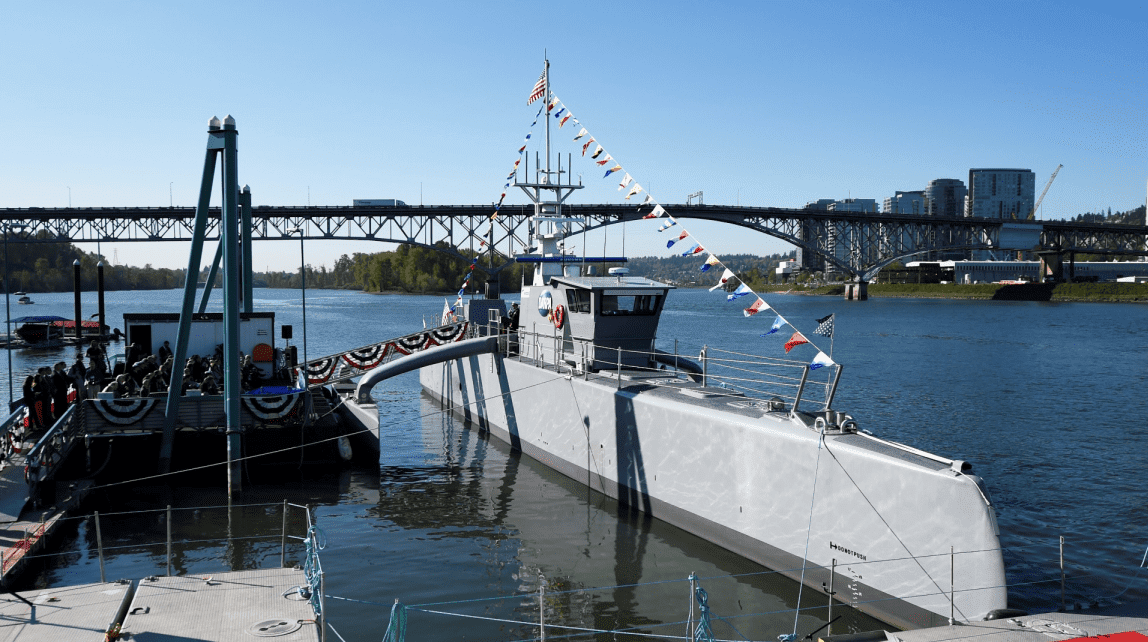
Sea Hunter

Here are some of the claims being made for Sea Hunter:

-It has been described by the Navy as being capable of finding and following submarines indefinitely using a high frequency, fixed sonar array. (1)

-It has been suggested by observers as being capable of conducting complete, independent ASW operations.

-It has been suggested by commentators as being capable of conducting AAW/ASW wide area surveillance while, apparently, being undectectable.

“The drone boats could also scout well ahead of manned ships for the enemy… and get close to particularly high value assets, such as aircraft carriers or amphibious assault ships.” (1)

-It has been suggested as a replacement for capital ships.

“ACTUV represents a new vision of naval surface warfare that trades small numbers of very capable, high-value assets for large numbers of commoditized, simpler platforms that are more capable in the aggregate,” said Fred Kennedy, director of DARPA’s Tactical Technology Office (TTO). (1)

-It has been suggested as a mine countermeasures vessel and was tested in the role by DARPA. (1)

-It has been suggested as a harbor protection vessel.

-It has been suggested as a logistics supply vessel.

-It is planned to be used as an intel collection vessel.

… plans already in the pipeline include equipping drones with anti-submarine weapons and additional sensor suites to gather visual and electronic intelligence. (1)


As a refresher, the $20M Sea Hunter is a moderate size vessel (Medium Displacement Unmanned Surface Vessel, MDUSV) of 132 ft in length, capable of 27 kts, and was designed by DARPA to operate unmanned and autonomously.  The vessel appears to be non-stealthy in the extreme.  It is designed to be modular with regard to payloads.  DARPA indicates the vessel can operate for 90 days with a range of 10,000 miles. (1)

DARPA has developed Sea Hunter, a prototype unmanned submarine tracking vessel with the ability to autonomously patrol the seas for months on end at a fraction of current costs. (1)

DARPA tested the Sea Hunter with the Towed Airborne Lift of Naval Systems (TALONS – a tortured, contrived acronym if ever there was one!) which is, essentially, a parasail carrying a sensor or communications package aloft via a cabled parasail. (1)

Operating costs are reported to be in the range of $15,000-$20,000 per day versus $700,000 per day for a destroyer. (1)

Sea Hunter was transferred from DARPA to the Office Of Naval Research (ONR) in early 2018.


So, there’s the background.  Now how about some analysis?


ASW – The small size and low power of whatever sonar array the vessel has suggests a very limited sonar range.  Also, the vessel has no helo which, on this blog, nearly every commentator has stated is mandatory for successful ASW (ComNavOps, of course, does not believe helos are mandatory for successful ASW – useful, yes; mandatory, no).  Despite this, the Navy claims that the vessel, with a low powered, small sonar array and no helo, will be able to find and track submarines indefinitely despite that fact that our very best full size, high powered sonars on Burke destroyers, with the benefit of human interpretation of data and anticipation of submarine behavior and tactics and using helos to help search and prosecute, cannot reliably detect and track submarines.  Does it really make sense to you that a $20M vessel with a small, low powered, unmanned sonar can outperform our Burkes?  If that was really true and if that was what testing has already demonstrated (and I’m unaware of any realistic testing having been performed) wouldn’t the Navy be engaged in a crash program to replace the Burke sonars with these small, low powered sonars that require no manning and yet are many times more effective?  And yet, they aren’t.  What does that tell you?

Some commenters have suggested a swarm of Sea Hunters sweeping ahead of a surface group and clearing the path of submarines.  Again, the very limited range of the sonar fit precludes any useful ASW sweep capability unless several dozen such vessels were employed and who is going to control and perform data analysis on several dozen vessels simultaneously?

Surveillance/Intel/Scouting – The small size and limited power again limit the range of whatever sensors might be placed on the vessel.  More importantly, the vessel is non-stealthy, in the extreme, and would have a lifespan of minutes in a forward battle area.  How anyone thinks this vessel will sail ahead of a surface group and survive long enough to collect any useful surveillance data is beyond me.  Remember that to achieve any useful sensor range will require active radar which also pinpoints the craft’s location to the enemy.

Survivability – The vessel has no self-defense capability and is non-stealthy in the extreme.  It’s lifespan will be measured in minutes in a battle zone.

Control – Unless these vessels are going to operate 100% autonomously – and no one believes we’re at that level of software capability – then someone has to control the vessels and analyze any data they collect.  Given that most of the proffered applications call for many vessels, likely dozens, operating together, who is going to control the vessels and how will they do it?  It will require continuous, wide area, two-way communications which doesn’t exactly fit with combat EMCON requirements.

Logistics – The use of a Sea Hunter as a logistics transport vessel is nearly pointless.  It has no significant cargo capacity and no means to load/unload whatever it might carry.

Capital Ship Replacement – This is stupidity on a platter.  Our surface fleet is already too small and steadily shrinking and we would replace what we have with these combat useless vessels?  Claiming that the Sea Hunter is more capable in the aggregate is analogous to claiming that infantrymen are more capable in the aggregate than an armored unit of tanks.  Infantry have their uses but they are not more capable than armored units.

Patrol – This is the one application that is potentially useful.  Such a vessel might well make an efficient and effective harbor patrol craft.  Of course, that’s a peripheral task rather than combat but it would still be useful if the vessel’s cost can be contained.


Conclusion

It is worth bearing in mind that for most of these suggested uses a MH-60R/S helo which costs about the same as Sea Hunter (helo costs are $28M-$42M depending on type and source) has much more mobility, speed, capability, and survivability than a Sea Hunter.  In fact, the only redeeming quality of the Sea Hunter compared to a helo is the endurance and even that is only valid under certain defined circumstances.  The helo’s endurance is unlimited in the sense that it is carried by a host ship and so can travel as far and as long as the host ship.  The helos endurance becomes a factor only when it’s in the air – for example, dropping sonobuoys.  In comparison, given the Sea Hunter’s utter lack of survivability, its endurance is likely to be a non-factor!  All things considered for the helo vs. Sea Hunter, it almost seems as if we’re reinventing the wheel just to be able to make it unmanned.

Any reasonable analysis of Sea Hunter capability reveals the vessel to be very heavy on hype and very light on any useful function.  As I’ve harped on so many times, this is what a CONOPS does – it lays out, in detail, how a vessel will be used.  Sea Hunter has no CONOPS and, therefore, it can do anything and everything, or so its proponents would have us believe.

Sea Hunter, as it currently exists, is a hyped-up myth, nothing more.  That’s not to say that it isn’t worthwhile as a research program.  By all means, let’s continue to explore autonomy and unmanned vessels.  However, the Navy has already committed to a fleet of these vessels (specifically, their small and medium displacement unmanned vessels) with absolutely no CONOPS and no idea of how to use them or what their capabilities are (hint to the Navy: I’ve just told you what their capabilities are; they don’t have any!).  Does this sound eerily familiar?  It should.  It’s exactly what the Navy did with the LCS and you see how that turned out.  Remember all the projected uses for the LCS?  Why it was going to revolutionize the Navy and win wars single-handed.  The reality is that they have no use, are a drain on resources, can’t seem to sail two days with a breakdown, require more manning than the Perrys they replace, and have no place in combat.  It appears as if the Navy is now committed to building the unmanned version of the LCS.  Well, no one ever accused the Navy of being able to learn lessons!


_____________________________________

(1)Naval Technology website, “Sea Hunter: inside the US Navy’s autonomous submarine tracking vessel”, 3-May-2018,
https://www.naval-technology.com/features/sea-hunter-inside-us-navys-autonomous-submarine-tracking-vessel/

Monday, May 9, 2016

Sea Hunter

DARPA is testing a large, unmanned sub-hunting surface vessel (USV) dubbed Sea Hunter (1).  This is an interesting concept and well worth the effort.  The vessel is a bit smaller than a Cyclone class patrol ship and is intended to track and trail submarines using on-board sonar.  It is capable of 27 kts and can operate up to Sea State 5 and survive up to Sea State 7.  Endurance is 70 days.  Cost is $20M.  The vessel is currently unarmed although adding weapons would, presumably, not be difficult.

The type of sonar(s) has not been specified and there is no indication whether it is active, passive, or both.  Note, though, that the size of the vessel is quite small.  Thus, the sonar will be small and not very powerful.  This means that the search volume will be correspondingly small.  This is not a vessel that's going to search and sanitize a thousand square miles every minute!  Lacking any definitive information, I see this as a somewhat more powerful, mobile sonobuoy but not much more.  Other than dumb luck, I don't know how it will acquire a target to track.

What’s interesting is to contemplate the intended mission.  From what little the Navy has revealed, the mission is to find and trail enemy submarines.  During peacetime, this is a good way to keep track of enemy submarine movements and, presumably, gather acoustic signatures data.  During war, the mission would presumably be the same (ignoring weaponization of the vessel), however, the usefulness becomes questionable in much the same way as the P-8.

These vessels are not claimed to be stealthy and they have no self-defense, whatsoever.  In fact, they're fairly large, as unmanned vessels go and, I would assume, quite readily detected.  In war, they would simply be floating targets and easily eliminated.  The obvious question, then, is what is the wartime role?

One can imagine swarms of these vessels sent to chokepoints to pick up submarine movements.  As long as the chokepoint is under friendly control this will work.  Conversely, sending swarms into enemy controlled air/water space would simply be throwing them away.  While the $20M price tag confers a degree of expendability, simply throwing them away is pointless.  Of course, if we were to build thousands of them, the price tag would come down somewhat, one would hope.

Perhaps the vessels can be used to scout ahead of ship movements although, again, how to keep them afloat in the face of enemy action is a mystery.

Further compounding the problem is the requirement to maintain contact with, and control of, the vessel.  As we’ve often discussed, in war the vessel will have to operate in a heavy ECM environment and the ability to maintain communication is suspect under those conditions.

Sea Hunter USV


As with the P-8, I’m missing the wartime role.

Another interesting aspect of the peacetime role is the unmanned nature.  Given China’s willingness to forcibly confront the US (EP-3 forcedown and various naval encounters) I strongly suspect that the Chinese won’t hesitate to sink these boats.  It’s quite easy to deny any knowledge of an unmanned vessel that vanishes at sea.  UAVs disappear all the time.  Why not USVs?  These vessels would also provide excellent live fire training exercises for Chinese submarines.  Not to neglect the Iranians, if they’re willing to seize US boats and crews, I can’t see them not seizing an unmanned, defenseless vessel.  I assume Russia and NKorea would similarly seize or destroy any vessels they find.  If deployed in this role, I suspect we’ll see large numbers of the vessels disappear for no apparent reason.

Looking at the broader picture, the third offset strategy championed by Bob Work is filled with this kind of highly questionable product that sounds good on paper but fails the test of combat logic.  We’re banking on a highly questionable strategy while conceding numerical superiority and quality.  That’s a good way to lose a future war.


_____________________

(1)Breaking Defense website, " DSD Work Embraces DARPA's Robot Boat, Sea Hunter”, Sydney J. Freedberg Jr., April 07, 2016,